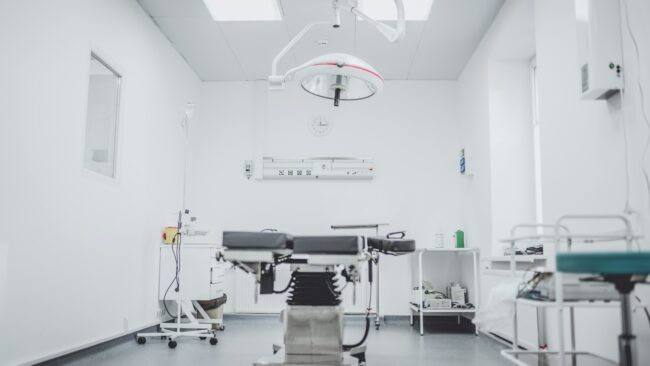
Photo by Arseny Togulev on Unsplash (Unsplash License).
Quick Answer: Florida is now one of the country’s largest and fastest-growing markets for ambulatory surgery centers (ASCs). Becker’s ASC Review counted Florida with 10 of the 53 ASC developments it tracked nationally through early fall 2026, the most of any state, and an October 2026 industry white paper places Florida among just three states with more than 700 surgery centers.
Florida’s outpatient surgery business is growing faster than almost anywhere else in the United States. Hospital systems, physician groups and national operators are opening, breaking ground on and partnering on new surgery centers from Santa Rosa Beach to Palm Beach Gardens. The growth is driven by population gains, Medicare policy that keeps moving procedures out of the hospital, and a state licensing framework that is lighter than in many other states.
This report pulls together the verifiable numbers on Florida’s ASC market as of November 2026: how many centers the state has, how quickly that count has grown, which projects are underway, how the state licenses these facilities, and what the data says about where the market is heading.
How many ambulatory surgery centers does Florida have?
The answer depends on who is counting and what they count. Three widely cited figures describe Florida’s ASC base, and they are not one consistent series.
- 463 ASCs versus 372 hospitals. A January 2023 Becker’s ASC Review list, built on data from the Ambulatory Surgery Center Association and Definitive Healthcare, put Florida among 10 states with more surgery centers than hospitals.
- 509 Medicare-certified ASCs. A January 2025 Becker’s analysis of Centers for Medicare and Medicaid Services (CMS) data showed Florida with 509 Medicare-certified centers, a gain of 41 since December 2022.
- More than 700 ASCs. A November 2026 Becker’s report, citing an October 2026 white paper by Medicus Healthcare Solutions, said Florida is one of three states with more than 700 ASCs, alongside California and Texas. Medicus counted about 10,900 ASCs nationwide.
The gap between the Medicare-certified count and the broader count is worth understanding. Florida’s Agency for Health Care Administration (AHCA) requires every ASC to hold a state license, but it states that Medicare certification and accreditation are optional. A center that does not bill Medicare would not appear in a CMS certification count, which is one reason the totals differ. Different methodologies, dates and definitions also play a part, so the figures should be read as separate snapshots rather than a trend line.
Florida ASC market at a glance
| Measure | Florida figure | Source and date |
|---|---|---|
| ASCs vs. hospitals | 463 ASCs; 372 hospitals | ASCA and Definitive Healthcare via Becker’s, Jan. 2023 |
| Medicare-certified ASCs | 509 (+41 since Dec. 2022) | CMS data via Becker’s, Jan. 2025 |
| Total ASCs | More than 700 | Medicus Healthcare Solutions via Becker’s, Oct.–Nov. 2026 |
| Share of tracked 2026 developments | 10 of 53 (most of any state) | Becker’s ASC Review, Sept. 2026 |
| State license fee (initial) | $1,679.82 plus $400 survey fee | Florida AHCA |
Is Florida adding surgery centers faster than other states?
On the most recent comparable federal data, Florida ranks second in net growth. Becker’s January 2025 review of CMS data found Medicare-certified ASCs nationally had increased 3.5% since December 2022. California added the most centers, and Florida was close behind.
Which states added the most Medicare-certified ASCs?
| Rank | State | Medicare-certified ASCs | Net gain since Dec. 2022 |
|---|---|---|---|
| 1 | California | 894 | +46 |
| 2 | Florida | 509 | +41 |
| 3 | Georgia | 419 | +33 |
| 4 | Texas | 488 | +30 |
| 5 | New York | 179 | +19 |
| 6 | Tennessee | 151 | +14 |
| 7 | Ohio | 211 | +13 |
| 8 | Arizona | 233 | +12 |
Source: CMS data compiled by Becker’s ASC Review, January 2025.
Two points stand out. First, Florida’s gain of 41 centers came on a smaller base than California’s, so its percentage growth was faster: 41 new centers on a starting base of about 468 implies growth of roughly 8.8%, compared with about 5.4% for California’s 46 centers on a base of about 848. Second, three of the top four growth states (Florida, Georgia and Texas) are in the South, a pattern that industry analysts have been describing for several years.
The 2026 project pipeline points the same way. In a September 2026 report, Becker’s ASC Review said Florida accounted for 10 of the 53 ASC developments it had tracked nationally so far that year, the most of any state. Its November 2026 follow-up reported that Florida led the nation in new ASC developments, with at least 10 announced, approved or under construction through early June, compared with at least four in California.
Which surgery center projects are underway in Florida?
The 2026 pipeline spans almost every corner of the state and a wide range of specialties, including spine, gastroenterology, orthopedics, radiation oncology and pediatric surgery. Projects documented in Becker’s 2026 reporting include the following.
Florida ASC and outpatient surgery projects reported in 2026
| Project | Location | Specialty or scope | Status reported |
|---|---|---|---|
| Southeast Orthopedic Specialists with Ascension St. Vincent’s | St. Augustine | Orthopedics, physician-led | Opened |
| Tampa General Hospital and Mass General Brigham joint venture | Palm Beach Gardens | Outpatient services, starting with radiation oncology | Launched; center set to open in 2026 |
| Borland Groover, Emerald Coast Endoscopy Center | Santa Rosa Beach | Gastroenterology | Broke ground |
| DISC Surgery Center | Florida (first location in state) | Spine | Opened June 2026 |
| Florida Coast Medical Center | Port St. Lucie | ASC in medical office building next to hospital | Expected later in 2026 |
| Lee Health ASC and medical office building | Fort Myers | 60,000 sq. ft. | Planned |
| Lee Health ambulatory clinic | Cape Coral | 100,000 sq. ft.; four ORs and two cath/EP labs | Planned |
| Lee Health pediatric surgery center | Lee County | 60,000 sq. ft., pediatric surgery | Slated for early 2028 |
Source: Becker’s ASC Review reports dated March 3, Sept. 1 and Nov. 3, 2026.
What do these projects say about who is building?
The list shows three distinct kinds of developers. Hospital systems such as Lee Health and Tampa General are building outpatient capacity to keep surgical volume inside their networks as procedures leave the inpatient setting. Physician groups, such as Southeast Orthopedic Specialists and Borland Groover, are building specialty centers where they control scheduling and workflow. Out-of-state operators, such as DISC Surgery Center from Newport Beach, California, are entering Florida to follow population and demand.
Joint ventures between hospitals and physicians, or between two health systems, are a recurring structure. The Tampa General and Mass General Brigham partnership is notable because it pairs a Florida academic system with one of the country’s best-known Boston systems to serve Florida’s east coast, starting with radiation oncology in Palm Beach Gardens.
Why are surgery centers growing so fast in Florida?
Does Medicare policy push surgery into ASCs?
Yes. Becker’s reported that the CMS 2026 final payment rule added hundreds of procedure codes to the list of services Medicare will pay for in an ASC and continued moving procedures off the inpatient-only list. Each addition gives surgeons and health systems another case type that can be performed in a lower-cost outpatient setting. In a state with one of the country’s oldest populations, Medicare policy has an outsized effect on where surgery happens.
Does Florida’s regulatory framework help?
Becker’s September 2026 report states that Florida has already eliminated the certificate-of-need requirements that roughly three dozen other states still apply. Certificate-of-need laws require a provider to show a state agency that new capacity is needed before building it. Their absence lowers the time and legal cost of opening a center.
Regulation still shapes the market in neighboring states. Becker’s reported that Georgia’s 2024 reforms exempt certain single-specialty ASCs owned by one physician or practice, below capital and operating room thresholds. In a hospital leadership survey by Avanza and MedHQ cited by Becker’s, 35% of hospitals without an ASC said regulatory obstacles such as certificate of need were the main reason. Florida developers do not face that hurdle.
Is demand outrunning capacity?
Real estate data suggest that it is in at least one Florida market. Becker’s cited a March JLL report projecting that outpatient visits in Orlando will grow 16.4% through 2029, while outpatient construction is projected to grow 3.8%. JLL also put national medical office occupancy at about 93%, and CBRE data cited by Becker’s showed ASC rents rising more than 8%, the largest increase of any outpatient facility type. Tight space and rising rents favor developers that can finance new construction, which helps explain why health systems and well-capitalized operators are leading the pipeline.
Are national operators targeting Florida?
They are saying so publicly. Solara Surgical Partners told Becker’s in January 2026 that it plans to put more strategic focus on the southeastern United States over the next five years, with Florida and the Southeast a priority and a possible shift toward acquisitions. Its chief development officer, Steve Hockert, told Becker’s that “There may be consolidation opportunities.” Becker’s also noted that USPI expanded in Florida in 2024 through a partnership with Tampa-based Florida Orthopedic Institute, and that a July 2025 Research and Markets report identified the Southeast as holding the largest share of the national ASC market.
How does Florida license an ambulatory surgery center?
Lighter regulation does not mean no regulation. AHCA defines an ASC as a licensed facility that is not part of a hospital and whose primary purpose is providing elective surgical care, with patients admitted and discharged within 24 hours. Centers are licensed under Chapter 395, Part I, and Chapter 408, Part II, of the Florida Statutes.
Key AHCA licensing requirements
| Requirement | Detail |
|---|---|
| Initial license | $1,679.82 application fee plus $400 survey fee; apply 60 to 120 days before opening |
| Construction review | Initial applicants need a current project review with the Office of Plans and Construction |
| Change of ownership | Triggered by transfer of 51% or more; apply at least 60 days before |
| Facility changes | Name, address, operating or procedure rooms, or recovery beds: notify 60 days ahead or face a $500 fine |
| Renewal | Submit 120 to 60 days before expiration; an expired license cannot be renewed |
| Accreditation | Voluntary; AAAHC, QUAD A, ACHC or The Joint Commission accreditation is deemed for state licensure and Medicare |
| Background screening | Level 2 screen for administrators and financial officers |
Source: Florida Agency for Health Care Administration, Ambulatory Surgical Center licensing page.
For investors and acquirers, the change-of-ownership rule matters most. Any deal that moves 51% or more of a center’s ownership requires a new AHCA application at least 60 days before closing, which should be built into transaction timelines. The 21-day reporting window for changes in controlling interest or key personnel also applies to smaller ownership shifts.
Which specialties are driving Florida’s ASC growth?
Becker’s September 2026 analysis described Florida’s growth as broad, spanning spine, gastroenterology and endoscopy, orthopedics, ophthalmology, radiation oncology and pediatric surgery. The project list supports that view. A spine-focused operator chose Florida for its first center outside California. A large GI group is building on the Emerald Coast. An orthopedic group partnered with Ascension St. Vincent’s in St. Augustine. A pediatric surgery center is on Lee Health’s schedule for 2028.
The pediatric and radiation oncology projects are a sign that the outpatient model is spreading beyond its traditional base of cataract, endoscopy and joint cases into service lines that once sat almost entirely inside hospitals.
What should Florida healthcare businesses watch next?
- Consolidation. With Solara signaling interest in acquisitions and national operators already partnered with Florida physician groups, independent centers are likely to see more buyer interest. Owners should know their AHCA change-of-ownership obligations before entering talks.
- Hospital-physician joint ventures. Systems such as Lee Health and Tampa General are building their own outpatient networks. Physician groups will face a choice between partnering with a system, partnering with a national operator or staying independent.
- Real estate costs. Rising ASC rents and high medical office occupancy will reward groups that secure space early or own their buildings.
- Medicare rule changes. Each annual CMS payment rule can add procedures to the ASC list. Florida’s large Medicare population means those changes quickly reach local volume.
- Data quality. Florida’s ASC counts vary from about 509 Medicare-certified centers to more than 700 total centers, depending on the source. Any market study or investment case should state which count it uses.
Frequently Asked Questions
How many surgery centers are in Florida?
Counts vary by source. CMS data compiled in January 2025 showed 509 Medicare-certified ASCs, while an October 2026 Medicus Healthcare Solutions white paper placed Florida among three states with more than 700 ASCs.
Does Florida require a certificate of need for an ASC?
Becker’s ASC Review reported in September 2026 that Florida has eliminated certificate-of-need requirements that roughly three dozen other states still maintain. Florida does require a state license from AHCA.
Is Medicare certification required to operate an ASC in Florida?
No. AHCA states that a center must maintain state licensure, but Medicare certification and accreditation are optional. A center that wants to bill Medicare must meet federal requirements under 42 CFR Part 416.
Which Florida ASC projects were announced in 2026?
Reported projects include an orthopedic ASC in St. Augustine, a GI endoscopy center in Santa Rosa Beach, a Tampa General and Mass General Brigham joint venture in Palm Beach Gardens, DISC Surgery Center’s first Florida location, and several Lee Health outpatient projects.
What does it cost to license a new ASC in Florida?
AHCA lists an initial licensure application fee of $1,679.82 and a $400 survey fee. Applications are due 60 to 120 days before the planned opening.
Sources and Further Reading
- “Florida’s ASC growth: 8 things to know,” Becker’s ASC Review
- “Where ASCs are booming and where they aren’t,” Becker’s ASC Review
- “11 states adding the most ASCs,” Becker’s ASC Review
- “10 states with more ASCs than hospitals,” Becker’s ASC Review
- “Why ASCs are surging in the South,” Becker’s ASC Review
- “3 new ASCs in Florida,” Becker’s ASC Review
- Ambulatory Surgical Center licensing, Florida Agency for Health Care Administration