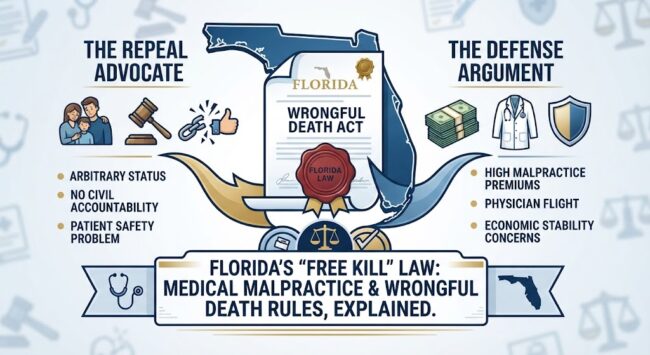
Medical Malpractice and Wrongful Death Rules, Explained
The Direct Answer
Florida’s so-called “free kill” law is a provision of the state’s Wrongful Death Act (Fla. Stat. § 768.21(8)) that bars certain survivors from recovering non-economic damages (pain and suffering) in medical-negligence wrongful-death cases. In practice: when the person who dies from alleged medical malpractice is an adult (25 or older) who leaves no spouse and no children under 25, their surviving parents and adult children cannot recover pain-and-suffering damages — which, because economic damages for such decedents are often small, frequently means no economically viable case can be brought at all. Florida is regularly described as the only state with this specific carve-out. Repeal has been a recurring legislative fight: a repeal bill passed the legislature in a recent session but was vetoed — see the tracker below for current status, because this is an active, changing area.
How the Law Actually Works
The Wrongful Death Act baseline. In Florida wrongful-death cases, statutory “survivors” — the spouse, minor children, dependents, and in some cases parents and adult children — can recover economic damages, and eligible survivors can also recover non-economic damages for their loss.
The medical-negligence carve-out (§ 768.21(8)). In cases where the death was caused by medical negligence specifically, the statute changes the rules:
- Adult children (25 or older) cannot recover non-economic damages for the malpractice death of a parent, and
- Parents cannot recover non-economic damages for the malpractice death of an adult child (25 or older).
Why it’s called “free kill.” If the decedent is a single adult over 25 with no minor children — a widowed retiree, a 30-year-old unmarried professional — the surviving family has no claim for pain and suffering, and the economic damages that remain (lost financial support, medical and funeral costs) may be minimal. Medical malpractice litigation is expensive to prosecute: expert witnesses, presuit investigation requirements, and years of defense. Without non-economic damages in play, attorneys frequently cannot take the case on contingency, so no suit is filed regardless of the merits of the claim. Critics coined “free kill” to describe that outcome. The term is advocacy shorthand, not statutory language — this page uses it because it is the phrase people actually search.
What the law does NOT do. It does not bar malpractice claims by living patients. It does not bar wrongful-death claims by eligible survivors such as spouses and minor children. And it does not prevent complaints to the Department of Health or the Board of Medicine — professional discipline is entirely independent of civil litigation, and remains available to families in every case.
The Arguments, Both Sides, Stated Fairly
The case for repeal (made by patient and family advocates): The carve-out arbitrarily values lives by marital and parental status — the same act of negligence is compensable if the patient was married and effectively immune from suit if the patient was single. It eliminates civil accountability precisely in the cases where litigation would otherwise deter substandard care. Every other state permits some form of such recovery. And unaccountable negligence, advocates argue, is a patient-safety problem, not merely a compensation gap.
The case against repeal (made by physician groups, insurers, and some hospital systems): Repeal would expand liability exposure in a state already contending with high malpractice premiums and physician recruitment and retention challenges. Premium increases would ultimately be passed through to a healthcare system under strain and could accelerate physician flight from high-risk specialties. Defenders note the provision traces to Florida’s malpractice-insurance crisis era and was enacted to stabilize coverage availability — and argue that repeal without accompanying reforms, such as damage caps or presuit process changes, would reignite that crisis.
Where the fight goes procedurally. Full repeal bills, partial repeals (for example, restoring parents’ claims only), and repeal-plus-caps compromise packages have all been filed in recent legislative sessions. In the cycle in which repeal passed both chambers, the governor’s veto rationale centered on liability-cost concerns — which suggests the realistic legislative path forward likely couples repeal with other tort changes. Track the current session’s bills in the tracker above.
What This Means for Practicing Physicians
Exposure mapping. The carve-out materially shapes which adverse outcomes generate lawsuits. Practices serving older, unmarried patient populations face structurally lower civil-suit exposure under current law — but identical exposure to Board discipline, payer quality programs, and hospital peer review, none of which the statute touches.
If repeal passes. Expect claim-frequency increases in the affected demographic, malpractice premium repricing, and renewed defense attention to Florida’s presuit requirements — the notice, corroborating expert, and investigation provisions of chapter 766 that govern every malpractice claim before it can be filed. Carriers began modeling repeal scenarios during the recent legislative fights; practices should ask theirs what repeal would mean for their premium.
Regardless of what happens. The strongest risk posture is the same under either regime: rigorous documentation, early disclosure-and-resolution practices after adverse events, and disciplined compliance with chapter 766 presuit procedure.
What This Means for Families
Families affected by the carve-out still have options worth understanding, even where a civil suit is not viable:
- A wrongful-death action for economic damages may still be available to statutory survivors, though in many carve-out cases those damages are too small to support litigation.
- A complaint to the Florida Department of Health can trigger investigation and professional discipline against the practitioner, at no cost to the family, regardless of civil viability.
- Hospital grievance and patient-safety reporting channels operate independently of litigation.
- Legislative advocacy has been the primary channel through which affected families have pursued change, and it has repeatedly moved repeal bills through committee and, in one session, through both chambers.
Frequently Asked Questions
Is Florida really the only state with a “free kill” law? Florida is widely described as the only state with this specific bar on non-economic damages for these survivor classes in medical-negligence deaths. Other states limit wrongful-death damages in different ways — caps, narrower survivor definitions — but Florida’s medical-negligence carve-out is unique in form.
Has Florida’s free kill law been repealed? Check the dated status line in the tracker above. A repeal passed the legislature in a recent session and was vetoed, and repeal efforts have continued in subsequent sessions. The answer can change every spring, which is exactly why this page carries a dated status line rather than a static answer.
Can parents sue for the malpractice death of an adult child in Florida? They may be able to bring the wrongful-death action for economic damages if they qualify as survivors, but under § 768.21(8) they cannot recover non-economic (pain and suffering) damages if the child was 25 or older — which in most cases makes the suit economically unviable to bring at all.
Does the law protect doctors from all lawsuits? No. Claims by living patients are unaffected, claims by spouses and minor children are unaffected, and Board of Medicine discipline is available in every case regardless of civil viability.
Why was the law passed in the first place? It traces to Florida’s malpractice-insurance crisis era; the stated purpose was limiting liability costs to stabilize malpractice coverage availability for physicians. Whether that rationale still justifies the carve-out is the policy fight described above.
What is the deadline to file a malpractice wrongful-death claim in Florida? Medical-negligence claims are governed by Florida’s malpractice limitations periods and chapter 766 presuit requirements, which involve strict and sometimes short deadlines with limited extensions. Families should consult a Florida attorney promptly — limitations analysis is case-specific and unforgiving.
Sources
- Fla. Stat. § 768.21 — Damages under the Wrongful Death Act (Online Sunshine, leg.state.fl.us)
- Fla. Stat. ch. 766 — Medical malpractice presuit requirements
- Florida Legislature bill tracking for current-session repeal bills — flsenate.gov / myfloridahouse.gov
- Governor’s official veto transmittal letters
- Florida Medical Association and Florida Justice Association position materials
This article is for general information and is not legal advice. Statutory status is current as of the date in the tracker above; consult a Florida attorney about any specific situation.