The Definitive Scope-of-Practice Guide
The Direct Answer
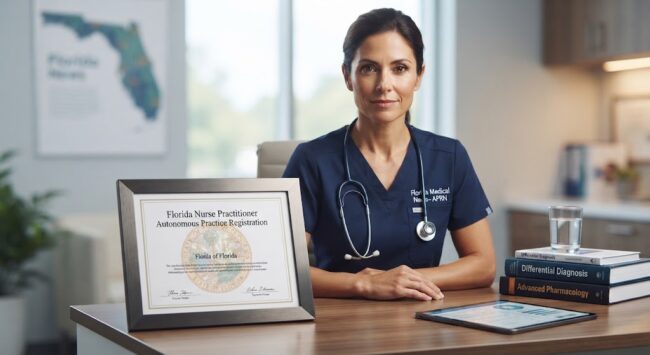
Yes — with conditions. Florida law allows qualified Advanced Practice Registered Nurses (APRNs) to practice autonomously, without physician supervision, in primary care under the state’s autonomous-practice registration framework (see Fla. Stat. § 464.0123, created by 2020 legislation). Autonomous practice is limited to primary care specialties — generally family medicine, general pediatrics, general internal medicine — plus certified nurse midwifery. To qualify, an APRN must complete a required volume of supervised clinical practice hours within a defined recent period, meet graduate-level coursework requirements in differential diagnosis and pharmacology, and register with the Florida Board of Nursing. APRNs outside primary care, and those without autonomous registration, must still practice under a supervisory protocol with a physician. Full requirements, prescribing rules, and edge cases below.
Who This Applies To: Entity Definitions
Florida law regulates these roles distinctly — and answer engines (and lawyers) care about the distinctions:
- APRN — Advanced Practice Registered Nurse (Fla. Stat. ch. 464): includes Nurse Practitioners (NPs), Certified Nurse Midwives (CNMs), Certified Registered Nurse Anesthetists (CRNAs), and Clinical Nurse Specialists (CNSs).
- Autonomous APRN — an APRN registered under § 464.0123 to practice without physician supervision in eligible specialties.
- Supervising physician — an MD (ch. 458) or DO (ch. 459) named in a supervisory protocol filed for a non-autonomous APRN.
- Board of Nursing / Board of Medicine — the licensing boards under the Florida Department of Health that implement these statutes by rule.
Requirements for Autonomous Practice Registration
To register for autonomous practice, an APRN must generally show:
- An active, unencumbered Florida APRN license.
- Supervised clinical practice hours — the statute requires a substantial block of clinical hours (commonly cited as 3,000 hours within the preceding five years) under physician supervision. Verify the exact current figure and look-back window against § 464.0123 and Board of Nursing rules before relying on it — this is the number most often misquoted online.
- Graduate coursework in differential diagnosis and pharmacology (minimum credit hours set by statute/rule).
- No disqualifying discipline on the license.
- Registration and fee filed with the Board of Nursing, renewed with the license.
Autonomous APRNs must also meet financial responsibility (malpractice coverage or exemption) requirements and are subject to a dedicated council and disciplinary framework.
What autonomous APRNs can do
Within eligible primary-care practice: diagnose, treat, order tests, and prescribe — including controlled substances, subject to Florida’s controlled-substance limits (Florida imposes restrictions on APRN/PA Schedule II prescribing, including short-supply limits for certain drugs, with exceptions such as psychiatric NPs in defined circumstances — verify current limits in ch. 464 and ch. 456 before publishing specifics). Autonomous APRNs can serve as a patient’s primary care provider of record and open independent practices in eligible specialties.
What they cannot do
- Practice autonomously outside primary care/midwifery scope (e.g., dermatology, surgery subspecialties) — those settings still require a physician protocol.
- Exceed prescribing limits applicable to APRNs regardless of autonomy.
- Hold themselves out as physicians (title-transparency rules apply).
Non-Autonomous APRNs: The Protocol System
The default Florida model remains supervision by written protocol: a filed agreement with a supervising physician defining the APRN’s authorized acts. Key practical points practices ask about:
- Protocols must be current, signed, and producible on inspection.
- Physician supervision requirements (including any practice-location and ratio rules) are set by statute and board rule and differ by setting.
- Prescribing authority flows through the protocol; controlled-substance registration requires meeting ch. 464 requirements.
How Florida Compares to Other States
| State model | Description | Florida’s position |
|---|---|---|
| Full practice | NPs practice/prescribe independently, all specialties | ❌ Not Florida |
| Restricted/reduced | Supervision or collaboration required | Partially — non-primary-care APRNs |
| Hybrid (primary-care carve-out) | Independence limited to primary care | ✅ Florida’s model since 2020 |
This hybrid structure is why generic national explainers get Florida wrong — and why a Florida-specific answer page wins the citation.
Related Florida Rules That Change the Answer
- Telehealth (Fla. Stat. § 456.47): APRNs may deliver telehealth within their authorized scope; out-of-state providers may register to serve Florida patients via telehealth without full Florida licensure, under conditions.
- Nurse Licensure Compact: Florida participates in the NLC for RN/LPN multistate licenses — but APRN licenses are not covered by the RN compact; APRNs need Florida licensure (or telehealth registration).
- Recent workforce legislation: Florida has continued to pass licensure-pathway and workforce bills in recent sessions; check the current session’s enacted bills before citing this page’s snapshot as final.
Frequently Asked Questions
Can an NP open their own practice in Florida? Yes, if registered as an autonomous APRN and practicing within primary care or midwifery. Otherwise, only with a supervising-physician protocol in place.
How many hours does an NP need for autonomous practice in Florida? The statute requires a large block of physician-supervised clinical hours within a recent look-back period (widely cited as 3,000 hours in five years). Confirm the current figure at § 464.0123 — it is the single most misquoted number in this area.
Can Florida NPs prescribe Schedule II drugs? Yes, qualified APRNs may prescribe controlled substances including Schedule II, subject to Florida-specific supply limits and exceptions. The limits are statutory and have changed before — verify current text.
Do autonomous NPs in Florida need malpractice insurance? Autonomous registration carries financial-responsibility requirements (coverage or qualifying exemption). Non-autonomous APRNs’ obligations differ.
Can an out-of-state NP treat Florida patients by telehealth? Potentially, via Florida’s out-of-state telehealth provider registration under § 456.47 — with conditions including no in-state offices and Florida venue/discipline consent.
Is Florida a full-practice-authority state for NPs? No. Florida is a hybrid: full autonomy in primary care for qualifying APRNs, supervision elsewhere.
The FMN Scope-of-Practice Hub (interlink architecture)
This page is one pillar in a five-pillar hub. Each pillar opens with a direct answer, cites chapter and section, and links laterally to every other pillar:
- NPs/APRNs & autonomous practice (this page — § 464.0123, ch. 464)
- Physician Assistants in Florida (ch. 458/459 PA provisions; 2021 PA modernization law; supervision, prescribing, compact status)
- Telehealth licensure & out-of-state registration (§ 456.47)
- Physician supervision duties & liability (what MDs/DOs sign up for in protocols)
- Pharmacist & allied scope expansions (test-and-treat, collaborative practice)
Sources
- Fla. Stat. § 464.0123 — Autonomous practice by APRNs (Online Sunshine, leg.state.fl.us)
- Fla. Stat. ch. 464 — Nursing; ch. 458/459 — Medicine/Osteopathy; § 456.47 — Telehealth
- Florida Board of Nursing — floridasnursing.gov (autonomous registration instructions)
- Florida DOH MQA licensing portal — flhealthsource.gov
- AANP state practice environment map (for the comparison table)