Hurricane Preparedness for Florida Medical Practices and Hospitals: The Complete 2026 Playbook
The Direct Answer
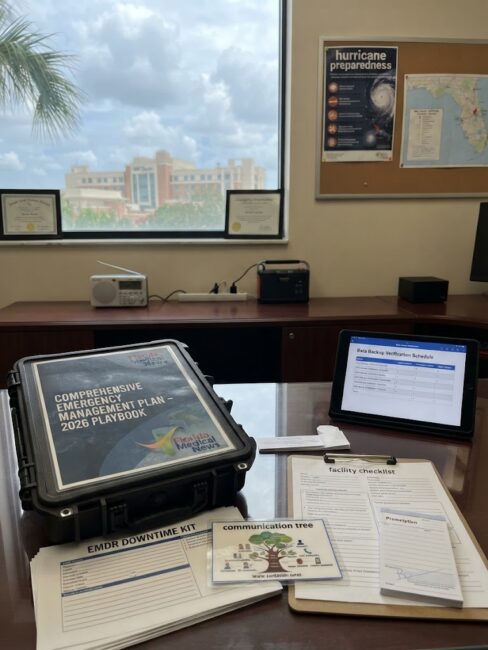
Every Florida medical practice needs four things in place before June 1 (the start of Atlantic hurricane season): (1) a written Comprehensive Emergency Management Plan — required by rule for licensed facilities and best practice for private practices; (2) an EMR downtime protocol with paper workflows, offline patient lists, and a data-backup verification schedule; (3) a communication tree covering staff, patients, payers, and vendors with out-of-state backup contacts; and (4) a post-storm regulatory file — knowing what a state of emergency changes about licensure, prescribing, telehealth, and insurance claim deadlines before you need it. Florida executive orders during declared emergencies routinely relax certain licensure and prescription-refill rules and trigger insurer grace periods, but the specifics differ storm to storm.
🔴 Active Emergency Orders Box
(Live element — populate only during a declared emergency. Empty state text below.)
No active hurricane-related emergency orders affecting medical practice at this time. During a declared state of emergency, this box lists: the executive order number, licensure provisions activated, prescription refill provisions, and insurer claim-deadline extensions, each with a link to the primary order.
Part 1: The Pre-Season Checklist (Complete by June 1)
Administrative
- [ ] Review/update the written emergency management plan; confirm which staff hold which roles
- [ ] Verify insurance coverage: property, business interruption, flood (separate policy — 30-day wait typically applies)
- [ ] Photograph/video the entire facility and equipment for claims documentation
- [ ] Confirm payroll can run remotely
- [ ] Print a current patient roster capability test — can you produce it in 10 minutes?
Clinical & EMR
- [ ] Test full EMR backup restoration — a backup you haven’t restored is a hope, not a plan
- [ ] Print/stage downtime kits: paper encounter forms, prescription pads, superbills, consent forms
- [ ] Export offline lists: patients on oxygen/DME, dialysis, chemotherapy, controlled-substance schedules, high-risk OB
- [ ] Verify vaccine/medication refrigeration contingency (generator, transfer agreement with a nearby facility, temperature logging)
- [ ] Confirm e-prescribing fallback procedures with your local pharmacies
Facilities
- [ ] Generator service and fuel contract (hospitals and nursing homes: confirm compliance with Florida’s emergency power rules adopted after Hurricane Irma)
- [ ] Elevate/relocate server hardware and paper records above flood level
- [ ] Shutter/window protection plan with assigned staff and a trigger timeline (72/48/24 hours out)
Communication
- [ ] Staff phone tree with out-of-state relay contact
- [ ] Patient notification templates pre-drafted (closure, reopening, telehealth availability)
- [ ] Update Google Business Profile and website banner workflow — this is also where AI assistants pull your open/closed status
- [ ] Payer and clearinghouse emergency contacts documented
Part 2: EMR Downtime Protocol (The 6-Step Standard)
- Declare downtime formally — a designated person announces it, timestamps it, and starts the downtime log. Ambiguity is how documentation gets lost.
- Deploy paper kits — pre-staged, numbered encounter forms so every visit can be reconciled later.
- Work from the offline high-risk lists — proactive outreach to oxygen, dialysis, and infusion patients is the highest-value clinical act before landfall.
- Queue, don’t guess, on prescriptions — follow the pharmacy fallback procedure; document verbal orders per protocol.
- Reconcile on restoration — every paper encounter entered into the EMR with a downtime flag; a two-person team verifies the numbered forms match the log.
- Debrief within 7 days — what failed becomes next season’s checklist line.
Part 3: What a Florida State of Emergency Actually Changes
(Explainer — the section competitors don’t have and clinicians search for mid-storm.)
When the Governor declares a state of emergency, several practice-relevant provisions can activate. The details are set per-order, so always read the operative executive order — but historically, declarations have commonly involved:
- Early prescription refills: Florida law requires insurers to authorize early refills during a declared emergency in affected counties (verify current statutory citation and its conditions before publishing).
- Out-of-state practitioner provisions: Emergency orders and DOH actions have at times permitted out-of-state licensees to render aid or expanded telehealth flexibility for affected areas.
- Insurance claim-deadline extensions: The Office of Insurance Regulation has issued orders extending claim filing deadlines and prohibiting cancellations during recovery windows.
- Facility evacuation/reopening rules: AHCA controls licensure status of evacuated facilities and reopening inspections; hospitals and ASCs report status through the state’s emergency reporting system.
- Controlled substances: Emergency provisions have addressed dispensing flexibility; DEA also has its own disaster guidance — the state order does not override federal requirements.
Frequently Asked Questions
Are Florida medical practices legally required to have a hurricane plan? Licensed facilities (hospitals, nursing homes, ASCs, and others under AHCA licensure) must maintain approved comprehensive emergency management plans under Florida rules. Private physician offices generally aren’t facility-licensed, but HIPAA’s contingency-plan requirements and payer contracts effectively require disaster planning anyway.
Can I prescribe for patients evacuated to another state? Cross-state prescribing depends on the receiving state’s licensure and telehealth rules plus any emergency orders in effect in both states. Document the emergency context; verify the destination state’s provisions.
Do patients get early prescription refills during a hurricane? Florida has a statutory early-refill provision that activates for affected counties during a declared emergency. Confirm the current statute text and the counties named in the order.
What happens to my claim filing deadlines after a storm? The Florida Office of Insurance Regulation typically issues emergency orders extending deadlines and restricting policy cancellations. Medicare/Medicaid deadlines follow separate federal/state waiver actions (e.g., CMS 1135 waivers) — track both.
Does a hurricane excuse HIPAA compliance? No — HIPAA remains in effect, though HHS can waive limited provisions for hospitals in a declared emergency, and the Privacy Rule already permits certain disclosures for treatment and disaster relief purposes.
When should a practice decide to close before a storm? Best practice is a pre-committed trigger timeline (e.g., decisions at 72/48/24 hours from projected landfall) rather than a game-time call — staff need time to secure their own homes.
Sources
- Florida Division of Emergency Management — floridadisaster.org
- AHCA emergency management/facility status resources — ahca.myflorida.com
- Florida Office of Insurance Regulation emergency orders — floir.com
- Online Sunshine — Florida Statutes (emergency refill and emergency management provisions): leg.state.fl.us
- HHS/OCR — HIPAA in emergency situations; CMS 1135 waiver guidance
- NOAA/National Hurricane Center — nhc.noaa.gov