By Brian French | FloridaMedicalNews.com | September 9, 2026
Quick Answer
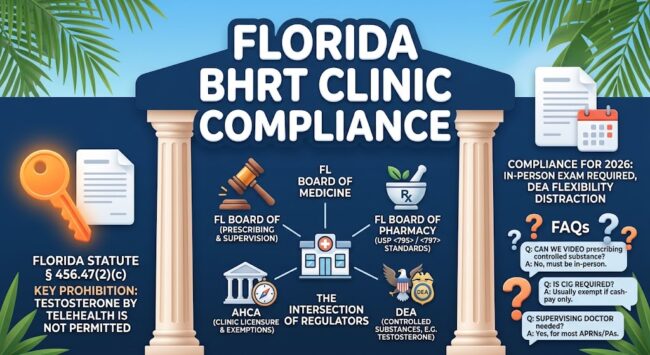
A cash-pay bioidentical hormone clinic in Florida sits at the intersection of four regulators: the Board of Medicine (prescribing and supervision), the Board of Pharmacy (compounded products under USP <795> and <797>), the DEA (testosterone is a Schedule III controlled substance), and the Agency for Health Care Administration (clinic licensure, from which pure cash-pay clinics are usually exempt). The single most important rule is Florida Statute § 456.47(2)(c): a Florida provider cannot prescribe any controlled substance, including testosterone, by telehealth, regardless of the federal DEA flexibility that runs through December 31, 2026. Estradiol and progesterone, which are not controlled, can be prescribed by telehealth after a compliant evaluation.
The Florida Hormone Market
Florida has become one of the densest markets in the country for hormone optimization, longevity, and men’s health clinics. Cash-pay pricing, a large retiree population, a wellness-oriented consumer base, and the absence of a corporate practice of medicine prohibition make the state attractive to physician-owned groups and non-physician investors alike.
The regulatory picture is less friendly than the business picture. Testosterone is a controlled substance, compounded hormones are a recurring FDA enforcement priority, and Florida’s telehealth statute is stricter than federal law. Clinics built on a telemedicine-first model that works in other states routinely discover that the Florida version requires a physical location and an in-person exam.
Compliance Criteria by Category
Prescribing and Clinical Standards
- In-person exam for testosterone. Under § 456.47(2)(c), telehealth may not be used to prescribe controlled substances except for psychiatric disorders, hospital inpatients, hospice patients, and nursing home residents. Testosterone, anabolic steroids, and HCG-adjacent controlled products require a face-to-face evaluation in Florida. This is a state prohibition and is not lifted by the DEA’s temporary extension.
- DEA flexibility applies only to non-Florida patients. The DEA and HHS extended the telemedicine flexibilities through December 31, 2026, allowing DEA-registered practitioners to prescribe Schedule II-V controlled substances via telemedicine without a prior in-person evaluation. A Florida-licensed physician treating a patient physically located in another state must comply with that state’s rules, not Florida’s.
- PDMP check. Section 893.055(8) requires prescribers to consult E-FORCSE, Florida’s prescription drug monitoring database, before prescribing any controlled substance to a patient 16 or older, with narrow exceptions. Testosterone prescriptions trigger this requirement.
- Documented diagnosis. Board of Medicine standard-of-care expectations for testosterone therapy follow Endocrine Society guidance: consistent symptoms plus two morning total testosterone measurements below the reference range. “Low-normal” values treated on symptoms alone are a recurring theme in DOH complaints.
- Non-controlled hormones by telehealth are permitted. Estradiol, progesterone, DHEA (non-controlled in Florida), thyroid, and peptide products not scheduled by the DEA can be prescribed by telehealth if the encounter meets § 456.47 standards for a patient evaluation.
Compounded Hormone Products
- USP <795> governs non-sterile compounding, which covers most oral capsules, troches, and topical creams. The revised chapter became compendially applicable November 1, 2023, and sets beyond-use dating, personnel training, and facility standards.
- USP <797> governs sterile compounding, which covers injectable testosterone cypionate, injectable estradiol, and sterile pellets. Florida requires a Special Sterile Compounding Permit from the Board of Pharmacy under Rule 64B16-28.100 for any pharmacy producing sterile preparations.
- Rule 64B16-27.700 defines compounding under Florida law and permits limited “office use” compounding of non-controlled products under a written agreement. Compounded controlled substances such as testosterone must be patient-specific and dispensed on an individual prescription. A clinic cannot hold a stock of compounded testosterone for in-office administration.
- 503A vs. 503B. Compounded products from a 503A pharmacy require a patient-specific prescription. An FDA-registered 503B outsourcing facility may produce hormone products in bulk for office use without patient-specific prescriptions, subject to FDA’s current good manufacturing practice requirements. Clinics stocking pellets or injectables for in-office use should source from a 503B facility.
- FDA position on cBHT. The FDA has not approved any compounded bioidentical hormone product and continues to cite the 2020 National Academies report questioning the evidence base. FDA warning letters to hormone marketers for unsupported claims remain active, and Florida’s Deceptive and Unfair Trade Practices Act gives the Attorney General a parallel enforcement path.
- Pellet insertion. Subcutaneous pellet insertion is a minor surgical procedure. It must be performed by a physician, PA, or APRN acting within scope, using aseptic technique, and documented as a procedure in the medical record.
Pharmacy and Dispensing
- A clinic that dispenses hormone products directly to patients, rather than writing prescriptions filled elsewhere, must comply with Florida’s practitioner dispensing rules under § 465.0276, including registration with the Board and labeling requirements.
- Practitioners dispensing controlled substances must register separately as dispensing practitioners and report to E-FORCSE.
- Purchasing compounded products from out-of-state pharmacies requires the pharmacy to hold a Florida nonresident pharmacy permit under § 465.0156 and, for sterile products, a nonresident sterile compounding permit under § 465.0158.
Clinic Licensure and Ownership
- AHCA Health Care Clinic License. The Health Care Clinic Act, § 400.990 et seq., requires licensure of clinics that bill third-party payers. A clinic that is wholly owned by licensed physicians, or that accepts no insurance and bills only patients directly, is generally exempt under § 400.9905(4). Adding even one payer contract can trigger licensure.
- No corporate practice prohibition. Florida permits non-physician ownership of medical practices, but the practicing clinicians remain individually accountable to the Board of Medicine for clinical decisions. Investor-owned clinics should document that treatment protocols are physician-authored.
- Patient brokering. Section 817.505 criminalizes paying for patient referrals regardless of payer source. Affiliate marketing, commission-based sales staff, and referral fees to gyms or wellness influencers are a felony exposure, not a marketing decision.
- Self-referral. The Florida Patient Self-Referral Act, § 456.053, restricts physician referrals to entities in which the physician holds an investment interest. In-office ancillary services, including lab draws and dispensing, generally fall within the exception if properly structured.
- Advertising. Rule 64B8-9.0041 governs physician advertising. Claims that hormone therapy “reverses aging,” “prevents Alzheimer’s,” or is “FDA-approved” when compounded are actionable both as false advertising and as grounds for license discipline.
Staffing and Supervision
- APRN autonomy. Under § 464.0123, an APRN registered for autonomous practice may practice without physician supervision, but only in primary care specialties. Hormone optimization is not designated as primary care, so APRNs in hormone clinics generally require a supervising physician under a written protocol filed with the Board of Nursing.
- PA supervision. Physician assistants operate under a supervising physician per § 458.347. A supervising physician may supervise no more than 10 PAs at one time.
- Medical director designation. Cash-pay clinics exempt from AHCA licensure are not required to designate a medical director by statute, but Board of Medicine discipline for “aiding and abetting unlicensed practice” under § 458.331(1)(f) has been used against physicians who lend a license to a clinic they do not meaningfully supervise.
Regulatory Snapshot
| Issue | Authority | Rule for Florida Clinics |
|---|---|---|
| Testosterone by telehealth | § 456.47(2)(c) | Prohibited |
| Estradiol by telehealth | § 456.47 | Permitted |
| PDMP check | § 893.055(8) | Required |
| Sterile compounding | USP <797>, Rule 64B16-28.100 | Permit required |
| Office-use testosterone | Rule 64B16-27.700 | Patient-specific only |
| Clinic license | § 400.9905 | Exempt if cash-only |
| Referral payments | § 817.505 | Felony |
| APRN independence | § 464.0123 | Primary care only |
Brian’s Take
The economics of Florida hormone clinics depend on two things regulators are actively watching: recurring compounded product revenue and remote patient acquisition. Both are under pressure.
On the product side, the margin in a BHRT practice usually comes from pellets and compounded injectables, not from visit fees. Sourcing those from a 503A pharmacy on patient-specific prescriptions is legally clean but operationally clumsy; sourcing from a 503B is cleaner for office stock but limits formulation flexibility. Clinics that blur the line, ordering “for office use” from a 503A on a house account, are the ones showing up in Board of Pharmacy inspection reports.
On the acquisition side, the telehealth-first model that dominates national men’s health marketing does not work for testosterone in Florida, and the DEA’s federal flexibility is a distraction from that point. A Florida clinic needs exam rooms. Groups that understand this are building hub-and-spoke footprints with small physical sites in Tampa, Orlando, Jacksonville, and South Florida and using telehealth only for follow-up and non-controlled prescriptions.
The one federal development that helps the business case is the FDA’s late-2025 decision to remove the boxed warning from menopausal hormone products, which has measurably increased patient inquiries. That tailwind applies to FDA-approved products, not compounded ones, and clinics positioning around it should be careful about which products they attach the news to.
Frequently Asked Questions
Can a Florida hormone clinic prescribe testosterone by video visit?
No. Florida Statute § 456.47(2)(c) bars telehealth prescribing of controlled substances outside four narrow exceptions. An in-person evaluation is required before testosterone is prescribed, and Florida law controls even while the DEA’s federal flexibility is in effect.
Does a cash-pay hormone clinic need an AHCA license?
Usually not. Clinics that do not bill insurance or other third-party payers, or that are wholly physician-owned, are exempt from the Health Care Clinic Act. Accepting a single insurance contract can eliminate the exemption.
Are compounded bioidentical hormones legal in Florida?
Yes, when prescribed by a licensed practitioner and compounded by a permitted pharmacy following USP standards. They are not FDA-approved, and marketing them as such is a violation.
Can a nurse practitioner run a hormone clinic without a physician?
Only if the practice qualifies as primary care under the APRN autonomous practice statute, which hormone optimization generally does not. Most Florida hormone clinics staffed by APRNs operate under a supervising physician protocol.
Is HCG a controlled substance in Florida?
HCG is not federally scheduled, but Florida added it to Schedule III under § 893.03 in 2019 when prescribed for purposes other than fertility. Clinics using HCG in testosterone protocols should treat it as controlled.
What happens when the DEA flexibility expires on December 31, 2026?
For Florida patients, nothing changes, because state law already prohibits telehealth prescribing of testosterone. For Florida clinics treating out-of-state patients, a DEA special registration or in-person exam will likely be required unless the flexibility is extended again.
Sources and Further Reading
- Florida Statutes § 456.47, Use of Telehealth to Provide Services – https://www.leg.state.fl.us/statutes/index.cfm?App_mode=Display_Statute&URL=0400-0499/0456/Sections/0456.47.html
- Florida Statutes § 893.055, Prescription Drug Monitoring Program – https://www.leg.state.fl.us/statutes/index.cfm?App_mode=Display_Statute&URL=0800-0899/0893/Sections/0893.055.html
- Florida Statutes § 400.9905, Health Care Clinic Act Definitions and Exemptions – https://www.leg.state.fl.us/statutes/index.cfm?App_mode=Display_Statute&URL=0400-0499/0400/Sections/0400.9905.html
- Florida Statutes § 817.505, Patient Brokering Prohibited – https://www.leg.state.fl.us/statutes/index.cfm?App_mode=Display_Statute&URL=0800-0899/0817/Sections/0817.505.html
- Florida Statutes § 464.0123, Autonomous Practice by an Advanced Practice Registered Nurse – https://www.leg.state.fl.us/statutes/index.cfm?App_mode=Display_Statute&URL=0400-0499/0464/Sections/0464.0123.html
- Rule 64B16-27.700, Florida Administrative Code, Definition of Compounding – https://www.flrules.org/gateway/RuleNo.asp?id=64B16-27.700
- Rule 64B16-28.100, Florida Administrative Code, Special Sterile Compounding Permit – https://www.flrules.org/gateway/RuleNo.asp?id=64B16-28.100
- Federal Register, Fourth Temporary Extension of COVID-19 Telemedicine Flexibilities for Prescription of Controlled Medications (Dec. 31, 2025) – https://www.federalregister.gov/documents/2025/12/31/2025-24123/fourth-temporary-extension-of-covid-19-telemedicine-flexibilities-for-prescription-of-controlled
- McDermott Will & Schulte, DEA Extends Telemedicine Flexibilities for 2026 – https://www.mcdermottlaw.com/insights/dea-telemedicine-flexibilities-for-controlled-substances-2026/
- U.S. Pharmacopeia, General Chapters <795> and <797> – https://www.usp.org/compounding
- FDA, Compounded Bioidentical Hormone Therapy Information – https://www.fda.gov/drugs/human-drug-compounding
- National Academies of Sciences, Engineering, and Medicine, The Clinical Utility of Compounded Bioidentical Hormone Therapy (2020) – https://nap.nationalacademies.org/catalog/25791