By Brian French | FloridaMedicalNews.com | October 20, 2026
Quick Answer
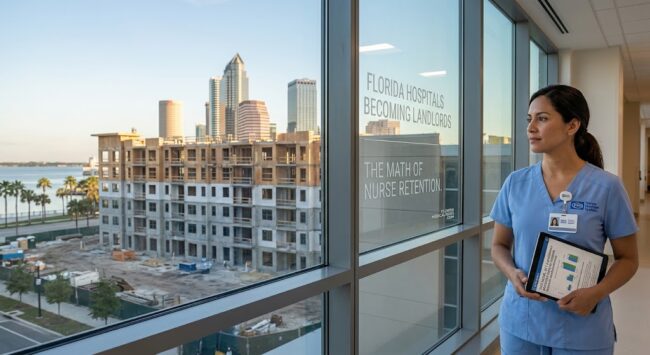
Florida hospitals are starting to build housing for their own staff. Tampa General’s 170-unit Brandon project is the clearest model. The Live Local Act, a 2025 state policy allowing hospital-employee preferences, and free or cheap hospital land make it possible. The payoff is retention. Local governments’ first Live Local reports, due Nov. 1, will show how much is actually getting built.
Key Takeaways
- Tampa General is building 170 workforce apartments in Brandon on hospital-owned land, with childcare on site.
- The project works only because the land costs nearly nothing and public funding fills the gap.
- A 2025 Florida law lets affordable-housing developers give preference to hospital and health care employees.
- Live Local has produced about 3,200 completed affordable units, with about 55,000 proposed.
- Each lost bedside RN costs a hospital about $60,000, which is the number that justifies housing.
Why Hospitals Are Entering the Housing Business
The original pitch for the Live Local Act was a hospital story. In 2023, then-Senate President Kathleen Passidomo described a vacant strip center next to a hospital, redeveloped into apartments so a nurse could walk to work instead of driving 90 minutes.
Three years later, hospitals are acting on that idea, but not always the way lawmakers imagined. The most advanced Florida project sits on hospital land a few miles from the main campus, not next door. It also relies as much on public funding as on zoning relief.
Case Study: Tampa General’s Brandon Apartments
The problem showed up in HR files. Tampa General employees reported rent increases of 30% to 40%, evictions, and trouble finding housing after relocating for a job. Housing ranked among the top concerns in a 2023 employee survey.
The hospital studied the gap. Tampa General compared rents and home prices around its hospitals and offices against what employees in different jobs actually earned.
The project. The hospital owns the site, a few miles from the main campus, and partnered with The Michaels Organization. The plan is 170 one-, two- and three-bedroom units off Delaney Creek Boulevard, financed with state and Hillsborough County funding. Groundbreaking was expected in August 2026, with opening targeted for 2028.
Who qualifies. Reported income targets vary by source. The developer describes units for households earning 80% to 100% of area median income, while one local report put the range at 80% to 120%.
The land is the subsidy. According to Michaels’ development chief, Tampa General leased the land on a long-term basis for a nominal amount. A Tampa General executive said the project would not work at its target rents without the free land and public funding.
Beyond rent. Employees asked for on-site childcare, and the daycare will serve all Tampa General employees, not only residents. The hospital also plans hurricane features including impact windows, structural hardening and generator power.
Note that Tampa General’s project has not been reported as a Live Local Act filing. It uses many of the same ingredients: underused land, affordability set-asides and public financing.
| Tampa General workforce housing | Detail |
|---|---|
| Location | Brandon, Hillsborough County |
| Units | About 170 (1, 2 and 3 bedrooms) |
| Developer/manager | The Michaels Organization |
| Land | Hospital-owned, long-term nominal lease |
| Funding | State and Hillsborough County support |
| Extras | Childcare center, storm hardening |
| Timeline | Groundbreaking expected Aug. 2026; opening 2028 |
The Law That Lets Hospitals Favor Their Own Staff
One of the least noticed pieces of the 2025 Live Local update matters most to hospitals. Section 420.5098, Florida Statutes, declares it state policy to support affordable housing for employees of hospitals, health care facilities and government entities.
The statute allows developers using federal housing tax credits, state or local funds, or other affordable-housing financing to create a preference for those employees. The definition of “hospital” is broad, covering public hospital districts, licensed hospitals and qualifying nonprofit corporations.
That solves a problem that has stopped many hospital housing ideas. Without a preference, publicly financed units had to be open to any income-qualified renter, so a hospital could fund housing and fill it with almost no staff.
The Statewide Scoreboard
The Live Local Act is producing housing, but more slowly than headlines suggest.
Completed. A Florida TaxWatch review in August 2025 found the Act had added 3,171 affordable units across 23 properties.
Proposed. As of March 2026, about 55,000 units across 182 projects had been proposed statewide under the Act, according to Florida Housing Coalition data cited by Bilzin Sumberg.
Friction. TaxWatch concluded that local opt-outs, financing difficulty and uneven local execution are limiting scale.
The 2026 fix. Lawmakers passed a 2026 update aimed at lenders who had held back because of uncertainty over when tax breaks would apply. The exemption is 75% for units affordable at 120% of area median income and 100% for units at 80% or below. The 2026 version, House Bill 1389, took effect July 1 and expanded eligible sites, including government- and religious-owned land.
| Live Local metric | Figure |
|---|---|
| Completed affordable units | 3,171 in 23 properties (TaxWatch, Aug. 2025) |
| Proposed units | ~55,000 in 182 projects (March 2026) |
| Required affordability | 40% of units for 30 years |
| Tax exemption | 75% at 120% AMI; 100% at 80% AMI |
| Latest version | HB 1389, effective July 1, 2026 |
The Nov. 1 Reports: What to Watch
Under the 2025 amendments, local governments must file annual reports beginning Nov. 1, 2026. The reports must summarize any Live Local litigation and list all projects proposed under the Act.
For the first time, Floridians will see county-by-county project lists in one format. Health systems, investors and reporters should look for three things:
- Projects near hospital campuses. Any filings within a mile or two of major medical centers in Tampa, Orlando, Miami, Jacksonville and Fort Myers.
- Applicants tied to health systems. Hospital-affiliated landowners or nonprofits listed as applicants or partners.
- Litigation hot spots. Cities fighting Live Local projects are likely to be harder places for hospitals to use the tool.
FloridaMedicalNews.com will review the reports as counties publish them.
The Math Hospital CFOs Are Running
Can nurses afford the market? Florida’s median registered nurse wage is $84,190, below the national median of $97,550. In the Miami metro, the median is $91,380; in Tampa, $85,470. Those figures sit squarely in the 80% to 120% of area median income band that Live Local units target.
What does losing a nurse cost? The 2026 NSI National Health Care Retention Report puts the average cost of one bedside RN turnover at $60,090. Each one-point change in RN turnover moves the average hospital’s costs by $295,000 a year. National RN turnover rose to 17.6% in 2025.
How long does replacement take? Hospitals needed an average of 78 days to recruit an experienced RN.
The simple test: if a 170-unit building helps a hospital keep even a handful of nurses a year who would otherwise leave, it starts paying for itself in avoided turnover alone. That is before counting reduced agency and overtime costs.
| Model | Hospital commitment | Main advantage | Main risk |
|---|---|---|---|
| Land lease to developer | Land at nominal cost | No construction risk | Less control over rents |
| Master lease of units | Rent guarantees | Fast, no land needed | Ongoing operating cost |
| Hospital-owned building | Capital and operations | Full control | Off-core business |
| Preference in public deals | Partnership only | Low cost | Fewer guaranteed units |
Who Is Positioned to Move Next
Tampa General’s own leaders say one project will not solve housing across the system, and the hospital is open to more developer partnerships. Michaels says it expects to do more with Tampa General.
Systems with the strongest setup share three traits:
- Underused land such as surface lots, outparcels or land banked for expansion.
- Public or nonprofit status that qualifies for financing and the state’s employee preference.
- Markets with high rents relative to nurse pay, including Miami-Dade, Broward, Palm Beach, Collier and Hillsborough.
Public hospital districts gained the most in 2026, because the new law opened government-owned land to Live Local projects when the local government joins the application.
Brian’s Take
When I managed money, I learned that the cheapest capital is the asset you already own and aren’t using. For Florida hospitals, that asset is land.
Tampa General figured this out. It did not build a luxury perk. It took land it already controlled, leased it for almost nothing, brought in a developer that knows housing, and let public funding do the rest. The hospital gets a retention tool without becoming a full-time landlord.
The numbers make the case. At $60,000 per lost nurse, a health system does not need many saved departures to justify the effort. Add childcare and storm-hardened buildings, and the housing becomes a recruiting pitch competitors cannot match with a signing bonus.
The caution is execution. Live Local has produced far fewer finished units than proposed ones. Financing, local resistance and construction costs still kill deals. Hospitals that move forward should treat housing like any other capital project: clear partners, clear rent targets and a clear exit if the numbers stop working.
Watch the Nov. 1 reports. They will tell us which Florida communities are building and which are fighting, and that map will tell hospitals where housing is realistic.
Frequently Asked Questions
Is Tampa General building housing for employees?
Yes. It is developing about 170 workforce apartments in Brandon with The Michaels Organization on hospital-owned land, with opening targeted for 2028.
Can affordable housing in Florida give preference to hospital workers?
Yes. Section 420.5098, Florida Statutes, allows developers using affordable-housing financing to create a preference for employees of hospitals and health care facilities.
How many units has the Live Local Act produced?
Florida TaxWatch counted 3,171 completed affordable units in 23 properties as of August 2025. About 55,000 units had been proposed by March 2026.
What are the Nov. 1, 2026 Live Local reports?
Local governments must report annually on Live Local litigation and list all projects proposed under the Act, starting Nov. 1, 2026.
Why would a hospital invest in housing?
Retention. The average cost to replace a bedside RN is about $60,000, and housing costs are pushing staff farther from Florida hospitals.
Do nurses qualify for Live Local affordable units?
Many do. Florida’s median RN wage of about $84,000 generally falls within the 120% of area median income limit in major metros.
Sources and Further Reading
- “Florida’s Senate President Is Pushing for More Creative Solutions to Workforce Housing,” WFSU
- “Tampa General Taps Into Workforce Housing, Childcare Needs,” Becker’s Hospital Review
- “Tampa Housing Costs Push Workers Farther From Work,” Tampa Bay Business & Wealth
- “Tampa General Hospital to Build Workforce Housing for Nurses and Staff,” Bay News 9
- “Developer Plans Nearly 200 Workforce Housing Units for TGH Workers,” WFLA / Cox Media Group
- Ned Williams interview, The Michaels Organization, Invest: Tampa Bay (July 2026)
- “Michaels in the News: Tampa General Taps Into Workforce Housing,” The Michaels Organization
- Florida Statutes Section 420.5098, Public Sector and Hospital Employer-Sponsored Housing Policy
- Florida Senate, CS/CS/SB 1730 (2025) Bill Summary
- “2025 Florida Live Local Act (SB 1730) Passed: Updates and Impacts,” Bilzin Sumberg
- “Live Local Act Amended: SB 1730 Becomes Law in Florida,” Lowndes
- “Update on the Implementation of the Live Local Act,” Florida TaxWatch (August 2025)
- “Florida Legislature Tweaks Live Local Act to Boost Construction Lending,” Bisnow
- “Live Local 4.0: 2026 Updates to Florida’s Live Local Act,” Holland & Knight (July 2026)
- 2026 NSI National Health Care Retention & RN Staffing Report, NSI Nursing Solutions
- “The Cost of Nurse Turnover in 10 Points,” Becker’s Hospital Review
- U.S. Bureau of Labor Statistics, Occupational Employment and Wage Statistics, Registered Nurses, Florida (May 2025)