By Brian French | FloridaMedicalNews.com | October 21, 2026
Quick Answer
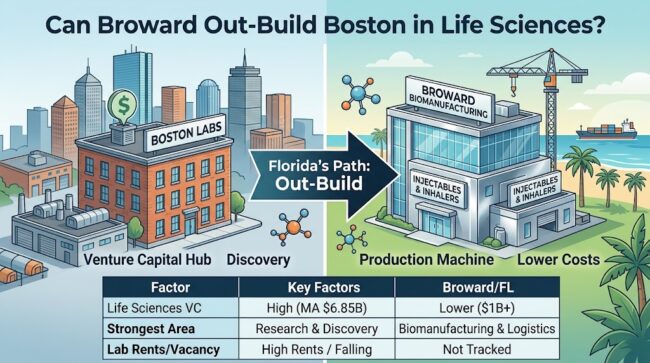
Not in research, but possibly in manufacturing. Boston and the San Francisco Bay Area still attract many times more venture capital than all of Florida. Broward County is winning a different contest: building drug, inhaler and biologics plants. Lower costs, no state income tax, port access and Florida’s 2025 stem cell law help. But the stem cell advantage is narrowing as other states copy it.
Key Takeaways
- Florida drew just over $1 billion in life sciences venture capital in 2025, versus $6.85 billion in Massachusetts alone.
- Boston lab space is in a slump, with nearly 29% vacancy and falling rents.
- Broward’s growth is concentrated in manufacturing, including Pherros Biosciences in Deerfield Beach and Transpire Bio in Pembroke Pines.
- Florida’s stem cell law created demand, but it does not require cells to be made in Florida.
- Tennessee and Georgia have adopted similar stem cell laws, shrinking Florida’s head start.
Two Different Races
When people compare Florida to Boston or San Francisco, they usually mean drug discovery: university labs, early-stage startups and venture-backed science. On that measure, Florida is still a small player.
But there is a second race: who makes the medicines once they exist. That race rewards land, labor costs, logistics and speed to permit. Broward is built for it.
The Venture Capital Gap
Florida is growing fast from a small base. BioFlorida CEO Mark Glickman said Florida deployed just over $1 billion in life sciences venture capital in 2025. By May 2026, the state had already reached $900 million, and he projected the full year would at least double 2025.
The big hubs are far ahead, even in a down cycle. Massachusetts biopharma companies raised $6.85 billion in venture capital in 2025, the lowest total since 2019. The Bay Area led the nation with $12.36 billion in 2024.
So even in Boston’s worst year since 2019, Massachusetts raised roughly six to seven times what all of Florida did.
Boston’s Real Estate Slump
The more interesting number is cost, and it is moving in Boston’s favor.
CBRE reported that Greater Boston lab vacancy rose to 28.9% in the third quarter of 2026. Asking rents fell to $77.97 per square foot, down 8.1% from a year earlier. East Cambridge rents have now fallen for 18 straight quarters.
Earlier in 2026, Boston’s asking rent was above the Bay Area’s $68.64 and San Diego’s $64.30, and more than double Raleigh-Durham’s $37.77.
The takeaway: Boston is still the most expensive lab market in the country, but it is getting cheaper and has space to spare. Florida cannot win simply by saying “we cost less.” It has to offer something Boston lacks.
What Broward Offers Instead
Manufacturing scale. Broward’s recent wins are factories, not labs.
Pherros Biosciences, Deerfield Beach. The company is in a multi-phase expansion to produce up to 100,000 units a day of new and generic injectable medicines, plus biologics and biosimilars. When finished, it will have more than 60,000 square feet of manufacturing space and about 85 high-value jobs by the end of 2026.
Transpire Bio, Pembroke Pines. This clinical-stage company focused on inhaled therapeutics is building a 139,000-square-foot pharmaceutical manufacturing plant with a $100 million capital investment.
Momentum continues. The Greater Fort Lauderdale Alliance reported more than $272 million in new capital investment secured since October 2025, across sectors including pharmaceutical manufacturing and life sciences. That includes previously reported projects such as Lupin’s Coral Springs plant and MediPath’s Miramar lab.
Lower operating costs. Florida has no personal income tax, and the state eliminated the sales tax on business leases in its 2025 session.
Global logistics. Companies relocating to Broward have cited easy access to foreign markets through Port Everglades and Fort Lauderdale-Hollywood International Airport.
A statewide manufacturing base. Florida is now the nation’s second-largest medical device manufacturing hub. Nearly 40,000 people work in the state’s biotechnology, biologics, medical device and pharmaceutical industries.
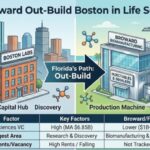
Scorecard: Broward vs. the Big Hubs
| Factor | Broward / Florida | Boston | Bay Area |
|---|---|---|---|
| Life sciences VC | ~$1B (FL, 2025) | $6.85B (MA, 2025) | $12.36B (2024) |
| Lab asking rent | Not tracked by national brokers | $77.97/sq ft (Q3 2026) | $68.64/sq ft (early 2026) |
| Lab vacancy | Not tracked | 28.9% | Elevated |
| State income tax | None | Yes | Yes |
| Core strength | Manufacturing, logistics | Discovery, capital | Discovery, capital |
The Stem Cell Law, One Year In
Florida’s SB 1768 took effect July 1, 2025. It lets licensed physicians use certain non-FDA-approved stem cell therapies in orthopedics, wound care and pain management. Cells must come from FDA-registered facilities certified or accredited by groups such as AABB. Doctors must follow good manufacturing practices, disclose unapproved status in ads and get informed consent.
A Broward company built around it. ZEO ScientifiX in Davie operates out of Nova Southeastern University’s Collaborative Center for Research and makes its products in an FDA-registered, cGMP-compliant lab. The company has said it expects the law to attract medical tourists who previously went abroad for stem cell care.
Out-of-state supply counts too. Israeli developer Cytora chose Florida as a launch market for a diabetic foot ulcer therapy and partnered with ZEO for sales. But Cytora’s product is manufactured by Made Scientific in Princeton, New Jersey. The law requires FDA-registered production. It does not require Florida production.
The head start is shrinking. By July 2026, Tennessee and Georgia had adopted similar stem cell laws. Florida is no longer the only Southeast market.
Oversight is unsettled. A stem cell supplier CEO told the South Florida Business Journal that regulators need to clarify who will police manufacturing and provider compliance. Without that, she said, noncompliant clinics have little reason to stop.
| Stem cell law effect | Helps Broward? |
|---|---|
| Physician demand for registered products | Yes |
| Medical tourism into Florida | Yes |
| Out-of-state manufacturers can supply Florida | No |
| Similar laws in Tennessee and Georgia | No |
| Unclear enforcement | Risk to the whole category |
What Industry Leaders Should Watch
- Florida’s full-year 2026 VC number. If it doubles as BioFlorida projects, the gap with Boston narrows meaningfully.
- Pherros’ production ramp. Hitting its end-of-2026 jobs target would confirm Broward as an injectables hub.
- Transpire Bio’s plant timeline. Inhaled drug manufacturing could make Broward a respiratory medicine center.
- Stem cell enforcement rules. Clear oversight would protect compliant Broward makers from low-quality competitors.
- Boston rent bottom. If Boston lab rents keep falling, Florida’s cost pitch weakens for research tenants.
Brian’s Take
As a former money manager, I always asked one question first: what game is this company actually playing? Florida keeps getting graded on Boston’s game, and it keeps losing. That is the wrong scorecard.
Boston and San Francisco are discovery machines. They turn federal grants and venture money into new science. Broward is becoming a production machine. It turns approved science into physical product: injectables in Deerfield Beach, inhalers in Pembroke Pines, biologics in Davie. That is a different business with different economics, and it is a good one.
I would be careful about overselling the stem cell law. It created real demand, and companies like ZEO are positioned for it. But the law does not force anyone to manufacture in Florida, and two neighboring states have already copied it. A head start is not a moat.
The durable advantage is the plain one. Florida makes it cheaper and faster to build a plant, and Broward can ship anywhere through its port and airport. If the state keeps permitting fast and adds serious stem cell enforcement, Broward will not out-research Boston. It will out-build it.
Frequently Asked Questions
How much venture capital does Florida life sciences attract?
BioFlorida reported just over $1 billion in 2025 and $900 million by May 2026, with a projection to at least double 2025’s total.
How does Florida compare to Massachusetts in biotech funding?
Massachusetts biopharma companies raised $6.85 billion in 2025, roughly six to seven times Florida’s total.
Which life sciences manufacturers are expanding in Broward County?
Recent examples include Pherros Biosciences in Deerfield Beach, Transpire Bio in Pembroke Pines and ZEO ScientifiX in Davie.
Does Florida’s stem cell law require cells to be made in Florida?
No. Cells must come from FDA-registered and accredited facilities, which can be located in other states.
Have other states passed stem cell laws like Florida’s?
Yes. Tennessee and Georgia adopted similar laws by mid-2026.
Why are Boston lab rents falling?
A wave of speculative lab construction met weaker demand, pushing Greater Boston vacancy near 29% in 2026.
Sources and Further Reading
- “Abby Lindenberg: Florida Is the Next Medtech Hub,” Invest: (Capital Analytics Associates), citing BioFlorida
- 2025 Massachusetts Biopharma Funding and Pipeline Report, MassBio
- “Top 10 U.S. Biopharma Clusters 2025,” Genetic Engineering & Biotechnology News
- Boston Metro Life Science Figures, Q3 2026, CBRE
- “Lab Rents Down 20% in Boston, But a Deeper Reset May Be Needed,” Bisnow
- Greater Fort Lauderdale/Broward County special section, Business Facilities (July/August 2025)
- “Broward Lands $272 Million in Investments,” Greater Fort Lauderdale Alliance (May 2026)
- Life Sciences industry overview, Powering Florida
- “Special Report: Greater Fort Lauderdale, Magnet for Biotech/Pharma Growth,” Business Facilities
- “Florida Advances Bill to Expand Access to Unapproved Stem Cell Therapies,” AABB
- “ZEO ScientifiX Positioned for New Growth as Florida Opens Stem Cell Market,” ZEO ScientifiX / BioSpace
- “Zeo ScientifiX Poised for Growth With New Florida Law,” TipRanks
- “New Florida Law Brings Israeli Stem Cell Innovator to State,” Refresh Miami
- “ZEO ScientifiX to Host Live Educational Webinar,” Newswire (July 2026)
- “Plantation Stem Cell Lab Doubles Output as Florida Opens Stem Cell Market,” Hoodline