By Brian French | FloridaMedicalNews.com | October 27, 2026
Quick Answer
AI is now producing real breakthroughs across medicine, chemistry, metallurgy, engineering, mathematics, and even poetry. An AI-designed drug entered Phase III trials in July, self-driving labs are finding new materials in hours, and AI found new heat-resistant alloys in weeks. These are early results. The next five years of AI-driven change are likely to be far larger than anything seen so far.
Key Takeaways
- Rentosertib, a drug whose target and molecule were both generated by AI, began a 320-patient Phase III trial on July 7, 2026.
- More than 173 AI-designed drug programs are in clinical development, and AI-discovered molecules pass Phase I safety trials 80% to 90% of the time, compared with a historical average of 40% to 65%.
- An autonomous chemistry lab ran 120 experiments in 12 hours to find brighter, lead-free light-emitting materials.
- A University of Toronto self-driving lab found six new high-temperature alloys in a few weeks, one of which beat a long-standing industry benchmark.
- Readers in a peer-reviewed study could not reliably tell AI poems from those of famous poets, and often preferred the AI versions.
- Florida institutions, including Moffitt Cancer Center and the University of Florida, are building the infrastructure to put these tools to work for patients.
The Scoreboard: Six Fields, One Year
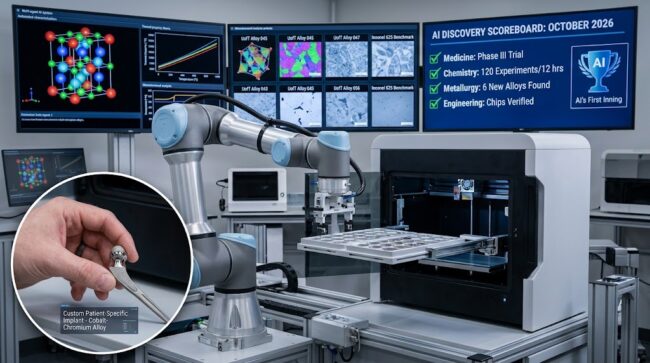
| Field | 2026 Milestone | Stage |
|---|---|---|
| Medicine | AI-designed drug enters Phase III | Trial underway |
| Chemistry | 120 experiments in 12 hours | Peer-reviewed |
| Metallurgy | 6 new alloys found in weeks | Peer-reviewed |
| Engineering | Multi-agent AI chip design | Commercial beta |
| Mathematics | Navier-Stokes proof claimed | Under review |
| Poetry | AI rated above famous poets | Studies published |
Why “First Inning” Is the Right Frame
For most of the past decade, artificial intelligence was described in terms of what it might someday do. In 2026, that changed. The examples above are not forecasts. They are drug trials, lab results, alloy samples, and published studies.
Still, nearly all of them sit at the very start of their journey. The drug has not been approved. The alloys have not been certified for jet engines. The math proof is under formal review. That is exactly what makes this moment important. In baseball terms, the game has started, the first runs are on the board, and there are eight innings left to play.
The pattern across every field is the same. AI is compressing the slowest part of discovery, which is searching through enormous numbers of possibilities, from years into weeks, days, or hours. When the search gets cheap, the number of discoveries goes up. When each discovery feeds the next generation of tools, the pace accelerates.
Medicine: From Software to Phase III
Drug development has long been one of the slowest and most expensive processes in modern industry, often taking more than a decade and billions of dollars to bring a single medicine to market. AI is now attacking both the time and the failure rate.
The most advanced example is rentosertib, developed by Insilico Medicine for idiopathic pulmonary fibrosis, a progressive and often fatal lung disease. According to the company, AI software identified the biological target, a protein called TNIK, and a separate AI platform then generated and optimized the molecule. In the Phase IIa trial published in Nature Medicine, patients on the highest dose gained an average of 98.4 mL in lung capacity over 12 weeks while patients on placebo lost ground. The trial also showed side effects, including liver problems that led some patients at the top dose to stop treatment.
On July 7, 2026, Insilico launched a Phase III trial enrolling 320 patients across 47 centers in China. If it succeeds, rentosertib could become the first drug discovered end to end by AI to win approval from a major regulator. As of late summer 2026, no AI-discovered drug had crossed that line.
The broader pipeline is growing fast:
- Volume. Industry trackers count more than 173 AI-designed drug programs in clinical development.
- Safety trials. AI-discovered molecules have cleared Phase I at rates of 80% to 90%, well above historical norms.
- Efficacy trials. In Phase II, where a drug must show it actually works, AI-discovered drugs have succeeded at about 40%, roughly the same as traditional drugs. That gap is the next problem AI has to solve.
- Capital. Isomorphic Labs, the Google DeepMind spinout, raised $2.1 billion in May 2026 to scale its AI drug design engine.
AI is also reshaping care itself. A study of clinical trial registries found 8,532 AI-related clinical trials registered as of April 2026, with 2026 on pace to set a single-year record. These trials test AI in stroke detection in ambulances, antibiotic prescribing, and even automated anesthesia dosing.
Chemistry: Labs That Run Themselves
The biggest change in chemistry is the rise of the self-driving laboratory, a facility where AI chooses the experiment, robots run it, instruments measure the results, and the AI uses that data to decide what to try next.
At North Carolina State University, a system called PoLARIS searched through billions of possible recipes and identified brighter, lead-free light-emitting nanomaterials in just 12 hours, running 120 experiments along the way. Its developers described it as both a navigation system for discovery and a miniature factory, because it can keep producing the material once it finds the right recipe.
At Washington University in St. Louis, AI agents screened thousands of possible chemical transformations and identified 10 new materials that pull water from the air more effectively than current aluminum-based materials.
These advances build on a foundation that was recognized at the highest level. The 2024 Nobel Prize in Chemistry went in part to Demis Hassabis and John Jumper of Google DeepMind for AlphaFold, the AI system that predicts the three-dimensional shapes of proteins. Protein structure is the starting point for much of modern drug design, and AlphaFold turned a problem that once took years per protein into one that takes minutes.
Metallurgy: New Metals in Weeks
Metallurgy may seem like an old science, but new alloys have driven nearly every major technological era, from bronze tools to jet engines. The problem is scale. Mixing a few dozen elements from the periodic table produces roughly a trillion possible combinations, far too many to test by hand.
In July 2026, researchers at the University of Toronto reported that their AI-driven self-driving lab had identified six new 3D-printable alloys made of nickel, cobalt, and chromium that keep their strength at extreme temperatures. Working in just a few weeks, the team found that one three-element alloy outperformed Inconel 625, an industry-standard alloy containing more than 10 elements, by 4.5% in lab tests. Another was designed for the hottest sections of jet engines, where temperatures reach about 1,000°C. The researchers plan to move next to alloys with 10 to 12 elements, a design space that would be almost impossible to explore without AI.
On October 26, Texas A&M University announced a $2 million grant to build the Aggie AI Foundry, which it describes as academia’s first automated lab using AI and robotics to develop and test new metals.
For medicine, this matters more than it might appear. Cobalt-chromium and titanium alloys are already the backbone of hip replacements, knee implants, and surgical tools. The same AI methods now designing jet engine metals could be pointed at lighter, stronger, longer-lasting implants built for individual patients through 3D printing.
Engineering: Designs Humans Did Not Imagine
Engineering design is shifting from rules of thumb and established templates to AI systems that explore options no human team would have time to test.
- Chips. In March 2026, Synopsys unveiled a multi-agent AI workflow for chip design and verification, work that typically takes a team of engineers four to six months on a large chip. Earlier, Princeton researchers showed AI could design complex wireless chips in hours instead of weeks, sometimes producing layouts that worked better than human designs even though engineers could not fully explain why.
- Rockets. LEAP 71’s computational engineering model designed a working rocket engine in about two weeks, a task that traditionally takes months.
- Simulation. Engineering software from Siemens’ Altair and Synopsys’ Ansys now uses AI to produce near-real-time predictions that once required hours of supercomputer time.
The common thread is that AI is moving engineering from experience-driven design to search-driven design. That shift will affect medical devices, imaging equipment, and hospital infrastructure as much as it affects aerospace.
Mathematics: The Proof That Changed the Debate
Mathematics was the field where AI skeptics felt safest, because a proof cannot be faked. That changed this fall. On September 8, OpenAI announced that roughly 10,000 coordinating AI agents had produced a proof showing that the Navier-Stokes equations, which describe how fluids move, can break down in finite time. The result addresses one of the seven Millennium Prize Problems, though only the versions with an outside force. The Clay Mathematics Institute has opened a deliberately slow, multi-year review.
On October 6, OpenAI released 722 AI-written math manuscripts in a single day. Three were withdrawn within a day after an error surfaced, a reminder that verification is now the bottleneck.
For medicine, the connection is direct. The same Navier-Stokes equations are used to model blood flowing through arteries and heart valves. AI that can reason about fluid equations at the research frontier could eventually improve cardiovascular modeling and device design.
Poetry: The Surprise Nobody Predicted
Of all the fields AI was expected to struggle with, poetry was near the top of the list. It depends on emotion, ambiguity, and personal experience. The research suggests readers do not see it that way.
In a study published in Scientific Reports, University of Pittsburgh researchers showed readers poems by 10 well-known poets, including Shakespeare, Emily Dickinson, Walt Whitman, and Sylvia Plath, alongside AI poems written in each poet’s style. Non-expert readers could not reliably tell them apart, were more likely to think the AI poems were written by people, and rated the AI poems higher on qualities such as rhythm and beauty. The preference reversed when readers were told a poem came from a machine.
A 2026 preprint by researchers including Tuhin Chakrabarty went further, testing prose written in the style of Nobel and Booker Prize winners. Under some test conditions, even readers with MFA training preferred the AI passages for how well they matched the author’s style.
Poets and critics push back, arguing that readers favored the AI work because it was simpler and clearer, not because it was better. That debate is healthy. But the fact that it is happening at all shows how far AI has reached. If machines can compete in the most human of art forms, there are few fields of knowledge work they will not touch.
Why the Next Five Years Will Look Nothing Like the Last Five
In October 2024, Anthropic CEO Dario Amodei predicted that AI could compress 50 to 100 years of progress in biology and medicine into 5 to 10 years. When he wrote that, AI had not designed a drug in Phase III, discovered alloys in a robotic lab, or claimed a Millennium Prize result. All three have now happened.
Three forces suggest the next five years will move much faster than the last five:
- Each tool builds the next one. Better AI designs better chips, which train better AI, which designs better experiments.
- Costs are collapsing. Research-grade analysis that once required a full team for months can now be run in hours.
- Labs are going autonomous. Self-driving labs work around the clock, learn from every failed experiment, and do not get tired.
Put together, the realistic expectation is that breakthroughs will no longer arrive one at a time. They will arrive in clusters, across fields, and they will combine. A new alloy enables a better implant. A new molecule becomes a new therapy. A new simulation method shortens a device approval. The amount of change ahead is genuinely difficult to picture from where we stand today.
The Caveats That Keep It Honest
Speed in the lab does not erase the realities of medicine. Several limits will shape how fast these breakthroughs reach patients:
- Clinical trials still take time. At an Anthropic science event in June 2026, GLP-1 pioneer Lotte Knudsen cautioned that some studies, such as five-year outcome trials, cannot be shortened no matter how much AI is applied. Amodei himself said the full acceleration might take closer to a decade.
- AI drugs have not yet proven better at Phase II. Passing safety tests is not the same as working in patients.
- Discovery claims need checking. Berkeley’s autonomous A-Lab published a correction in January 2026 after outside researchers questioned whether its materials were truly new to science.
- Errors still slip through. OpenAI’s withdrawn math manuscripts show that volume without verification creates risk.
None of these caveats slow the direction of travel. They define where human judgment matters most.
What It Means for Florida Medicine
Florida is well positioned for this shift, and several of its institutions are already moving.
Moffitt Cancer Center in Tampa has published research showing that AI improved the effectiveness of radiation treatment planning, with physicians remaining central to the final decisions. Moffitt has also expanded an AI-enabled virtual oncology model and announced a collaboration to develop AI innovation space as part of a proposal for St. Petersburg’s Historic Gas Plant District.
The University of Florida operates HiPerGator, the fastest university-owned and operated AI supercomputer in the United States. UF faculty have received more than $511 million in AI research awards since 2017, and 71% of UF’s spring 2026 graduates completed at least one AI course. UF researchers use HiPerGator for cancer research, clinical prediction tools, and early disease detection, and the system is available to every institution in Florida’s State University System.
For Florida’s hospitals, physician groups, medical device makers, and life sciences companies, the practical question is no longer whether AI will change their field. It is whether they will be early adopters or late followers. Florida’s aging population, large clinical trial footprint, and growing biotech corridors give the state a strong reason to be early.
How FloridaMedicalNews.com Uses AI
The same shift is reshaping how health and business news is produced. FloridaMedicalNews.com is part of the Florida Authority Network, a group of 35 Florida-focused publications. The network uses a method it calls Human Insight + Tech Intelligent Curation. AI tools gather and organize public information such as research papers, trial data, and institutional announcements. A human analyst, Brian French, then verifies the facts and adds analysis before anything is published.
That model mirrors the lesson from every field in this article. AI produces speed and volume. Human review produces trust.
Brian’s Take
As a money manager years ago, I learned that the biggest market moves happen when the cost of something essential suddenly drops. The cost of discovery is dropping right now, across nearly every field at once.
What strikes me most is not any single result. It is that a drug trial, a new metal, a chip design, a math proof, and a poetry study all landed in the same year. Those fields have almost nothing in common except that they all depend on searching through enormous numbers of possibilities, and AI has made that search cheap.
We are in the first inning. Most people are still judging AI by the chatbot they tried two years ago, the same way early investors judged the internet by dial-up modems. The next five years will bring changes in medicine and science that are hard to imagine from today’s vantage point. Florida’s healthcare leaders who start building with these tools now, while keeping experienced human judgment in charge, will set the pace for everyone else.
FAQ
Has an AI-designed drug been approved by the FDA?
Not as of late summer 2026. Insilico Medicine’s rentosertib, for idiopathic pulmonary fibrosis, began Phase III trials on July 7, 2026, and is the furthest along.
What is a self-driving lab?
A laboratory where AI chooses each experiment, robots carry it out, and the results are fed back into the AI to plan the next step, with minimal human intervention.
How is AI changing metallurgy?
AI-driven labs are testing alloy combinations far faster than humans can. University of Toronto researchers found six new high-temperature alloys in a few weeks, including one that beat the industry-standard Inconel 625.
Can AI really write good poetry?
In published studies, non-expert readers often could not tell AI poems from those of famous poets and rated the AI poems higher, though critics argue that reflects a preference for simpler writing.
Will AI really compress decades of medical progress into a few years?
Anthropic’s Dario Amodei has predicted 50 to 100 years of progress in 5 to 10 years. Clinical trials and regulatory review will limit the pace, but early results in 2026 show the acceleration is real.
How are Florida institutions using AI in medicine?
Moffitt Cancer Center uses AI in radiation treatment planning and virtual oncology care, and the University of Florida’s HiPerGator supercomputer powers cancer, neuroscience, and clinical prediction research statewide.
Sources and Further Reading
- Life Science Daily News — AI-Discovered Drugs in 2026: The State of Play
- Nature Medicine — A generative AI-discovered TNIK inhibitor for idiopathic pulmonary fibrosis: a randomized phase 2a trial
- Insilico Medicine — Insilico Initiates Phase III Clinical Trial for Rentosertib
- IntuitionLabs — AI-Discovered Drugs in Clinical Trials 2026: Full Pipeline
- Drug Discovery Today — How successful are AI-discovered drugs in clinical trials? A first analysis and emerging lessons
- arXiv — The Clinical Trial Pipeline Reveals the Next Wave of Artificial Intelligence in Healthcare: A Multidimensional Analysis of 8,532 Registered Studies
- North Carolina State University — AI-Powered Lab Discovers Brighter Lead-Free Nanomaterials in 12 Hours
- Phys.org — Machine learning methods move self-driving labs closer to materials discovery at scale
- AZoM — How AI and Automation Are Changing Materials Discovery
- University of Toronto Engineering News — Self-driving lab leverages AI to develop tough new 3D-printable metal alloys
- Texas A&M Today — Texas A&M to create AI-powered foundry for faster alloy discovery
- Synopsys — Synopsys Outlines Vision for Engineering the Future (March 11, 2026)
- CO/AI — Princeton AI-designed wireless chips
- Quanta Magazine — AI Has Solved One of Math’s $1 Million Millennium Prize Problems
- NYU Shanghai RITS — OpenAI Drops 722 Math Manuscripts From an Unreleased Model
- Scientific Reports — Porter and Machery, AI-generated poetry is indistinguishable from human-written poetry and is rated more favorably
- University of Virginia News — Do You Prefer AI Poems or Poets?
- Dario Amodei — Machines of Loving Grace (October 2024)
- Fast Company — 5 takeaways from Anthropic’s big science event
- Moffitt Cancer Center — Moffitt Study Shows AI Boosts Efficacy of Cancer Treatment, But Doctors Remain Key
- University of Florida AI — Year in Review 2026
- Tampa Bay Times — Here’s how UF is deploying AI to tackle Florida’s growing health challenges