By Brian French | FloridaMedicalNews.com | September 13, 2026
Quick Answer
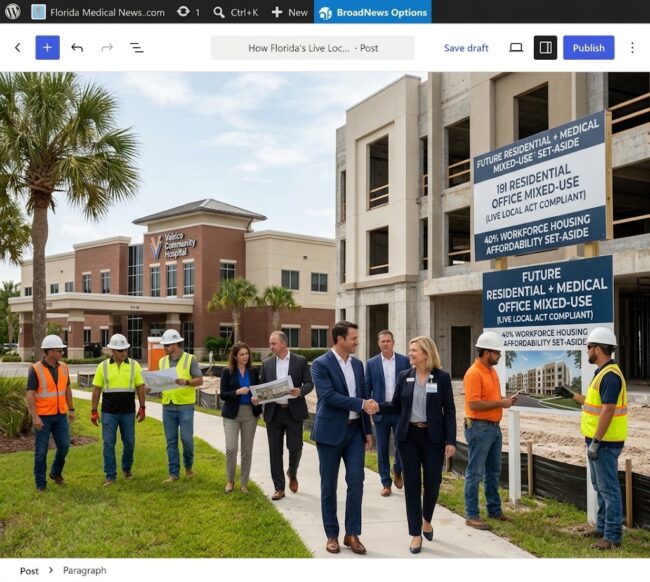
The Live Local Act (Senate Bill 102, 2023, as amended in 2024, 2025, and 2026) lets a developer build multifamily or mixed-use residential housing on any commercially, industrially, or mixed-use zoned parcel in Florida without a rezoning, comprehensive plan amendment, public hearing, or council vote, provided at least 40% of the units are reserved for households earning up to 120% of area median income for 30 years. For hospital systems and medical groups, that means workforce housing for nurses, technicians, and residents can be built by right on hospital-adjacent commercial land, and a medical office building can be paired with housing in a single project, at the highest density and height the jurisdiction allows anywhere. Local governments must approve qualifying projects administratively, and the preemption runs through October 1, 2033.
The Healthcare Staffing Problem the Act Was Not Written For
The Live Local Act was drafted as housing policy, not healthcare policy. But its mechanics line up unusually well with a problem every Florida hospital CEO is managing: clinical staff cannot afford to live near the facilities that employ them. A registered nurse earning $80,000 in Miami-Dade, Tampa, or Naples sits between 80% and 120% of area median income, which is exactly the “missing middle” band the statute targets.
Hospital systems also own or control large amounts of commercially zoned land, typically surface parking, outpatient pads, and outparcels acquired for future expansion. Under prior law, converting that land to residential use required a rezoning fight. Under Live Local, it requires a site plan.
What the Statute Preempts
The operative provisions are Florida Statute § 166.04151(7) for municipalities and § 125.01055(7) for counties. A qualifying project receives the following regardless of local zoning:
- Use. Multifamily or mixed-use residential is allowed in any area zoned commercial, industrial, or mixed-use. Senate Bill 1730 (2025) confirmed that flexibly zoned districts such as planned unit developments qualify, which matters because most hospital campuses sit in PUD or institutional overlays layered on commercial land.
- Density. The project may be built at the highest residential density allowed anywhere in the jurisdiction. In Miami-Dade or Orlando, that can mean hundreds of units per acre on a parcel currently zoned for a two-story clinic.
- Height. The project may reach the highest height allowed for any commercial or residential building within one mile, or three stories, whichever is greater. Near single-family neighborhoods, SB 328 (2024) limits height to 150% of the tallest adjacent building or three stories, whichever is greater. HB 1389 (2026) bars local governments from using setback or stepback requirements to indirectly cut height.
- Floor area ratio. Local governments cannot restrict a qualifying project below 150% of the highest FAR permitted in the jurisdiction.
- Approval process. SB 1730 requires administrative approval without action by any board, commission, or quasi-judicial body. No public hearing, no rezoning, no comp plan amendment.
- Parking. Parking requirements must be reduced by at least 20% within a half mile of a major transit stop, and eliminated entirely within a designated transit-oriented development. Parking is the single largest cost driver in urban medical campus housing, and this provision alone can change project feasibility.
- Moratoria. A local government may impose only one temporary moratorium of no more than 90 days in any three-year period on Live Local projects.
Qualifying Conditions
The preemption is not free. The project must satisfy all of the following:
- At least 40% of residential units are affordable to households at or below 120% of AMI for at least 30 years, documented by a recorded land use restriction.
- For mixed-use projects, at least 65% of the total square footage must be residential. A medical office building with apartments above works only if the residential component dominates.
- The project must still meet all other local development regulations that are not preempted, including stormwater, concurrency, landscaping, setbacks, and building code.
- The parcel cannot be in an airport zone without airport authority consent, an area of critical state concern, land under a conservation easement, or open-space zoning districts, all exclusions added or clarified in HB 1389 (2026).
The 2026 Amendments and Public Hospitals
House Bill 1389, passed in March 2026 and effective July 1, 2026, added two provisions with direct significance for healthcare developers:
- Government-owned land. Live Local projects are now permitted on property owned by a county, municipality, or school district, if the local government is a party to the application. Public hospital districts and county-owned medical campuses, including land held by entities like Jackson Health System in Miami-Dade, Tampa General’s county-leased footprint, and Lee Health’s public parcels, gain a pathway to workforce housing without rezoning.
- Religious lands. Parcels of more than three acres that have housed a place of worship for at least 10 years are now eligible regardless of underlying zoning. Faith-affiliated health systems such as AdventHealth and BayCare frequently control such land adjacent to their facilities.
HB 1389 also waived sovereign immunity under the Florida Fair Housing Act, allowing developers to sue local governments that obstruct qualifying projects, and grandfathered applications filed before July 1, 2026 under the 2025 version of the statute.
Tax Incentives That Change the Pro Forma
Beyond zoning, the Act created the “Missing Middle” property tax exemption under § 196.1978(3). For developments of more than 70 units that set aside qualifying affordable units, ad valorem taxes are reduced 75% on units serving households at 80% to 120% of AMI and 100% on units at or below 80% of AMI. The exemption applies to newly constructed or substantially rehabilitated projects for up to three years after a certificate of occupancy… and renews annually for qualifying units.
Local governments may opt out of the 80%-to-120% tier only if the University of Florida’s Shimberg Center data shows a housing surplus for the previous three years, a standard tightened by HB 1389. Projects that apply for the exemption within four years of receiving a building permit keep the benefit even if the jurisdiction later opts out.
A separate sales tax refund on building materials for affordable units, and access to State Apartment Incentive Loan financing through the Florida Housing Finance Corporation, are available to projects that meet program criteria.
Live Local at a Glance
| Provision | Rule for Qualifying Projects |
|---|---|
| Eligible zoning | Commercial, industrial, mixed-use, PUD |
| Affordability | 40% of units, ≤120% AMI, 30 years |
| Mixed-use ratio | 65%+ residential |
| Density | Highest allowed in jurisdiction |
| Height | Highest within 1 mile or 3 stories |
| FAR | 150% of highest allowed |
| Approval | Administrative, no hearing |
| Parking near transit | 20% cut or eliminated |
| Tax exemption | 75% or 100% on affordable units |
| Sunset | October 1, 2033 |
How Medical Group Developers Use It
Campus workforce housing. A hospital converts a surface parking lot on commercially zoned land into a 200-unit apartment building with 80 units reserved for staff earning under 120% of AMI. The hospital retains ownership through a ground lease to a residential developer, structures employee housing as a recruitment benefit, and captures the tax exemption on the affordable units.
Mixed-use medical office. A physician group planning a 40,000-square-foot ambulatory center adds 120 residential units above it. Because residential must be 65% of square footage, the medical component is sized at roughly 35%, but the group obtains height and density it could not otherwise get, with no rezoning risk.
Rural and suburban urgent care. In counties where the highest allowed residential density is low, the preemption yields less. The Act’s value scales with the density ceiling of the jurisdiction, so it favors urban and dense suburban markets over rural ones.
Health system as landlord. Some systems have structured master-leased buildings where the operator holds units for traveling nurses and residents, which meets the affordability test as long as rents stay within HUD income limits and the tenants qualify.
Brian’s Take
The Live Local Act is the most useful land use tool Florida hospitals have been handed in a generation, and most of them are still not using it. The reason is organizational. Real estate at a health system reports to facilities, workforce housing is an HR problem, and the finance office sees residential as off-strategy. The Act only pays off when those three functions look at the same parcel together.
The other reason is that the statute keeps moving. Four versions in four sessions means local planning staff in many counties are applying last year’s rules, and litigation like Bal Harbour Shops v. Village of Bal Harbour has shown that cities will still contest applications on procedural grounds. Developers who win are the ones filing complete administrative applications that track the statutory checklist line by line, leaving nothing to interpretation.
For hospital systems specifically, the 2026 expansion to county- and city-owned land is the change to watch. Public hospital districts across Florida control thousands of acres of underused land, and the statute now gives them a way to build for their own staff without a referendum or a rezoning. The first system to execute that at scale will have a recruiting advantage its competitors cannot match with signing bonuses.
Frequently Asked Questions
Can a hospital build staff housing under the Live Local Act on its own campus?
Yes, if the parcel is zoned commercial, industrial, mixed-use, or sits in a PUD, and the project meets the 40% affordability requirement. Land zoned purely institutional or residential does not qualify unless it is publicly owned and the local government joins the application.
Do the affordable units have to be rented to hospital employees?
No. The units must be available to any income-qualified household. A hospital can market them to staff but cannot restrict occupancy to employees without risking the affordability certification.
Does the Act allow a hospital tower or clinic to bypass zoning?
No. The preemption applies only to residential and mixed-use projects where residential is at least 65% of the square footage. A standalone medical facility receives no benefit.
What is the area median income threshold in practice?
120% of AMI for a family of four in 2026 is roughly $130,000 to $145,000 in Miami-Dade, Tampa Bay, and Orlando, and higher in Collier and Monroe counties. Most nurses, technicians, and early-career physicians in training qualify.
Can a city deny a qualifying Live Local application?
Only for failure to meet non-preempted regulations such as stormwater, concurrency, or building code. Denials based on use, density, height, or FAR are contrary to the statute and, after HB 1389, expose the local government to suit under the Florida Fair Housing Act.
When does the Live Local preemption expire?
The zoning preemption sunsets October 1, 2033. Projects approved before then retain their entitlements.
Sources and Further Reading
- Florida Statutes § 166.04151, Affordable Housing (Municipalities) – https://www.leg.state.fl.us/statutes/index.cfm?App_mode=Display_Statute&URL=0100-0199/0166/Sections/0166.04151.html
- Florida Statutes § 125.01055, Affordable Housing (Counties) – https://www.leg.state.fl.us/statutes/index.cfm?App_mode=Display_Statute&URL=0100-0199/0125/Sections/0125.01055.html
- Florida Statutes § 196.1978, Affordable Housing Property Exemption – https://www.leg.state.fl.us/statutes/index.cfm?App_mode=Display_Statute&URL=0100-0199/0196/Sections/0196.1978.html
- Florida Senate, SB 102 (2023), Live Local Act – https://www.flsenate.gov/Session/Bill/2023/102
- Florida Senate, SB 328 (2024) – https://www.flsenate.gov/Session/Bill/2024/328
- Florida Senate, SB 1730 (2025) – https://www.flsenate.gov/Session/Bill/2025/1730
- Florida Senate, HB 1389 (2026) – https://www.flsenate.gov/Session/Bill/2026/1389
- Stearns Weaver Miller, Live Local 4.0 – An Update on House Bill 1389 (March 2026) – https://www.stearnsweaver.com/blog/live-local-4-0-an-update-on-house-bill-1389-passed-during-2026-legislative-session/
- Miami-Dade County, 2026 Live Local Act Implementation Memorandum (March 25, 2026) – https://www.miamidade.gov/resources/economy/zoning/documents/2026-03-25-live-local-act-update-memo.pdf
- Lowndes, Live Local Act Amended: SB 1730 Becomes Law – https://www.lowndes-law.com/newsroom/insights/Live-Local-Act-Amended-SB-1730-Becomes-Law-in-Florida
- Florida Housing Finance Corporation, Live Local Act Resources – https://www.floridahousing.org/live-local-act
- Shimberg Center for Housing Studies, University of Florida – https://www.shimberg.ufl.edu