Published on FloridaMedicalNews.com, part of the Florida Authority Network, published by Brian French.
Quick Answer
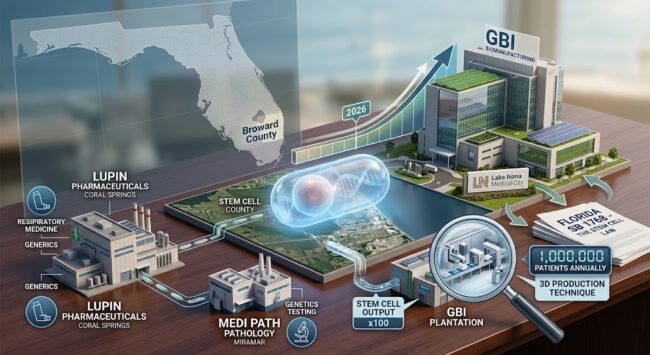
Broward County is becoming Florida’s center for medical manufacturing rather than drug discovery. Three forces are converging in 2026: the state’s 2025 stem cell therapy law (SB 1768), which opened a physician-led market for non-FDA-approved regenerative treatments and prompted GBI Biomanufacturing to double stem cell output in Plantation; a $250 million Lupin respiratory-medicine plant under construction in Coral Springs; and a $10 million MediPath genetics-testing lab in Miramar. For clinicians and health systems, the practical result is more locally produced biologics, generics and diagnostic capacity within a two-hour drive of most of South Florida.
Why the Stem Cell Law Matters to Broward
Most coverage of Florida’s stem cell legislation has focused on patient access and oversight debates. Less discussed is its industrial effect. Florida’s 2025 legislation, SB 1768, created a limited pathway that allows licensed physicians to use certain non-FDA-approved stem cell therapies for orthopedics, wound care and pain management, with the requirement that cells be retrieved, manufactured and stored in FDA-registered facilities.
That manufacturing requirement is the hinge. Florida is one of five states that has green-lighted stem cell use for conditions not yet approved by the FDA, and because the law demands registered production facilities, it creates demand for exactly the kind of cGMP capacity that Broward already had in place.
The law explicitly prohibits embryonic stem cells and instead focuses on sources such as donated umbilical cord blood and placental tissue, which keeps the supply chain inside the tissue-banking and biologics infrastructure that South Florida clinics already use.
GBI Biomanufacturing: From 10,000 Patients to 1 Million
The clearest beneficiary is GBI Biomanufacturing at 1850 NW 69th Ave. in Plantation, a contract manufacturer formerly known as Goodwin Biotechnology. The company has manufactured therapeutic proteins and antibodies at its 40,000-square-foot facility for years, and has now repurposed an additional 20,000 square feet, doubling its stem cell manufacturing capacity.
The stated scale-up target is dramatic. President Jesse McCool said the company can currently manufacture enough stem cells for about 10,000 patients per year, but that the current process is not very scalable, and that moving to 3D production techniques could allow it to scale up to 1 million patients a year at the Plantation site.
Financing came from private healthcare capital with state support possible. McCool said the company has invested $26 million in private capital from Signet Health, and is likely to receive some state funding secured by Rep. James Buchanan, who sponsored the stem cell legislation, to complete installation of bioreactors and clean rooms. GBI employs 60 people and expects to add 30 more, including biotech engineers and lab technicians, as new orders come in.
The company was also named BioFlorida’s 2025 Manufacturer of the Year, which signals that the state’s industry association sees Broward manufacturing as a flagship rather than a footnote.
The Oversight Question
Physicians evaluating stem cell suppliers should note that even manufacturers welcome tighter enforcement. McCool has been direct that the law’s requirements are strong but that without enforcement there is room for bad actors to cut corners, and industry partners such as Tavra Biosciences have raised similar concerns about contamination risks and product viability with living cell therapies. McCool framed the core challenge as how to scale while keeping stem cell products safe from microbial contamination and consistent, which requires quality manufacturing at the foundation.
For referring physicians, the checklist is straightforward: confirm the manufacturer is FDA-registered, confirm the cell source complies with SB 1768, and ask for lot-level sterility and potency documentation.
Lupin Coral Springs: Respiratory Generics at Scale
The largest dollar commitment in Broward’s medical sector this year is not a startup. Lupin Pharmaceuticals is building a new manufacturing plant in Coral Springs that will anchor its U.S. production of critical respiratory therapies, with a projected cumulative investment of $250 million over five years and capacity for more than 25 respiratory medicines, generating more than 200 skilled jobs by 2030.
For pulmonologists, allergists and hospital pharmacy directors, domestic inhaler and respiratory generic production addresses a recurring shortage category. The Coral Springs plant is framed explicitly around diversifying the supply chain and enhancing affordable, reliable access to lifesaving therapies.
MediPath Miramar: Genetics Testing Comes In-House
On the diagnostics side, MediPath Pathology Services, a CLIA-certified and CAP-accredited lab affiliated with TopLine MD Alliance, Florida’s largest physician-owned group, is launching a 26,000-square-foot, $10 million facility in Miramar with a new genetics testing department and 150 new jobs. Its pathologists work across cytopathology, anatomic, gynecologic, pediatric and breast pathology alongside surgeons and oncologists.
A physician-owned group standing up its own genetics lab is a notable shift. It keeps molecular testing turnaround and margin inside the practice network rather than sending samples to national reference labs.
Broward Medical Manufacturing at a Glance
| Facility | City | Focus | Capital | Clinical relevance |
|---|---|---|---|---|
| GBI Biomanufacturing | Plantation | Stem cells, antibodies, proteins | $26M private | Orthopedic, wound, pain therapies |
| Lupin Pharmaceuticals | Coral Springs | Respiratory generics | ~$250M / 5 yrs | Inhaler and respiratory supply |
| MediPath Pathology | Miramar | Anatomic pathology, genetics | $10M | Oncology, OB-GYN, pediatrics |
What This Means for Florida Physicians
Three practical takeaways. First, regenerative medicine practices in Florida now have an in-state, FDA-registered manufacturer with expanding capacity, which reduces the compliance risk of sourcing cells from out-of-state clinics of uncertain provenance. Second, health systems negotiating respiratory drug contracts will have a Florida-made option by the end of the decade. Third, physician groups outside TopLine MD may see the MediPath model as a template for bringing molecular diagnostics in-house.
Frequently Asked Questions
Does Florida’s stem cell law let any clinic offer stem cell treatments?
No. Only licensed physicians may offer them, only for orthopedics, wound care and pain management, and only with cells produced in FDA-registered facilities. Embryonic cells are prohibited.
Which Broward company is the main stem cell manufacturer?
GBI Biomanufacturing in Plantation, which doubled its stem cell capacity in 2026 and manufactures primarily from bone marrow-derived cells.
When will Lupin’s Coral Springs plant be producing?
The company has stated a 2030 horizon for its full 200-job workforce; production ramp timing has not been publicly detailed.
Is Broward County a life sciences research hub?
It is a manufacturing and clinical-lab hub. Discovery research in South Florida remains concentrated in Palm Beach County’s institutes and Miami’s academic medical centers.
Brian’s Take
Florida did something unusual with SB 1768: it wrote a manufacturing standard into a patient-access law. The unintended consequence, or perhaps the intended one, is that Broward County now has a regulatory moat around its stem cell production. A compliant supplier has to be FDA-registered, and GBI is the one standing in Plantation with the clean rooms already built.
The risk is reputational. If enforcement lags and noncompliant operators flood the market with contaminated product, the whole category takes the hit, including the legitimate manufacturers who asked for tougher rules. The state should fund enforcement with the same enthusiasm it funded GBI’s bioreactors. Meanwhile, Lupin and MediPath show the durable version of the story: generics and diagnostics that health systems will still be buying in 2036.
Sources and Further Reading
- South Florida Sun Sentinel via GBI Biomanufacturing, “‘Demand is growing:’ Plantation lab ramps up stem-cell production,” May 7, 2026 — https://www.gbibio.com/demand-is-growing-plantation-lab-ramps-up-stem-cell-production/
- Greater Fort Lauderdale Alliance, 2026 Mid-Year Meeting press release, May 26, 2026 — https://www.gflalliance.org/news/2026/05/26/press-releases/greater-fort-lauderdale-alliance-2026-mid-year-meeting-highlights-princess-cruises-amongst-new-company-expansions-and-key-sector-growth/
- Venture Tech Chronicle, “GBI Biomanufacturing Expands in South Florida with Stem Cell Manufacturing Growth and New President,” May 12, 2026 — https://www.vtchronicle.com/blog/gbi-biomanufacturing-expands-in-south-florida-signaling-a-turning-point-for-the-regions-life-sciences-infrastructure
- Hoodline, “Plantation Lab Ramps Up Stem-Cell Manufacturing,” May 12, 2026 — https://hoodline.com/2026/05/plantation-stem-cell-lab-doubles-output-as-florida-opens-stem-cell-market/
Florida Authority Network: 813-409-4683