May 1, 2026
Florida is home to one of the most diverse and competitive medical school landscapes in America. With 11 allopathic (MD) programs and several osteopathic (DO) programs spread across the state, Florida ranks fourth nationally in number of medical schools — behind only New York, California, and Pennsylvania.
But within that crowded landscape, four medical schools stand head and shoulders above the rest — by every measure that matters: research dollars, residency match rates, clinical training quality, applicant selectivity, faculty distinction, and impact on Florida’s healthcare future.
These aren’t just good schools. These are programs producing the surgeons who will perform Florida’s most complex operations, the researchers who will discover Florida’s next breakthrough therapies, the primary care physicians who will serve Florida’s aging communities, and the leaders who will run Florida’s largest health systems for the next 30 years.
If you’re a pre-med student, a Florida parent, an aspiring physician, or anyone interested in Florida’s healthcare future, this is your comprehensive 2026 guide to the four top medical schools in Florida — what makes each one special, who they’re looking for, what it takes to get in, and how each school is shaping the future of medicine in the Sunshine State.
Let’s count down the four institutions defining Florida medical education.
1. University of Miami Leonard M. Miller School of Medicine (UMMSM)
Location: Miami, Florida Address: 1600 NW 10th Avenue, Miami, FL 33136 Founded: 1952 (Florida’s oldest medical school) Type: Private Class Size: Approximately 200 students per class (one of the largest in Florida) Website: med.miami.edu
The Big Picture
The University of Miami Miller School of Medicine is Florida’s oldest medical school and the top-ranked private medical school in the state. Located in the heart of Miami’s massive medical district, Miller serves as the academic teaching arm for Jackson Memorial Hospital — one of the largest and busiest teaching hospitals in the United States and the second-busiest medical center in the country by admissions. Combined with its own UHealth system, Bascom Palmer Eye Institute, Sylvester Comprehensive Cancer Center, and a vast network of specialty care, Miller offers students unmatched clinical exposure across South Florida.
Miller is the only medical school in Florida that combines:
- A top-tier private research university foundation
- Access to one of the largest public safety-net hospitals in America (Jackson)
- A high-volume international patient flow from across Latin America and the Caribbean
- An established academic legacy stretching back more than 70 years
Academic Profile
According to U.S. News & World Report, the University of Miami Miller School of Medicine ranks #43 in Research nationally, with consistent placement in the top 30-40 medical schools in the United States.
Miller’s academic strengths include:
- Innovative curriculum. Miller offers an integrated curriculum with a shortened, one-year pre-clinical phase — one of the most accelerated in American medical education. This frees students for earlier clinical exposure, scholarly projects, or accelerated transitions to residency.
- Small group and team-based learning. The curriculum emphasizes case-based, interactive learning rather than traditional lecture formats.
- Personalized scholarly pathways. Students develop individualized projects, research tracks, or specialty preparation in their final years.
- Diversity and global exposure. The patient population at UM-Jackson is among the most ethnically and clinically diverse in the country, exposing students to disease presentations and population health challenges they’d never see at most U.S. academic medical centers.
Research Excellence
Miller has built world-class research strengths in:
- Cancer care through the Sylvester Comprehensive Cancer Center
- Diabetes and endocrinology
- Genetics and genomics
- Ophthalmology through the renowned Bascom Palmer Eye Institute (consistently ranked the #1 ophthalmology center in the U.S.)
- Neuroscience and neurosurgery
- Cardiovascular medicine
- Cellular therapeutics and translational medicine
Miller faculty have made foundational contributions including the development of the first cardiopulmonary simulator and major innovations in cellular therapy.
Admissions Profile
Miller is highly selective:
- Average MCAT: ~514
- Average GPA: 3.75
- Acceptance Rate: Highly competitive (low single digits)
- Out-of-State Admissions: Miller accepts a relatively large percentage of out-of-state students compared to Florida’s public schools — roughly 30-40% of each class.
Miller requires 9 required + 3 optional secondary essays, more than most Florida medical schools, indicating the depth of mission-fit evaluation in their admissions process.
Why Students Choose Miller
- Unmatched clinical volume. Jackson Memorial Hospital alone admits more patients annually than nearly any U.S. teaching hospital.
- South Florida lifestyle. Miami offers cultural diversity, beach access, and an international atmosphere unmatched by other Florida medical school cities.
- Latin American connections. For students interested in international medicine, public health, or Latin American/Caribbean health issues, Miller’s reach is unique.
- Top-tier residency placements. Miller graduates consistently match at competitive programs nationwide across virtually every specialty.
Brian’s Take: Miami Miller Is Florida’s Most Internationally Influential Medical School.
The combination of South Florida’s diverse patient populations, Jackson Memorial’s massive case volume, and Miller’s research depth makes it one of the most distinctive training environments in American medicine — particularly for students interested in global health, cancer care, ophthalmology, or working with multilingual communities. If your career vision involves Florida’s growing role as a healthcare gateway between the U.S. and Latin America, Miller is genuinely irreplaceable.
— Brian
2. University of Florida College of Medicine (UF COM)
Location: Gainesville, Florida (with major Jacksonville campus) Address: 1600 SW Archer Road, Gainesville, FL 32610 Founded: 1956 Type: Public Class Size: Approximately 135 students per class Website: med.ufl.edu
The Big Picture
The University of Florida College of Medicine is the flagship public medical school in Florida and one of the most prestigious public medical institutions in the southeastern United States. Anchored at the UF Health Shands Hospital in Gainesville — Florida’s largest academic medical center — and supplemented by a growing presence at UF Health Jacksonville, UF COM offers Florida residents an elite medical education at significantly lower cost than the state’s private programs.
UF COM has been a leader in academic medicine for nearly 70 years and remains the standard-bearer for public Florida medical education.
Academic Profile
UF College of Medicine is consistently ranked among the top public medical schools in America:
- U.S. News & World Report Research Ranking: #37
- U.S. News & World Report Primary Care Ranking: #48
- National Reputation: Frequently ranked in the top 30-40 medical schools overall
UF COM offers what’s known as the clinical presentation model — a curriculum framework that organizes medical learning around 120 different ways patients can present their illnesses to physicians. This patient-centered teaching approach is particularly valuable in clinical settings where patients can only describe their symptoms, not diagnose themselves.
UF was also the first university in the United States to launch an AI curriculum across all disciplines in February 2022 — meaning UF medical students are integrated into one of the most ambitious AI-in-academia initiatives in American higher education.
Research and Clinical Training
UF College of Medicine’s research strengths include:
- Aging and geriatrics (especially relevant given Florida’s aging demographics)
- Neurology and neuroscience
- Cancer research through the UF Health Cancer Center
- Cardiovascular medicine
- Genetics and pharmacogenomics
- Translational medicine and clinical trials
Clinical training takes place primarily at:
- UF Health Shands Hospital (Gainesville flagship)
- UF Health Jacksonville
- UF Health Cancer Center
- UF Health Shands Children’s Hospital
- A network of regional clinical sites
- Student-run free clinics serving underserved populations
- International medical outreach trips
Admissions Profile
UF College of Medicine is highly selective, particularly for in-state applicants:
- Average MCAT: ~515 (top 90th percentile)
- Average GPA: 3.86
- In-State Preference: Strong preference for Florida residents
- Acceptance Rate: Highly competitive
UF requires 4 required + 2 optional secondary essays — a more streamlined application than Miller’s, but still substantial.
Why Students Choose UF COM
- Best public medical school value in Florida. Lower in-state tuition (~$32,000-$40,000) versus private schools at $60,000+.
- Prestigious public university brand. UF’s overall academic reputation extends to its medical college.
- Gainesville quality of life. A college-town atmosphere with manageable cost of living and a tight-knit medical school community.
- Jacksonville expansion. UF’s growing graduate medical campus in LaVilla creates new opportunities tied to Northeast Florida’s healthcare growth.
- AI integration. UF’s leadership in academic AI gives medical students unique exposure to how AI is reshaping medicine.
- Alumni network. Strong residency placement and a deep network of UF-trained physicians across Florida.
Brian’s Take: UF College of Medicine Is the Smart Money Choice for Most Florida Pre-Meds.
The combination of public-school tuition, top-40 national reputation, strong residency match rates, and access to Florida’s largest academic medical center makes UF College of Medicine the highest-ROI medical education most Florida residents can realistically pursue. If you’re a strong Florida applicant with a 515+ MCAT and a 3.85+ GPA, UF should be at the top of your list before you even think about more expensive options.
— Brian
3. University of South Florida Morsani College of Medicine (USF Morsani)
Location: Tampa, Florida (CORE program); Lehigh Valley, Pennsylvania (SELECT program) Address: 560 Channelside Drive, Tampa, FL 33602 Founded: 1971 Type: Public Class Size: Approximately 180 students per class (CORE + SELECT combined) Website: health.usf.edu/medicine
The Big Picture
The University of South Florida Morsani College of Medicine has emerged as one of the most rapidly ascending medical schools in the United States, recently ranked #1 in Florida and among the nation’s best for research by U.S. News & World Report. USF Morsani is now consistently competing with — and in some categories surpassing — its older Florida counterparts.
The school is the academic partner of Tampa General Hospital, the Tampa Bay region’s only Level One Trauma Center and one of America’s most respected academic medical centers. In recent years, USF Morsani opened a brand-new medical school facility in downtown Tampa adjacent to Tampa General Hospital, dramatically improving the synergy between classroom and clinical training.
Academic Profile
USF Morsani’s recent rankings tell the story of its rise:
- U.S. News & World Report Research Ranking: Climbing rapidly into the top 50
- Florida Ranking: Ranked #1 in Florida by U.S. News in 2025
- Average MCAT: Among the highest in Florida, with reports indicating averages around 518-520
- Average GPA: Approximately 3.95
USF Morsani offers two distinct MD pathways:
- CORE Program (Tampa). The traditional four-year MD program based entirely in Tampa with clinical rotations primarily at Tampa General Hospital.
- SELECT Program (Tampa + Lehigh Valley, PA). A unique dual-campus program where students spend their first two years in Tampa and final two years at the Lehigh Valley Health Network in Pennsylvania, focused on developing physician leaders for transformative healthcare.
Both programs feature an integrated, systems-based curriculum emphasizing small-group learning, early clinical exposure, and scholarly development.
Research and Clinical Training
USF Morsani’s research strengths include:
- Cardiovascular medicine (one of USF’s signature strengths)
- Neurosciences (notably Alzheimer’s, neurodegeneration, and brain injury)
- Cancer biology (in partnership with Moffitt Cancer Center, Florida’s only NCI-designated Comprehensive Cancer Center)
- Aging and geriatrics
- Health disparities and population health
- Genomics and personalized medicine
Clinical training happens primarily at:
- Tampa General Hospital — a Level One Trauma Center, transplant powerhouse, and one of the largest academic medical centers in the southeastern U.S.
- James A. Haley Veterans’ Hospital — a major VA teaching hospital in Tampa
- USF Health clinics and outpatient facilities
- Moffitt Cancer Center for oncology training
The Tampa General Hospital partnership is one of the most distinctive features of USF Morsani — TGH consistently ranks among the top employers in Florida healthcare, was named #1 employer in Florida in healthcare by Forbes in 2026, and provides one of the most diverse and high-volume clinical training environments in the state.
USF Morsani’s Scholarly Concentrations Program
A distinctive feature of USF Morsani is the Scholarly Concentrations program, which provides medical students with opportunities for deep academic pursuit in areas of special interest. Students can pursue concentrations in research, ethics, leadership, global health, business of medicine, and more — building the kind of differentiated profile that supports competitive residency applications.
Admissions Profile
USF Morsani has become one of Florida’s most selective medical schools:
- Average MCAT: ~518 (above the 95th percentile)
- Average GPA: ~3.95
- Acceptance Rate: Extremely competitive
- In-State and Out-of-State: USF accepts a notable percentage of out-of-state students compared to other Florida public schools
Why Students Choose USF Morsani
- Rising national reputation. USF Morsani is one of the fastest-rising medical schools in the U.S.
- New downtown Tampa facility. State-of-the-art building adjacent to Tampa General Hospital.
- Tampa General Hospital partnership. One of America’s premier Level One trauma centers and academic medical centers.
- Tampa Bay quality of life. Beaches, sports, growing cultural scene, and one of America’s fastest-growing metros.
- SELECT Program option. Unique dual-campus pathway for students interested in physician leadership.
- Affiliations with Moffitt Cancer Center and Haley VA. Deep cancer and veterans medicine training.
- Diverse student body. USF emphasizes a holistic admissions philosophy embracing diverse backgrounds and experiences.
Brian’s Take: USF Morsani Is the Most Improved Medical School in Florida and Quietly Threatens to Become #1.
The pace at which USF Morsani has climbed national rankings, attracted top faculty, opened a brand-new downtown facility, and deepened its Tampa General Hospital partnership is genuinely remarkable — and it’s only accelerating. If I were advising a strong Florida pre-med today, USF Morsani would be on my shortlist alongside UF and Miller, full stop. The Tampa Bay healthcare ecosystem is one of the most exciting in America right now, and Morsani is at the center of it.
— Brian
4. Florida State University College of Medicine (FSU COM)
Location: Tallahassee, Florida (main campus) + 6 regional campuses across Florida Address: 1115 West Call Street, Tallahassee, FL 32306 Founded: 2000 (Florida’s first new medical school in decades when it was established) Type: Public Class Size: Approximately 120 students per class Website: med.fsu.edu
The Big Picture
Florida State University College of Medicine occupies a uniquely important place in Florida’s medical education landscape. It is the only Florida medical school explicitly built around the mission of training primary care physicians and serving underserved populations — including rural communities, inner-city neighborhoods, the elderly, and minority populations.
Where Miller, UF, and USF Morsani prioritize academic medicine and research, FSU COM was built specifically to address Florida’s physician shortage in primary care and underserved areas. That distinctive mission shapes every aspect of the school — from admissions to curriculum to clinical training to graduate placement.
The U.S. News & World Report Primary Care Tier 2 ranking in 2025 — the highest of any Florida medical school in primary care — reflects FSU COM’s success in this distinctive mission.
A Truly Distributed Training Model
FSU COM has one of the most distinctive medical education models in the United States. Students spend their first two years on the main Tallahassee campus, building foundational biomedical sciences. Then they rotate through one of six regional campuses spread across Florida:
- Daytona Beach Regional Campus
- Fort Pierce Regional Campus
- Orlando Regional Campus
- Pensacola Regional Campus
- Sarasota Regional Campus
- Tallahassee Regional Campus
This means clinical training happens not in massive academic centers but in community hospitals, private practices, and local clinics across Florida — exactly the settings where most Floridians actually receive care.
Distinctive Programs and Mission
FSU COM is known for several mission-driven programs:
- Rural Education Program. Specialized training for students interested in practicing medicine in rural Florida communities.
- Department of Geriatrics. One of the few dedicated geriatrics departments in any U.S. medical school — particularly relevant given Florida’s massive senior population.
- Leadership in Medicine Program. Focused on developing physician leadership, ethics, and professionalism.
- Professionalism Charter. A school-wide commitment to ethical and professional behavior in medicine.
- Service-learning curriculum. Strong emphasis on community engagement and care for vulnerable populations.
The U.S. News & World Report rankings reflect FSU’s success:
- #51 in Graduates Practicing Primary Care
- #8 in Graduates Practicing in Health Professional Shortage Areas
More than half of FSU COM graduates continue to live and work in Florida — exactly the outcome the school was designed to produce.
Admissions Profile
FSU COM has historically been one of the most selective medical schools in the U.S. by acceptance rate, with admissions tightly aligned to mission fit:
- Average MCAT: ~509-512 (more accessible than UF, USF, or Miller, but still highly competitive)
- Average GPA: ~3.7-3.8
- Acceptance Rate: Historically very low (FSU has been among the most selective medical schools nationally by acceptance rate)
- In-State Preference: Strongly favors Florida residents
- Mission Fit: FSU explicitly prioritizes applicants with demonstrated commitment to underserved populations, primary care, and serving Florida communities
FSU COM secondary essays directly evaluate mission fit, asking applicants:
- “Why are you choosing to apply to the FSU College of Medicine?”
- “In what field/specialty of medicine do you envision yourself working ten years from now?”
- “Please describe how you envision using the specialty/ies you listed above to advance our unique mission and contribute to the success of the FSU College of Medicine.”
These prompts reveal everything about FSU’s selection priorities. Mission alignment is non-negotiable.
Why Students Choose FSU COM
- Mission-driven medical education. Students who know they want to serve underserved populations or pursue primary care find a perfect fit at FSU.
- Distributed clinical training. Real-world community medicine experience that doesn’t exist at most academic medical centers.
- Geriatrics specialization. One of the few medical schools with a dedicated geriatrics department.
- Leadership and professionalism focus. Programs explicitly designed to build ethical physician leaders.
- Florida retention. Higher percentage of graduates remaining in Florida to practice — building lifelong professional networks.
- Affordable in-state tuition. Lower cost than private programs.
Brian’s Take: FSU College of Medicine Is the Right Answer for the Right Student — Don’t Apply if Your Heart Isn’t in It.
Florida State’s medical school admissions process is more mission-aligned than virtually any other medical school in America, which means students who genuinely want to serve underserved populations have one of their best shots in the country at FSU — but students just trying to hedge their bets get filtered out fast. If you’ve spent your pre-med years volunteering in rural clinics, tutoring at-risk students, or working with elderly populations, FSU is built for you. If you haven’t, applying to FSU is largely a waste of a secondary essay.
— Brian
How to Choose Among These Four
Each of Florida’s top four medical schools serves a different type of student. Here’s a quick framework for matching yourself to the right program:
Choose Miami Miller If:
- You want the most diverse clinical environment in Florida
- Latin American or international medicine appeals to you
- You’re drawn to specialties like ophthalmology, cancer care, cellular therapy, or transplantation
- You’re an out-of-state applicant with strong stats — Miller accepts more out-of-state students than UF or FSU
- You want big-city medical training in one of America’s most international metros
Choose UF College of Medicine If:
- You’re a Florida resident wanting a top-tier public medical school education at lower cost
- You appreciate strong research integration with traditional academic medicine
- You’re interested in being part of UF’s growing AI-in-academia leadership
- You want access to one of the largest academic medical centers in Florida (UF Health Shands)
- You’re considering the Jacksonville expansion and Northeast Florida career path
Choose USF Morsani If:
- You want one of the most rapidly rising medical schools in the U.S.
- You’re drawn to the Tampa Bay healthcare ecosystem and Tampa General Hospital
- Trauma surgery, transplantation, cardiovascular medicine, or cancer (Moffitt) appeal to you
- You’re considering the SELECT program for physician leadership development
- You have very high MCAT/GPA stats (518+ MCAT, 3.95+ GPA) and want a school that values academic excellence
Choose FSU College of Medicine If:
- Your career vision involves primary care, geriatrics, rural medicine, or serving the underserved
- You want a distributed training model across multiple Florida communities
- You value mission-driven medical education over rankings
- You’re a Florida resident with deep community service experience
- You plan to practice medicine in Florida long-term, particularly in underserved areas
What All Four Schools Have in Common
Despite their different missions and identities, the top four Florida medical schools share several important characteristics:
- Strong residency match rates at competitive programs nationwide
- High pass rates on USMLE Step 1, Step 2, and Step 3 exams
- Robust faculty research portfolios (varying by school but all substantial)
- Active student wellness and mental health programs addressing physician burnout from day one
- Service-learning and community engagement components in their curricula
- Strong networks of Florida-based clinical training sites
- Active alumni networks across Florida and nationally
- Commitment to producing physicians who help address Florida’s growing healthcare needs
Each school is, in its own way, a major contributor to solving Florida’s projected physician shortage — particularly important given that nearly 60% of Florida clinicians are over age 50 and Florida’s population continues to grow rapidly.
Brian’s Take: Florida’s Top 4 Medical Schools Are Better Than Most Pre-Meds Realize.
A lot of Florida pre-med students assume they need to leave the state for “real” medical training at Harvard, Hopkins, or Stanford, but the reality is that Florida’s top four medical schools are providing world-class education with research credentials, clinical exposure, and residency placement records that compete with much more famous programs. Stay home, do great work, build relationships in Florida’s growing medical ecosystem, and you’ll have a more durable career than most of your peers chasing Ivy League brands at three times the cost.
— Brian
The Pre-Med Reality Check: How to Get Into Any of These Schools
If you’re a pre-med student aiming at Florida’s top four medical schools, here’s the realistic profile you’ll need:
Academic Stats
- MCAT: 510-520+ (varies by school; USF Morsani and UF require the highest)
- GPA: 3.7-3.95+
- Science GPA: Comparable or higher than overall GPA
Required Coursework
All four schools generally require:
- Two semesters of Biology with lab
- Two semesters of General Chemistry with lab
- Two semesters of Organic Chemistry (or equivalent biochemistry combination)
- Two semesters of Physics with lab
- One semester of Biochemistry
- English/expository writing
- Mathematics (varies by school)
- Behavioral and social sciences (psychology, sociology, ethics, humanities)
Beyond Stats: What Sets Applicants Apart
- Sustained research experience, ideally with a publication or presentation
- Meaningful clinical exposure (clinical volunteering, scribing, EMT work, CNA work)
- Genuine community service, particularly with underserved populations (essential for FSU)
- Leadership roles in student organizations or community projects
- Mission alignment with each specific school’s identity (this is the single most underestimated factor)
- Strong letters of recommendation from professors and clinical mentors
- Compelling personal narrative that explains why you’re pursuing medicine
What Florida’s Medical Schools Mean for the State’s Future
These four schools are doing more than training individual physicians. They’re actively shaping Florida’s healthcare future in critical ways:
- Producing physicians who stay in Florida. Roughly half or more of graduates from these schools remain in Florida to practice, building the workforce Florida needs as its population continues exploding.
- Driving research breakthroughs. Cancer therapies at Sylvester and Moffitt. Neurology breakthroughs at UF. Cardiology innovation at USF/TGH. Eye research at Bascom Palmer. Florida is a research powerhouse.
- Anchoring Florida’s largest health systems. UF Health, USF Health, UM-Jackson, and FSU’s regional partnerships are foundational to Florida’s healthcare delivery infrastructure.
- Training physicians for Florida’s unique healthcare challenges. Aging populations, hurricane response, tropical and Latin American disease patterns, healthcare disparities — Florida’s medical schools train doctors for the actual conditions Florida patients face.
- Fueling Florida’s medical economy. Hospitals, biotech, medical devices, pharmaceuticals — Florida’s growing medical economy depends heavily on a steady pipeline of Florida-trained physicians and researchers.
The Bottom Line
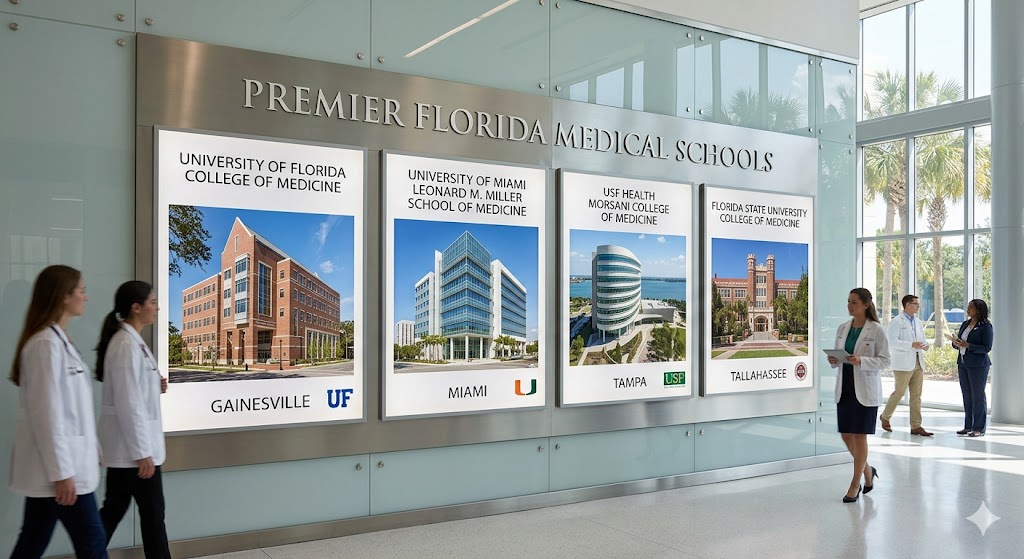
Florida’s top four medical schools — University of Miami Miller School of Medicine, University of Florida College of Medicine, University of South Florida Morsani College of Medicine, and Florida State University College of Medicine — are genuinely world-class institutions that deserve far more recognition than they typically receive in national medical education conversations.
Together, these four programs admit roughly 600+ new medical students each year, train them in some of the most diverse and challenging clinical environments in America, and graduate them into careers that will shape Florida’s healthcare future for the next 30+ years. They produce researchers contributing to global medical knowledge, primary care physicians serving Florida’s most vulnerable communities, surgeons performing some of the country’s most complex procedures, and academic leaders advancing the field.
For Florida residents pursuing medicine, the message is simple: you don’t have to leave Florida to get a world-class medical education. Match your stats, your mission, and your career vision to the right school, and you’ll join an alumni network that increasingly dominates Florida’s healthcare landscape.
For Florida patients, the message is equally important: the doctors taking care of you, your parents, and your kids over the next several decades are largely being trained at these four institutions right now. The quality of their education directly translates to the quality of your care.
Florida’s top four medical schools are quiet engines of the state’s future. They deserve recognition. They deserve support. And they deserve consideration from every Florida pre-med student who’s wondering whether they have to leave the Sunshine State to chase their medical dreams.
You don’t.
Florida’s best is right here.
Resources & Further Reading
- University of Miami Miller School of Medicine — Official website with admissions information, research programs, and clinical training details for Florida’s oldest and top-ranked private medical school.
- University of Florida College of Medicine — Official website for Florida’s flagship public medical school with information on the Gainesville and Jacksonville programs.
- USF Morsani College of Medicine — Official website for one of America’s most rapidly rising medical schools, including CORE and SELECT program details.
- Florida State University College of Medicine — Official website for FSU’s mission-driven medical school focused on primary care and underserved populations.
- U.S. News & World Report Best Medical Schools Rankings — Authoritative national rankings for research and primary care medical schools across the United States.
- Association of American Medical Colleges (AAMC) — The official national organization governing U.S. medical schools, with comprehensive resources on medical education, the MCAT, and the application process.
- AAMC Medical School Admission Requirements (MSAR) — The definitive resource for medical school admissions data, including detailed statistics on each Florida medical school.
- Florida Medical Association — Statewide physician advocacy organization with resources on Florida medical education, residency training, and the physician workforce.