April 20, 2026
If you walk into a hospital in 2026 and pay close attention, you’ll start noticing something most patients still miss: artificial intelligence is already there, working in the background, quietly changing nearly every part of how medicine gets practiced.
It’s reading the radiologist’s mammogram before the radiologist does. It’s flagging the cardiologist’s ECG abnormality before the cardiologist sees it. It’s drafting the doctor’s clinical note while the doctor is still examining the patient. It’s predicting which ICU patient will deteriorate in the next four hours. It’s screening 50 million chemical compounds for a new cancer drug in the time it used to take to screen 50. It’s answering the patient’s question at 2 AM through a chatbot trained on a million medical records.
And this is just the beginning.
According to NVIDIA’s State of AI in Healthcare and Life Sciences report and industry research from Wolters Kluwer, healthcare is entering its most transformative technological era in a century. Generative AI, large language models, foundation models, and physical AI (robotics) are converging on a single industry that has historically resisted change — and the result will reshape medicine more profoundly than any innovation since the discovery of antibiotics or the invention of the MRI.
For patients, this is mostly good news. For doctors and nurses, it’s a complicated mix of relief, threat, and opportunity. For the medical industry as a business, it’s a once-in-a-generation reset that will produce new winners, new losers, and new realities most healthcare leaders are only beginning to grasp.
Let’s break down what’s actually happening, what’s coming next, and what every patient, provider, investor, and Florida business owner should understand about the AI revolution in medicine.
Where AI in Medicine Stands Right Now (2026)
Let’s start with what’s already real — not science fiction projections, but technology in active use across U.S. hospitals today.
Diagnostic Imaging Is Being Rewritten
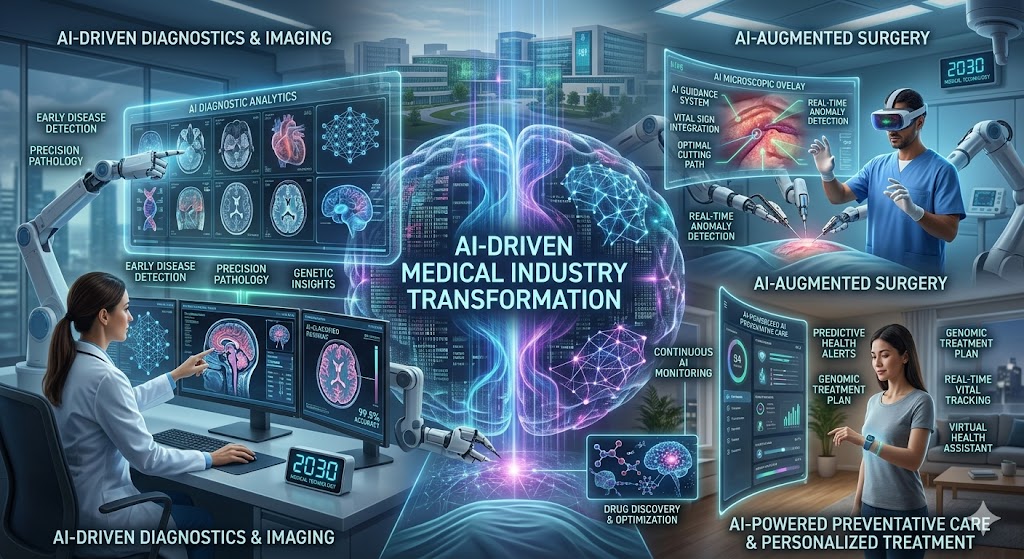
AI’s biggest current impact is in medical imaging. AI algorithms can now analyze X-rays, CT scans, MRIs, mammograms, retinal photographs, and pathology slides with accuracy that frequently matches or exceeds human specialists, particularly in detecting:
- Cancers (breast, lung, skin, colorectal, prostate)
- Cardiovascular abnormalities
- Diabetic retinopathy and macular degeneration
- Stroke and intracranial bleeding
- Bone fractures, particularly subtle ones often missed by humans
- Pulmonary embolism
- Liver disease and fatty liver progression
Google DeepMind’s research demonstrating accurate diagnosis of eye disease from retinal scans was an early breakthrough. Today, hundreds of AI-powered imaging tools are FDA-cleared and being deployed across U.S. health systems. Major Florida systems including Mayo Clinic Florida, Cleveland Clinic Florida, AdventHealth, Moffitt Cancer Center, and Tampa General Hospital are all integrating AI imaging tools into their clinical workflows.
The result for patients: diseases caught earlier, fewer false negatives, faster diagnoses, and improved outcomes.
Clinical Documentation Is Being Automated
The single most transformative current application of AI in everyday medicine isn’t dramatic — it’s the elimination of the clinical documentation burden that has been crushing American physicians for decades.
For years, doctors have spent roughly two hours on paperwork for every one hour of patient care, a major driver of physician burnout. AI scribes — most prominently products from companies like Abridge, Nuance DAX, Suki, and Augmedix — now listen to doctor-patient conversations through ambient microphones and automatically generate complete clinical notes, sometimes including diagnostic codes and treatment recommendations.
Physicians using AI scribes report:
- 50-70% reduction in documentation time
- 30%+ reduction in burnout symptoms
- Improved patient interactions (more eye contact, better listening)
- Faster note completion (often by end of visit)
- Better-quality, more comprehensive notes
This isn’t an experimental capability anymore. Major Florida health systems are deploying AI documentation tools at scale, and physicians who’ve used them generally describe the experience as professionally life-changing.
Drug Discovery Is Accelerating
Pharmaceutical research has historically been one of the slowest, most expensive endeavors in human industry — taking 10-15 years and $1-3 billion to bring a single new drug to market. AI is collapsing those timelines dramatically.
AI platforms can now:
- Screen tens of millions of chemical compounds in days rather than years
- Predict protein folding (a problem that took decades to solve traditionally) in seconds via tools like AlphaFold
- Identify promising drug candidates by analyzing vast biological databases
- Predict drug-drug interactions and adverse effects before clinical trials
- Optimize clinical trial design and patient recruitment
Companies like Recursion Pharmaceuticals, Insitro, BenevolentAI, and Insilico Medicine are pioneering AI-first drug discovery. Several AI-discovered drugs are already in human clinical trials. The first AI-discovered drug to receive FDA approval is widely expected within the next 2-3 years.
Clinical Decision Support Is Smarter Than Ever
AI is increasingly serving as a clinical co-pilot for physicians, providing real-time decision support across virtually every specialty:
- Surfacing relevant clinical evidence and guidelines from massive medical literature
- Flagging dangerous drug-drug interactions
- Suggesting differential diagnoses based on patient symptoms
- Recommending personalized treatment protocols based on patient genetics, history, and conditions
- Predicting which patients are likely to be readmitted or experience complications
- Identifying patients with care gaps who need outreach
UpToDate (the medical reference tool used by millions of clinicians worldwide) and similar platforms are increasingly integrating AI-driven recommendations directly into electronic health records.
Robotic Surgery Is Becoming Smarter
The da Vinci Surgical System has been performing AI-assisted procedures for years. New entrants like Intuitive Surgical’s da Vinci 5, Medtronic’s Hugo system, and J&J’s Ottava are bringing increasingly intelligent robotic platforms into operating rooms across America. The next generation of surgical robots will leverage physical AI — robotics powered by foundation models — to assist surgeons with tasks ranging from suture optimization to tumor margin identification to predictive complication management.
Brian’s Take: The AI Revolution in Medicine Is Quieter Than People Think — but Already Bigger Than They Realize.
Most Floridians still picture AI in medicine as some futuristic thing that’s coming someday, but if you’ve been to a major Florida hospital in the last 18 months, AI was already involved in your care whether you knew it or not — reading your imaging, drafting your physician’s notes, flagging your medication interactions, and predicting your risk of complications. The question isn’t whether AI will change medicine. It already has. The question is how fast the change accelerates over the next five years.
— Brian
What’s Coming Next: The Near-Term AI Disruption (2026-2030)
If today’s AI capabilities are impressive, the next five years are when AI starts genuinely reshaping how medicine gets practiced and delivered. Here’s what to expect.
The Personal AI Health Assistant Becomes Real
By 2028-2030, expect every American (and certainly every Floridian) to have access to a personal AI health assistant that can:
- Maintain a complete, longitudinal record of every health interaction, prescription, lab result, and clinical note
- Answer health questions 24/7 in plain language at expert clinical level
- Coordinate appointments, prescriptions, referrals, and prior authorizations
- Flag emerging health concerns before they become problems
- Translate medical jargon for the patient
- Negotiate with insurance companies on the patient’s behalf
- Track adherence to medications and treatments
- Alert family members or providers to concerning trends
For elderly Florida residents, snowbirds managing care across multiple states, busy parents juggling family healthcare, and individuals with complex chronic conditions, this single innovation will be transformative.
Generative AI Will Reshape Provider Workflows
By 2030, virtually every healthcare worker will have AI woven into their daily workflow:
- Physicians will dictate, document, and order through AI co-pilots
- Nurses will use AI for shift handoffs, care planning, and patient education
- Care coordinators will use AI to manage hundreds of patients simultaneously
- Pharmacists will use AI for medication therapy management and adherence monitoring
- Behavioral health clinicians will use AI to support therapeutic interventions
- Allied health professionals (PT, OT, RT) will use AI to personalize treatment plans
Wolters Kluwer’s 2026 healthcare AI trends research notes that “thousands of hours saved in manual work” is already documented across organizations deploying clinical-grade AI — and the impact compounds yearly.
Diagnostic AI Will Move From Specialist to Primary Care
Today’s AI diagnostic tools largely exist within specialty silos (radiology, pathology, cardiology). By 2028-2030, expect AI-powered diagnostic capabilities to be standard in primary care and even at-home settings:
- Smartphone cameras analyzing skin lesions for melanoma risk
- Smart toilets monitoring metabolic health and disease markers
- Wearables continuously screening for atrial fibrillation, sleep apnea, and early cardiac issues
- At-home AI-powered ultrasounds for prenatal monitoring
- AI-driven mental health screening built into routine primary care visits
- Voice analysis tools detecting Parkinson’s, dementia, and depression from everyday speech
The implications are enormous. Diseases will be caught earlier, when they’re more treatable. Routine screening will become continuous rather than episodic. Health disparities tied to access to specialists will narrow.
Drug Development Times Will Be Cut in Half
Within the next 5-10 years, expect AI to:
- Cut drug discovery timelines from 10-15 years to 5-7 years
- Reduce clinical trial costs by 30-50%
- Enable truly personalized medicine based on individual patient genetics
- Accelerate breakthroughs in cancer, Alzheimer’s, rare diseases, and aging-related conditions
- Drive a new wave of small-molecule and biological therapies the industry hasn’t seen since the early antibiotics era
For Florida’s significant biotech and life sciences sector — anchored by companies in Lake Nona’s medical city, Mayo Clinic Florida’s research division, the Scripps Research Institute (now part of UF Scripps), Sanford Burnham Prebys, and Moffitt Cancer Center — AI-accelerated drug discovery represents an enormous opportunity.
Surgical AI Will Reach New Capabilities
Surgical AI by 2030 will likely include:
- Real-time intraoperative imaging analysis showing surgeons what they can’t see
- AI-guided robotic procedures with semi-autonomous task completion
- Predictive complication management during surgery
- Personalized surgical planning based on the patient’s specific anatomy
- Remote surgical assistance allowing specialists to guide procedures hundreds of miles away
- Training simulators dramatically improving surgical residency education
Mental Health Care Gets a Massive Capacity Boost
Mental health is one of the areas where AI is poised to have the largest near-term impact, simply because demand vastly exceeds the supply of human providers. AI tools by 2028-2030 will:
- Provide 24/7 evidence-based therapeutic support through validated chatbots
- Triage patients to appropriate levels of human care
- Detect crisis situations and connect patients with emergency resources
- Support human therapists with session analysis and treatment recommendations
- Extend care to populations historically underserved by mental health systems
- Reduce wait times from months to days for many conditions
Brian’s Take: AI Will Save the American Healthcare System From a Workforce Crisis It Can’t Solve Any Other Way.
The U.S. is facing a projected shortage of nearly 200,000 physicians and 1 million nurses by 2030, and there’s no realistic scenario where traditional pipelines fill that gap fast enough to meet the demand of an aging population. AI isn’t just an enhancement to American medicine anymore, it’s the only mathematical path forward that prevents the system from collapsing under the weight of demographic demand. Florida, with its rapidly growing senior population, is the bellwether state for whether AI-augmented medicine can scale to meet what’s coming.
— Brian
The Long-Term Picture: AI’s Profound Reshaping of Medicine (2030-2040)
Looking out 10-15 years, AI’s impact on medicine becomes genuinely civilizational. The likely changes:
Genuine Personalized Medicine Becomes Mainstream
By 2035, expect medicine to be delivered with a degree of personalization that’s currently only available to the wealthiest patients at top academic medical centers. Every patient’s care plan will integrate:
- Complete genetic profile
- Continuous biometric monitoring
- Personal medical history with full longitudinal context
- Family medical history
- Lifestyle, environmental, and social determinants of health
- Real-time AI analysis correlating against millions of similar patients
The result: treatments and preventive care strategies tailored to the individual rather than the population average. The era of “this is what we typically prescribe for diabetes” gives way to “this is the specific approach optimized for you.”
The Hospital of 2040 Looks Dramatically Different
The hospital of 2040 will be substantially smaller in footprint but dramatically more capable. Many functions traditionally performed in hospitals will move to:
- Home-based care with AI-powered remote monitoring
- Ambulatory surgery centers with shorter recovery times
- Specialty centers of excellence for complex procedures
- Virtual care platforms for routine follow-up and chronic disease management
Inpatient hospital beds will be reserved for the most acute and complex cases. AI will handle most routine triage, monitoring, and care coordination. Robotic systems will handle pharmacy, supply chain, food service, and many environmental tasks.
Medical Specialties Will Be Restructured
Some current medical specialties will look very different by 2040:
- Radiology will shift from “reading every image” to “reviewing AI findings, handling complex edge cases, and consulting on patient management.” Demand for human radiologists may not shrink, but the work will fundamentally change.
- Pathology will undergo similar transformation as digital pathology and AI take over routine analysis.
- Primary care will be augmented by AI to handle dramatically larger panels of patients with better outcomes.
- Surgery will increasingly involve AI-augmented robotic platforms with shorter training cycles and broader procedure capabilities.
- Mental health will see massive capacity expansion through AI-augmented care.
- Geriatrics — particularly relevant for Florida — will be revolutionized by AI-powered home monitoring, medication management, and falls prevention.
Drug Costs Will Begin to Decline (Eventually)
Once AI-driven drug discovery starts producing approved medicines at scale, the historic drug-pricing trajectory may finally begin to bend downward. Lower R&D costs, faster trials, and more efficient manufacturing will reduce per-drug development costs from billions to potentially hundreds of millions. Combined with policy pressure, this could finally bring meaningful drug-cost relief — particularly for rare diseases where AI-accelerated discovery is most economically attractive.
Healthcare Becomes Genuinely Preventive Rather Than Reactive
The most profound long-term shift will be the movement of healthcare from reactive (treat after problems develop) to truly preventive (catch and address issues before they become disease). With AI continuously analyzing wearable data, environmental exposure, genetic risk, and lifestyle patterns, much of medicine in 2040 will be about preventing illness rather than treating it.
Brian’s Take: The Patients Who Win in the AI Healthcare Era Are the Ones Who Take Ownership Now.
The healthcare industry is going to integrate AI at its own pace based on regulation, reimbursement, and institutional inertia, but individuals who proactively use AI tools to manage their own health, understand their conditions, advocate during clinical encounters, and coordinate their care will outperform patients who wait for the system to catch up. Every Floridian — particularly those managing chronic conditions, caring for aging parents, or navigating complex healthcare situations — should be experimenting with AI health tools right now to build the personal habits that will define healthcare literacy for the next decade.
— Brian
The Real Risks and Challenges of AI in Medicine
A balanced view of AI in healthcare requires acknowledging real risks alongside the opportunities. The medical industry’s AI revolution is not without serious challenges.
Algorithmic Bias and Health Equity
AI systems trained on biased data can perpetuate and amplify health disparities. Studies have repeatedly shown that medical AI tools can underperform on Black patients, women, and other historically underrepresented populations. Addressing this requires:
- Diverse training datasets
- Transparent algorithm validation
- Ongoing performance monitoring across demographic groups
- Regulatory oversight focused on equity
- Provider training in AI limitations
Privacy, Security, and Data Governance
AI systems require massive amounts of patient data. Protecting that data while enabling AI to provide value requires robust governance frameworks, HIPAA-compliant infrastructure, advanced cybersecurity, and clear consent processes. Healthcare cybersecurity threats are increasing rapidly, and AI introduces new attack surfaces. Florida health systems have been hit by significant ransomware events in recent years, and AI systems represent both a tool against and a target of cyber threats.
Regulatory Lag
The FDA, CMS, and state regulators are working hard to keep pace with AI in healthcare, but regulation inevitably lags innovation. Questions about which AI tools require FDA clearance, how reimbursement works for AI-driven services, who’s liable when an AI makes a mistake, and how to maintain quality across thousands of AI systems remain partially unresolved.
Liability and Medical Malpractice
Who’s responsible when an AI tool contributes to a missed diagnosis or adverse event — the developer, the hospital, the physician, the AI itself? Legal frameworks are still being developed. Florida medical malpractice law will need to evolve to address AI-specific scenarios.
The Risk of Over-Reliance
Physicians and nurses who become too dependent on AI tools may lose critical clinical judgment skills over time. Maintaining human expertise alongside AI augmentation is a significant educational and operational challenge.
Workforce Displacement
While AI is more likely to augment than replace most healthcare workers, certain administrative roles, basic radiology screening positions, and some allied health functions will see significant disruption. Workforce transition planning is essential.
Hallucinations and Errors
Generative AI in particular has well-documented problems with “hallucinations” — confidently stating incorrect information. In clinical settings, hallucinations can lead to medical errors. Wolters Kluwer notes that “monitoring the quality of AI-generated responses should always fall on trusted, human expertise” — a principle that must guide every AI deployment in medicine.
Cost and Implementation Challenges
Deploying AI at scale across health systems requires significant investment in infrastructure, data integration, training, and change management. Smaller hospitals, rural facilities, and Federally Qualified Health Centers risk being left behind without targeted support.
What This Means for Florida’s Medical Industry
Florida is uniquely positioned to be both a beneficiary and a proving ground for AI in medicine. Several factors converge:
- Aging population. Florida has one of the oldest populations in America, and AI’s most profound clinical applications often benefit older adults — chronic disease management, falls prevention, medication management, dementia care, and home-based care.
- Major academic medical centers. Mayo Clinic Florida, UF Health, USF Health, University of Miami Health System, and others are deeply engaged in AI research and deployment.
- Significant private investment. Lake Nona’s medical city, growing biotech ecosystems in Tampa Bay and South Florida, and aggressive private capital deployment create a fertile environment.
- Tourism and seasonal medical demand. Florida sees massive seasonal population variation, creating unique demands for scalable, AI-augmented care delivery.
- High-acuity tertiary referral patterns. Top systems like Cleveland Clinic Florida, Mayo Clinic Florida, AdventHealth, Moffitt Cancer Center, and others draw complex cases from across the southeastern U.S., providing data and learning opportunities at scale.
- Regulatory and tax environment. Florida’s business-friendly climate and lack of state income tax attract AI healthcare startups and talent.
For Florida business owners — particularly in healthcare, B2B services to healthcare, and medical technology — the AI healthcare revolution represents an enormous opportunity over the next decade.
What Patients Should Do Right Now
If you’re a Floridian wondering how to navigate this transition personally, here are practical steps:
- Start using AI health tools. Learn ChatGPT, Claude, Perplexity, and specialized health AI tools to research conditions, understand medications, and prepare for medical appointments.
- Maintain your own health records. Use patient portals from your providers and consider a personal health record system.
- Be an advocate in clinical encounters. Bring questions, take notes, and don’t be afraid to ask whether AI tools were used in your care.
- Leverage wearables intelligently. Apple Watch, Fitbit, Oura, Whoop, and continuous glucose monitors can provide AI-powered insights into your health.
- Stay informed. Healthcare AI is evolving fast. Following sources like STAT News, Becker’s Hospital Review, and HIMSS publications helps you stay current.
- Demand transparency. When AI is involved in your care, ask how it works, what its limitations are, and how decisions are being made.
The Bottom Line: Medicine Will Never Be the Same
The medical industry has entered the most consequential technological transformation in its history. AI is not coming to healthcare. AI is here. The only question is how fast it scales, how effectively the industry manages the transition, and who benefits the most from the change.
For patients, AI offers the promise of better, faster, more accurate, and more personalized care than any prior generation has experienced. For providers, AI offers liberation from documentation burdens, decision support, and the ability to manage larger panels with better outcomes. For the medical industry as a business, AI represents both an existential challenge and the largest growth opportunity of the next 30 years.
For Florida specifically — with its aging population, robust academic medical centers, growing biotech sector, and unique demographic dynamics — the AI healthcare revolution will reshape the state’s largest industry over the next decade. The systems and operators that move thoughtfully and aggressively now will dominate Florida healthcare for the rest of the century.
The cranes are rising. The algorithms are learning. The data is flowing. The robots are training. The drugs are being discovered. The diagnoses are being made.
Medicine in 2040 will look almost unrecognizable compared to medicine in 2020. AI is the engine of that transformation.
For better or worse — and overwhelmingly for better, if managed wisely — the doctor of the future is already at work. They just happen to be partially silicon, deeply trained on every medical paper ever published, and quietly making your healthcare smarter every single day.
The revolution isn’t coming.
It’s already here.
Resources & Further Reading
- Wolters Kluwer: 2026 Healthcare AI Trends — Industry-leading insights on generative AI, governance frameworks, and clinical workflow transformation.
- NVIDIA State of AI in Healthcare and Life Sciences Report — Comprehensive industry data on AI adoption rates, use cases, and investment patterns across healthcare.
- Foresee Medical: Artificial Intelligence in Healthcare — Practitioner-focused resource on AI applications in clinical practice and risk adjustment.
- Becker’s Hospital Review: Healthcare AI Coverage — Industry-leading publication tracking AI adoption across U.S. hospitals and health systems.
- National Library of Medicine: AI in Medicine Research — Peer-reviewed scholarly research on the current status and future of AI in medicine.
- STAT News Health Tech — Independent journalism on the intersection of healthcare, AI, and life sciences innovation.
Disclaimer
This article is provided for general informational and educational purposes only. It reflects publicly available reporting and industry trends as of 2026 and does not constitute medical, legal, financial, or professional advice. Florida Medical News and its contributors make no representations or warranties regarding the accuracy, completeness, or reliability of any information presented herein.
References to specific technologies, vendors, studies, regulations, or organizations are intended for illustrative purposes only and should not be interpreted as endorsements. The healthcare and artificial intelligence landscape is evolving rapidly; readers should independently verify current facts, regulatory requirements, and clinical guidance with qualified professionals before making any decisions based on the content of this article.
Forward-looking statements about the future of AI in medicine are speculative and subject to change. Nothing in this article is intended to replace consultation with a licensed physician, attorney, compliance officer, or other qualified expert. Any reliance you place on this information is strictly at your own risk.