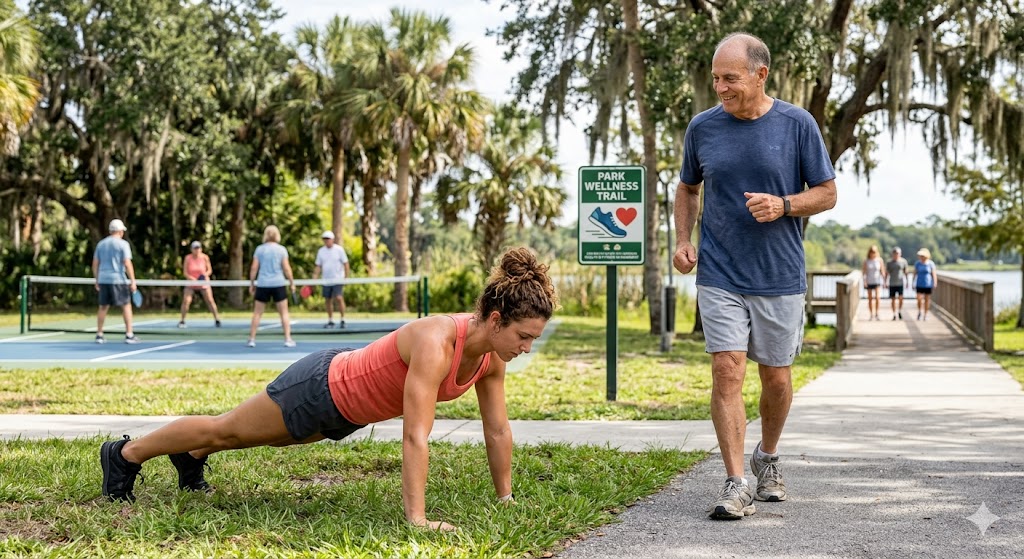
If you spend any time in Florida’s gyms, beaches, parks, pickleball courts, golf courses, or wellness studios, you’ll quickly notice something interesting: the people who look the fittest aren’t always the people who are the healthiest.
That muscular guy bench-pressing 315 pounds at the Brickell gym may have alarming cholesterol levels and the worst sleep habits of anyone in the room. The triathlete grinding out 100-mile training weeks in Naples may be one stress fracture and a bout of overtraining away from a major health crash. The yoga instructor with the perfect Instagram body in Miami Beach may be running on caffeine, four hours of sleep, and an undiagnosed thyroid problem. The marathon runner in Tampa may have heart calcification levels worse than sedentary people the same age.
Meanwhile, your seemingly average neighbor — who walks every morning, sleeps eight hours, eats real food, has solid relationships, manages stress well, sees the doctor regularly, and lifts weights twice a week without ever posting about it — may be in dramatically better overall health than the influencers, athletes, and gym warriors who look more impressive on the surface.
This is one of the most important and least understood truths in modern wellness culture: physical fitness and good health are not the same thing.
They overlap. They support each other. They often coexist. But they are genuinely different concepts, and the failure to understand the distinction leads many Floridians — and many Americans — to optimize for one while neglecting the other, sometimes with serious consequences.
This article unpacks what physical fitness really means, what good health really means, where the two diverge, and how Floridians can pursue both intelligently rather than confusing one for the other.
This is informational and not medical advice. Always consult with a board-certified physician for personalized health guidance.
Defining Physical Fitness
Physical fitness is the capacity to perform physical work. It’s a measurable, somewhat narrow construct that describes how well your body performs specific tasks. Exercise scientists generally break physical fitness into several distinct components:
- Cardiovascular endurance. How long your heart, lungs, and circulatory system can sustain aerobic effort.
- Muscular strength. How much force your muscles can produce in a single effort.
- Muscular endurance. How long your muscles can sustain repeated effort.
- Flexibility. Range of motion at your joints.
- Body composition. Ratio of lean muscle mass to body fat.
- Balance and coordination. Stability and movement control.
- Power. Ability to generate force quickly.
- Speed. Ability to move quickly.
- Agility. Ability to change direction and respond rapidly.
- Reaction time. Speed of neuromuscular response to stimuli.
Physical fitness is specific to what you train for. A marathon runner has elite cardiovascular endurance but may have minimal strength. A powerlifter has elite strength but may have poor cardiovascular capacity. A gymnast has remarkable flexibility, balance, and power but may struggle with sustained endurance. A yoga master has tremendous flexibility but may have limited cardiovascular fitness.
You can be exceptionally fit in some categories and quite unfit in others. There’s no single “fitness” — there are many fitnesses.
How Fitness Is Measured
Physical fitness is measured through specific, often objective tests:
- VO2 max for cardiovascular fitness
- One-rep max for maximum strength
- Heart rate variability and recovery for cardiovascular fitness
- Body fat percentage for body composition
- Sit-and-reach test for flexibility
- Push-up, pull-up, and plank tests for muscular endurance
- Mile run, 5K, marathon times for endurance performance
- Vertical jump and broad jump for power
- 40-yard dash and shuttle runs for speed and agility
A person scoring well on these tests is, by definition, “fit.” But that says nothing about whether they’re actually healthy.
Defining Good Health
Good health is a much broader, more holistic concept. The World Health Organization defines health as “a state of complete physical, mental and social well-being and not merely the absence of disease or infirmity.” That definition has held up for nearly 80 years for good reason.
Good health includes:
- Cardiovascular health. Healthy heart function, blood pressure, cholesterol, and circulation.
- Metabolic health. Healthy blood sugar, insulin sensitivity, hormone balance, and body composition.
- Cognitive health. Memory, focus, processing speed, and brain function.
- Mental and emotional health. Mood stability, stress resilience, ability to experience joy and meaning.
- Sleep health. Adequate quantity and quality of restorative sleep.
- Digestive health. Functional gut, healthy microbiome, regular digestion.
- Immune health. Effective immune response without excessive inflammation.
- Hormonal health. Balanced thyroid, adrenal, sex hormones, and metabolic hormones.
- Musculoskeletal health. Joint health, bone density, posture, and movement quality.
- Social health. Quality relationships, community connection, sense of belonging.
- Sexual health. Healthy function, intimacy, and well-being.
- Spiritual or existential health. Sense of meaning, purpose, and connection to something larger than oneself.
- Environmental health. Living and working in environments that support rather than degrade well-being.
- Financial health. Stability that doesn’t generate chronic stress.
- Preventive care. Regular medical care, screenings, and early intervention.
Good health is far broader than physical capacity. A person can be objectively fit yet objectively unhealthy in critical ways. A person can be modestly fit but extraordinarily healthy across multiple dimensions.
How Health Is Measured
Health is harder to measure than fitness because it spans so many dimensions. Common health markers include:
- Blood pressure
- Cholesterol panel (HDL, LDL, triglycerides, ApoB)
- Blood sugar and HbA1c
- Inflammatory markers (CRP, etc.)
- Hormone levels (thyroid, sex hormones, cortisol)
- Vitamin and mineral status
- Body composition and visceral fat
- Sleep quantity and quality
- Mental health screening scores
- Cognitive function tests
- Cancer screenings
- Cardiovascular imaging (CAC scores, etc.)
- Bone density scans
- Functional movement assessments
- Patient-reported quality of life measures
A truly healthy person scores well across multiple dimensions — not just one or two impressive fitness numbers.
Brian’s Take: Many People in Florida Are Optimizing for the Wrong Metric.
The Florida wellness culture has gotten incredibly good at selling people on the appearance of fitness — visible abs, impressive lifts, dramatic before-and-after photos — while quietly underselling the broader, messier, less Instagrammable work of being genuinely healthy. The smartest people I know in Florida have made a deliberate shift from chasing fitness aesthetics to building actual health, and the difference shows up in their energy, their longevity, and their quality of life in their 60s, 70s, and 80s in ways that the people chasing six-pack abs in their 40s rarely achieve.
— Brian
Where Fitness and Health Genuinely Overlap
Before we get into where they diverge, let’s acknowledge where physical fitness and good health genuinely reinforce each other. The overlap is significant:
- Cardiovascular fitness directly supports cardiovascular health. A strong heart and efficient circulatory system reduce risk of heart disease, stroke, and many other conditions.
- Strength training supports bone density, joint health, metabolic health, and longevity. This is one of the most universally beneficial health interventions available.
- Regular movement supports mental health, cognitive function, mood, and sleep.
- Maintaining a healthy body composition supports metabolic health and reduces disease risk.
- Functional movement quality supports independence and reduces fall risk in older adults.
- Aerobic fitness is associated with longer life expectancy — VO2 max is one of the strongest predictors of all-cause mortality.
- Strength is one of the strongest predictors of healthy aging. Grip strength, leg strength, and overall muscular fitness correlate strongly with longevity and quality of life.
So fitness genuinely helps health in many ways. The problem isn’t pursuing fitness. The problem is mistaking fitness for the entire picture of health — and either neglecting other dimensions or actively damaging health in pursuit of fitness aesthetics or performance.
Where Fitness and Health Genuinely Diverge
Here’s where the conversation gets uncomfortable. There are several specific ways physical fitness and good health can diverge — sometimes dramatically.
Divergence #1: Extreme Endurance Athletes Can Damage Cardiovascular Health
This sounds counterintuitive, but the research is increasingly clear. Excessive endurance training — particularly multi-decade ultra-endurance careers — has been associated with:
- Coronary artery calcification at higher rates than sedentary controls in some studies of long-term marathon runners
- Atrial fibrillation at significantly higher rates than the general population in endurance athletes
- Right ventricular dysfunction in some athletes after extreme events
- Cardiac fibrosis in ultra-endurance veterans
Moderate endurance exercise is profoundly health-promoting. Chronic excessive endurance training pushes into territory where the cardiovascular benefits begin to plateau and, in some cases, reverse.
The Florida triathlete crushing 20-hour training weeks for decades may be objectively more fit than their neighbors but not necessarily more cardiovascularly healthy.
Divergence #2: Bodybuilders and Aesthetic Athletes Often Damage Metabolic Health
The pursuit of visible muscularity, single-digit body fat, and stage-ready aesthetics often involves:
- Severe caloric restriction during cutting phases
- Extreme dehydration before competitions
- Performance-enhancing drug use (in many cases)
- Disordered eating patterns that persist long after competition
- Hormonal disruption from aggressive cycling
- Joint damage from heavy lifting without adequate recovery
- Mental health strain from body image preoccupation
The Florida bodybuilder with the perfect physique may be one of the least healthy people in their gym across multiple dimensions.
Divergence #3: Fit People Can Have Terrible Sleep
Many serious athletes — particularly those balancing training with demanding careers and family life — chronically underslept. They optimize for training and performance while compromising the recovery that actually drives both.
Sleep is so fundamental to health that chronic insufficient sleep undermines virtually every health marker. A fit person with chronic six-hour nights is genuinely less healthy than an unfit person with consistent eight-hour nights.
Divergence #4: Fit People Can Have Terrible Stress Management
The Type A executive who pounds out brutal CrossFit workouts at 5 AM, then spends 12 hours in high-stress meetings, then crashes into bed exhausted at 11 PM may look fit but is operating in a chronic stress state that elevates cortisol, suppresses immune function, accelerates aging, and increases disease risk.
Exercise can amplify stress when not balanced with adequate recovery and stress management. Fitness without stress management can drive worse health outcomes than moderate fitness with great stress management.
Divergence #5: Fit People Can Have Terrible Diets
This one is more common than people realize. Many fit people — particularly those focused on training volume — eat enormous quantities of low-quality processed food because they “earned it” with workouts. The relationship between exercise and diet quality is nowhere near as strong as people assume.
A relatively unfit person eating mostly real, whole foods may have dramatically better metabolic health than a fit person living on protein bars, energy gels, and post-workout fast food.
Divergence #6: Fit People Can Have Terrible Mental Health
Eating disorders, body dysmorphia, exercise addiction, and obsessive performance focus are surprisingly common in highly fit populations. The pursuit of fitness can become a vehicle for psychological distress rather than a contributor to genuine well-being.
A study after study has shown that obligatory exercise — exercise driven by compulsion rather than enjoyment — is associated with worse mental health outcomes despite often producing impressive physical results.
Divergence #7: Fit People Can Have Terrible Hormones
Female athletes in particular face well-documented risks from over-training and under-fueling, including the Female Athlete Triad (energy deficiency, menstrual dysfunction, and bone density loss). Male athletes can experience similar issues with testosterone suppression, thyroid dysfunction, and adrenal disruption.
A fit person with disrupted hormones is, in critical ways, not healthy — even if their performance numbers look impressive.
Divergence #8: Fitness Numbers Can Mask Underlying Disease
A fit person with impressive performance numbers may have undiagnosed conditions — silent cardiovascular disease, early cancer, hormonal disorders, autoimmune conditions — that fitness doesn’t reveal. Some athletes have discovered serious diseases only after a sudden cardiac event during competition.
Fitness performance is not a substitute for actual medical evaluation.
Brian’s Take: The Healthiest People I Know in Florida Aren’t the Most Impressive in the Gym — They’re the Most Boring.
The Floridians I know who are aging best — vibrant in their 70s and 80s, mentally sharp, energetic, surrounded by relationships, free of chronic disease — almost universally followed unsexy boring strategies for decades: they slept well, lifted moderate weights, walked a lot, ate real food, managed stress, maintained relationships, saw their doctors, and never tried to prove anything athletically beyond what their bodies could comfortably handle. None of them ever crushed a marathon PR or squatted 500 pounds. All of them are healthier today than the impressive athletes who burned out two decades ago.
— Brian
What Truly Healthy People Actually Do
If we observe Floridians who are aging extraordinarily well — vibrant into their 70s, 80s, and 90s with low disease burden, high energy, mental sharpness, and quality of life — patterns emerge that are quite different from the “fitness influencer” template.
Truly healthy Florida residents tend to:
- Sleep 7-9 hours nightly as a non-negotiable priority
- Move regularly throughout the day — walking, gardening, light activity — rather than just intense gym sessions
- Strength train 2-3 times weekly at moderate intensities they can sustain for decades
- Engage in aerobic activity they actually enjoy — walking, cycling, swimming, tennis, pickleball, golf with walking
- Eat mostly real, whole foods — vegetables, fruits, fish, lean proteins, healthy fats, fewer processed foods
- Maintain consistent meal patterns without extreme dieting cycles
- Stay hydrated
- Get sun exposure responsibly — Vitamin D synthesis with appropriate skin protection
- Maintain rich social connections and engaged relationships
- Have a sense of purpose — work, volunteering, family roles, or other meaningful engagement
- Practice some form of stress management — meditation, prayer, time in nature, hobbies
- Limit alcohol significantly
- Avoid smoking entirely
- Get regular preventive medical care — screenings, lab work, age-appropriate evaluations
- Maintain financial stability that doesn’t generate chronic stress
- Stay engaged with novel learning — new skills, books, experiences
- Get hearing checked and corrected if needed (significant dementia risk factor)
- Manage chronic conditions proactively when they arise
- Maintain adequate protein intake, particularly as they age, to preserve muscle mass
- Get outside daily — sunlight, fresh air, time in natural settings
Notice what’s not on this list: extreme training, single-digit body fat, marathon performances, or impressive social media-worthy fitness achievements. The healthy people are doing things almost everyone could do — they just do them consistently for decades.
The Florida Context: Why This Matters Even More Here
Florida’s unique demographics, climate, and culture make the fitness-vs-health distinction especially important. Several Florida-specific factors:
- Aging population. With more than 4.5 million Florida residents over age 65, the question “what supports a long, healthy life?” matters more here than almost anywhere.
- Active senior culture. Florida communities like The Villages, Sun City, Naples, Sarasota, and dozens of others foster active senior lifestyles. The line between healthy activity and overdoing it deserves attention.
- Beach and resort culture. Visible aesthetics matter to many Floridians. The pressure to optimize for appearance over actual health is real.
- Climate-enabled year-round activity. Florida allows essentially endless training opportunities, which can be both wonderful (more activity) and risky (more overtraining).
- High-end wellness market. Florida’s wealthy retirement and active populations support an enormous wellness industry that often emphasizes performance and aesthetics over long-term health.
- Sun exposure realities. Florida’s intense UV environment requires thoughtful balance between sun benefits and damage.
- Heat and hydration management. Pursuing fitness in Florida heat without smart hydration and recovery practices can damage health.
- Alcohol culture. Florida’s social and tourist culture often involves heavy alcohol use, which dramatically undermines health regardless of fitness.
For Florida residents, the goal isn’t choosing between fitness and health — it’s pursuing fitness as one component of comprehensive health, while explicitly prioritizing the broader dimensions that fitness alone cannot address.
Brian’s Take: The Smart Florida Approach Is Building Lifelong Health, Not Chasing Short-Term Fitness Performance.
The Florida residents I see thriving in their 70s and 80s built health for the long haul, while the ones I see burning out before 60 chased short-term fitness performance at the expense of everything else. If you’re going to invest in your physical well-being for the next 30 years of Florida living, build a sustainable foundation of sleep, real food, moderate consistent exercise, social connection, stress management, and quality medical care — and let fitness be one part of that foundation rather than the entire structure.
— Brian
Practical Guidance for Florida Residents
Here’s a practical framework for thinking about the fitness-vs-health distinction:
- Audit your priorities honestly. Are you optimizing for appearance, performance, or health? They’re different goals requiring different approaches.
- Get baseline health markers. Annual physical, comprehensive blood panels, blood pressure tracking, body composition, sleep quality assessment. You can’t improve what you don’t measure.
- Sleep first. If you’re chronically under-slept, no amount of fitness can compensate. Sleep is the foundation everything else builds on.
- Eat real food consistently. The quality of your nutrition matters more than the volume of your training.
- Strength train moderately for life. Two to three sessions per week, sustainable intensities, focus on movement quality and progressive consistency over decades.
- Walk daily. Walking is one of the most underrated health interventions available. Aim for substantial daily walking.
- Add aerobic work you enjoy. Cycling, swimming, hiking, pickleball, tennis, dancing — find something sustainable.
- Don’t overdo it. Chronic excessive training is a common path to fitness without health. Moderate consistency beats extreme intensity over time.
- Manage stress actively. Meditation, prayer, time in nature, hobbies, relationships — find what works and prioritize it.
- Maintain relationships intensely. Social connection is one of the strongest predictors of long-term health and longevity.
- Limit alcohol seriously. Even moderate drinking has worse health effects than the wellness industry once suggested.
- Get preventive care consistently. Annual physicals, age-appropriate screenings, dental care, eye exams, hearing tests, dermatology checks (essential in Florida).
- Address mental health proactively. Depression, anxiety, and chronic stress damage physical health as much as poor diet or insufficient exercise.
- Stay engaged with purpose and learning. Cognitive and emotional engagement support physical health more than most people realize.
- Don’t let fitness become an obsession. If your training is making you anxious, depressed, isolated, or compulsive, the fitness is no longer serving health.
The Bottom Line: Fitness Serves Health, Not the Other Way Around
Physical fitness is a wonderful thing. It supports independence, longevity, energy, mood, cognition, and quality of life. Pursuing fitness throughout your Florida years is one of the best investments you can make in your future self.
But fitness is a component of health, not a substitute for it. The fittest person in your gym may not be the healthiest. The most impressive athlete in your community may be one stress fracture or sudden cardiac event away from a major decline. The wellness influencer with the perfect Instagram aesthetic may be quietly suffering from sleep deprivation, hormonal disruption, disordered eating, or mental health struggles their followers never see.
Real health is broader, messier, harder to photograph, and dramatically more rewarding over the long haul.
For Florida residents, the wisest path is to pursue fitness as one important part of comprehensive health — alongside sleep, nutrition, social connection, stress management, mental health, preventive medical care, and engagement with meaning and purpose. The fittest person isn’t always the healthiest. But the genuinely healthy person — who has built a sustainable life of moderate fitness, quality sleep, real food, deep relationships, managed stress, regular medical care, and engaged purpose — almost always lives a longer, better, more vibrant life than the fitness obsessive who burned out at 50.
Florida is one of the best places in the world to build a lifetime of genuine health. The climate supports activity. The healthcare infrastructure supports prevention. The community supports connection. The lifestyle supports outdoor engagement. The opportunities are unmatched.
Use them wisely. Pursue fitness with intention. But never confuse fitness with health — they’re not the same thing, and the difference will determine the quality of the next 30 years of your life.
The most impressive thing you can be at 80 isn’t ripped. It’s vibrantly, fully, completely alive.
Build for that.
Disclaimer
The information presented in this article is for general educational and informational purposes only and is not intended as medical advice. The content does not establish a doctor-patient relationship and should not be used as a substitute for professional medical evaluation, diagnosis, or treatment. Individual health needs vary significantly, and any decisions regarding exercise programs, nutritional changes, supplementation, medical screening, or treatment of any condition should be made in consultation with a board-certified physician or other qualified healthcare provider familiar with your personal medical history, current health status, medications, and individual circumstances. Statements made in this article reflect general information drawn from publicly available sources and should not be interpreted as recommendations for any specific individual. The author and publisher disclaim any liability for adverse effects resulting from the use, application, or interpretation of the information contained herein. Always consult your physician before starting a new exercise program, changing your diet, beginning supplementation, or making other significant changes to your health practices, particularly if you have any pre-existing health conditions, are taking medications, are pregnant or nursing, or are an older adult.
Resources & Further Reading
- American College of Sports Medicine (ACSM) — The leading professional organization for sports medicine and exercise science, providing evidence-based guidance on exercise prescription, fitness assessment, and health applications.
- Centers for Disease Control and Prevention: Physical Activity Guidelines — Authoritative federal guidance on physical activity for health across all age groups, including specific recommendations for older adults.
- World Health Organization: Physical Activity and Health — Global health authority’s resources on the relationship between physical activity, fitness, and overall health.
- National Institutes of Health: Health Information — Comprehensive federal medical and health information resource covering preventive medicine, chronic disease management, and lifestyle factors.
- Mayo Clinic: Healthy Lifestyle — One of the most respected medical institutions in America providing evidence-based guidance on the broader dimensions of healthy living.
- Harvard T.H. Chan School of Public Health: The Nutrition Source — Leading academic public health resource on nutrition, lifestyle, and longevity research.
- National Sleep Foundation — Authoritative resource on sleep health, one of the most underappreciated dimensions of overall well-being.