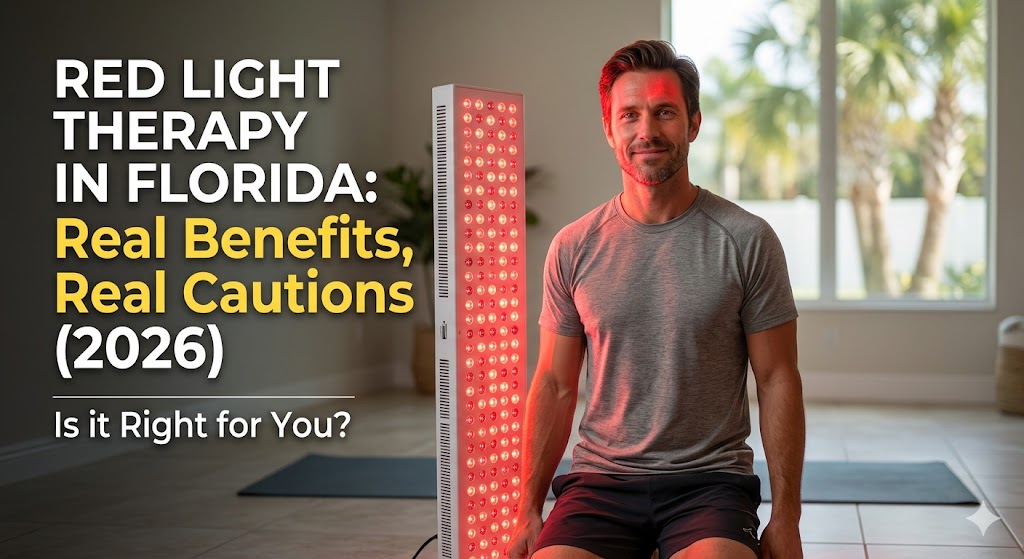
Red Light Therapy in Florida: The Real Benefits, the Real Cautions, and What Every Floridian Should Know in 2026
Walk through any Florida wellness center, gym, longevity clinic, med spa, dermatology office, physical therapy practice, or chiropractic office in 2026, and you’re likely to see one of the fastest-growing wellness modalities in the state: red light therapy.
Often marketed under names like photobiomodulation (PBM), low-level light therapy (LLLT), infrared therapy, red light therapy beds, or specific brand names like Joovv, Mito Red Light, BioMax, NovoTHOR, and dozens of others — red light therapy has exploded across Florida from a niche biohacking experiment into a mainstream wellness category. Standalone red light therapy studios are opening at remarkable pace from Naples to Jacksonville, Miami to Pensacola, and everywhere in between.
The promises are seductive. Better skin. Reduced wrinkles. Faster muscle recovery. Improved mood. Better sleep. Hair regrowth. Joint pain relief. Wound healing acceleration. Anti-aging. Cellular rejuvenation. And it’s all delivered without drugs, surgery, or invasive procedures — you simply stand in front of a panel or lie on a bed of red and near-infrared lights for 10-20 minutes.
But how much of this is real, evidence-based science, and how much is wellness marketing wrapped around legitimate but limited research? What does red light therapy actually do? When is it genuinely useful? When is it overhyped? What are the real risks? And how should Floridians — particularly those already exposed to extreme natural sunlight — approach this rapidly growing technology?
This is the comprehensive 2026 guide to red light therapy in Florida — what works, what doesn’t, what to be cautious about, and how to use this technology wisely.
This is informational and not medical advice. Always consult with a board-certified physician before starting any new therapy, particularly if you have underlying medical conditions.
What Red Light Therapy Actually Is
Red light therapy uses specific wavelengths of red light (typically 630-700 nanometers) and near-infrared light (typically 700-1100 nanometers) to penetrate the skin and underlying tissues. Unlike UV light (which damages skin and causes cancer), these wavelengths are non-ionizing and don’t damage DNA.
The proposed mechanism — supported by decades of research — is that red and near-infrared light is absorbed by mitochondria (the cellular structures that produce energy). When mitochondria absorb these wavelengths, they appear to:
- Increase production of adenosine triphosphate (ATP) — cellular energy
- Reduce oxidative stress
- Modulate inflammation
- Improve cellular signaling and repair processes
- Stimulate collagen and elastin production in skin
- Support circulation and microvascular function
This biological process is called photobiomodulation, and it’s been studied in thousands of peer-reviewed papers over more than 50 years. Originally developed by NASA for astronaut wound healing and plant growth experiments, photobiomodulation has been used in clinical medicine for decades — including FDA-cleared devices for specific medical conditions.
What’s relatively new is the consumer market explosion of red light therapy panels, beds, masks, wraps, and devices that allow people to access photobiomodulation outside of medical settings. The technology has become more affordable, more accessible, and more aggressively marketed.
In Florida, you’ll find red light therapy at:
- Standalone red light therapy studios (often franchise concepts)
- Med spas and aesthetic medicine practices
- Dermatology and skin clinics
- Chiropractic offices
- Physical therapy and sports medicine practices
- Longevity and functional medicine clinics
- Gyms and wellness centers
- Some salons and beauty studios
- Home device sales (Joovv, Mito Red Light, BioMax, and others)
The Real Benefits: What Evidence Actually Supports
Let’s start with where the science is genuinely strong. There are several conditions where red light therapy has accumulated meaningful evidence supporting real benefits.
Benefit #1: Skin Health and Anti-Aging
This is one of the most well-documented applications of red light therapy. Multiple peer-reviewed studies have demonstrated that red and near-infrared light therapy can:
- Stimulate collagen production in dermal fibroblasts
- Reduce the appearance of fine lines and wrinkles
- Improve skin texture and tone
- Reduce age spots and hyperpigmentation (with appropriate wavelengths)
- Help heal acne and reduce post-acne scarring
- Reduce redness and inflammation
- Speed wound healing
For Florida residents — many of whom have decades of cumulative sun damage — red light therapy offers a non-invasive way to support skin recovery and rejuvenation. Dermatologists across the state increasingly incorporate medical-grade red light therapy into treatment protocols for sun-damaged skin, post-procedural recovery, and general skin health.
Benefit #2: Hair Growth (Specifically Androgenetic Alopecia)
Red light therapy — particularly at specific wavelengths around 650nm — has FDA clearance for treating androgenetic alopecia (male and female pattern hair loss). Multiple clinical trials have shown:
- Increased hair count and density
- Improved hair thickness
- Slowed hair loss progression
- Better outcomes when combined with other treatments (minoxidil, finasteride, etc.)
While not a miracle cure, red light therapy is one of the few hair loss interventions with genuine FDA clearance and supporting clinical evidence.
Benefit #3: Pain Reduction and Inflammation
Red and near-infrared light therapy has accumulated substantial evidence for treating:
- Joint pain, including knee osteoarthritis
- Lower back pain
- Muscle soreness and DOMS (delayed onset muscle soreness)
- Tendinopathies
- Inflammatory conditions
The NovoTHOR whole-body photobiomodulation device, used in many Florida sports medicine and physical therapy clinics, has FDA-cleared indications for muscle and joint pain relief. Multiple studies support photobiomodulation as a non-pharmaceutical pain management option.
For Florida’s enormous population of active seniors, athletes, and chronic pain sufferers, red light therapy offers a meaningful tool for pain management without medication.
Benefit #4: Wound Healing
Some of the strongest evidence for red light therapy comes from its long history in wound care. Photobiomodulation has been studied and used for:
- Diabetic ulcers
- Pressure injuries
- Surgical wound healing
- Burns
- Radiation-induced wounds
- Oral mucositis (in cancer patients)
The wound healing applications are well-established enough that photobiomodulation is increasingly used in mainstream hospital settings.
Benefit #5: Sports Performance and Recovery
For Florida’s massive athletic community — pro athletes, collegiate athletes, weekend warriors, golfers, tennis players, runners, triathletes — red light therapy has become one of the most popular recovery modalities. Research supports:
- Reduced muscle soreness post-exercise
- Faster recovery between training sessions
- Improved muscle performance with pre-exercise application
- Reduced exercise-induced inflammation
Major athletic facilities, sports medicine practices, and elite training programs across Florida have integrated red light therapy into recovery protocols. NovoTHOR beds in particular have become standard in many high-end sports performance facilities.
Benefit #6: Mood, Sleep, and Cognitive Function
This is an emerging area with growing but still limited evidence. Some research suggests red and near-infrared light therapy may:
- Support circadian rhythm regulation
- Improve sleep quality
- Reduce symptoms of seasonal affective disorder (SAD)
- Provide modest mood enhancement
- Potentially support cognitive function (with transcranial photobiomodulation)
The research is most promising for sleep and mood, though stronger evidence is needed before red light therapy can be confidently recommended as a treatment for clinical depression, anxiety, or cognitive disorders.
Benefit #7: Hashimoto’s and Thyroid Function
Several studies — including some prominent recent research — have suggested red light therapy applied to the front of the neck may improve thyroid function in patients with Hashimoto’s thyroiditis (autoimmune hypothyroidism). This emerging research is provocative but still requires more replication before it becomes standard care.
Brian’s Take: Red Light Therapy Has More Real Science Behind It Than Most Florida Patients Realize — and Less Than the Marketing Claims.
Red light therapy occupies a strange space in the wellness world where the legitimate evidence is genuinely impressive in specific applications — skin health, pain reduction, wound healing, athletic recovery — but the marketing has expanded those legitimate uses into a long list of overpromises that the research doesn’t fully support. The smart Florida consumer learns which applications have real evidence, uses red light therapy strategically for those, and treats the broader claims with appropriate skepticism. That’s how you get the real benefits without falling for the hype.
— Brian
The Cautions: What Florida Patients Need to Honestly Consider
Now the harder conversation. Despite the legitimate science, red light therapy comes with real limitations, real risks, and real reasons for caution — particularly in Florida’s unique context.
Caution #1: Not All Red Light Therapy Is Created Equal
The single biggest issue in the red light therapy industry is the massive variability in device quality, wavelength accuracy, irradiance, and treatment protocols. Devices range from medical-grade panels with verified specifications to cheap consumer products that don’t deliver effective doses of the right wavelengths.
What matters in a quality red light therapy device:
- Specific wavelengths. 630-660nm (red) and 810-850nm (near-infrared) are most commonly studied.
- Adequate irradiance (power density, measured in mW/cm²). Low-power devices may not deliver therapeutic doses.
- Proper distance from the body. Effects vary dramatically with distance.
- Treatment time. Too short delivers no benefit. Too long can cause adverse effects.
- Even light distribution. Hot spots and dead zones produce uneven results.
- EMF emissions. Some cheap LED panels generate significant electromagnetic interference.
Many consumer panels — particularly inexpensive online products — fail to deliver therapeutic doses despite marketing claims. This is one of the biggest reasons people try red light therapy and see no results.
Caution #2: Florida’s Already-High UV Exposure Context
Florida residents already face the highest UV exposure of any state in America. While red light therapy uses non-UV wavelengths and doesn’t damage DNA the way sunlight does, Floridians should still be thoughtful about layering additional light exposure on top of already-significant sun exposure.
Particular concerns:
- Eye safety. Direct exposure to bright red and near-infrared light can damage eyes. Always use approved eye protection during sessions.
- Photosensitivity. Some medications, conditions, and skin types are photosensitive. Florida residents on medications like certain antibiotics, retinoids, or photosensitizing drugs should consult a physician before red light therapy.
- Cumulative skin exposure. Even non-UV light exposure can stress already-damaged skin. Florida residents with significant existing sun damage should work with a dermatologist on integrated treatment plans rather than self-administering aggressive home protocols.
- Recent sun exposure. Combining a beach day with red light therapy on the same day may stress skin unnecessarily.
Caution #3: Not Appropriate for Everyone
Red light therapy is generally considered safe for most people, but certain conditions warrant caution or avoidance:
- Pregnancy. Most red light therapy device manufacturers advise against use during pregnancy due to insufficient research, particularly over the abdomen.
- Active skin cancer or recent skin cancer treatment. Always consult an oncologist or dermatologist first.
- Photosensitive conditions. Lupus, porphyria, certain rashes, and other photosensitive conditions can worsen with light therapy.
- Photosensitizing medications. Including certain antibiotics, antifungals, retinoids, NSAIDs, antidepressants, and others.
- Recent surgical sites. Consult your surgeon about timing and protocols.
- Severe diabetes with vision complications. Ophthalmologic clearance is essential.
- Hyperthyroidism. Caution with neck-area treatments without medical supervision.
- Tattoos. May cause heating in dark tattoos; appropriate distance and protection important.
Caution #4: The Industry Is Largely Unregulated
Outside of FDA-cleared medical devices, the red light therapy industry operates in a regulatory gray zone. Standalone studios, franchise concepts, and home device sales face minimal regulatory oversight. Quality control, training of staff, treatment protocols, and safety standards vary dramatically.
Florida-specific concerns:
- Many standalone red light therapy studios are run by entrepreneurs without medical training.
- Treatment “consultations” are often sales pitches rather than medical assessments.
- Membership pricing models can pressure clients into excessive use without medical justification.
- Marketing claims often outpace evidence.
- Some practitioners may not adequately screen for contraindications.
Caution #5: Cost vs. Benefit Often Doesn’t Pencil Out
Red light therapy in Florida studios typically costs $30-$75 per session, with monthly memberships running $150-$400 per month or more. Home devices range from $200 for cheap consumer panels to $5,000+ for high-end medical-grade units.
For most Florida consumers, the marginal benefit of frequent red light therapy doesn’t justify the cost compared to investing in:
- A solid dermatologist relationship for actual skin concerns
- Proper sleep optimization (mattress, sleep tracking, sleep hygiene)
- Strength training and cardiovascular fitness
- Quality whole-food nutrition
- Sun protection (much higher leverage in Florida than red light therapy)
- Stress management practices
- Quality medical care for underlying conditions
For specific applications — chronic pain, athletic recovery, post-procedural skin support — red light therapy can be a worthwhile investment. For general “wellness,” the cost-benefit is questionable for most people.
Caution #6: Marketing Often Overpromises
Some red light therapy marketing claims that are not well-supported by evidence:
- Significant weight loss or fat reduction
- “Detoxification” of the body
- Immediate or dramatic energy increases
- Cancer prevention or treatment
- Reversal of serious chronic diseases
- Enhanced immune function in healthy people
- Permanent anti-aging effects
When evaluating claims, look for specific, peer-reviewed research rather than testimonials, before-and-after photos, or marketing copy. The legitimate uses of red light therapy don’t require exaggeration.
Caution #7: Eye Protection Is Non-Negotiable
This deserves its own section. Direct exposure to bright red and near-infrared light can damage eyes, particularly with extended exposure or close proximity. Consequences range from temporary visual disturbances to potential retinal damage.
Best practices:
- Always use approved goggles or eye protection.
- Close eyes during exposure if face is being treated.
- Never stare directly into the panels.
- Patients with diabetes, macular degeneration, or other retinal conditions should consult an ophthalmologist before use.
- Children’s eyes are particularly vulnerable; pediatric red light therapy should always involve appropriate medical supervision.
Brian’s Take: The Florida Patients Who Get the Best Results From Red Light Therapy Use It Strategically, Not as a Routine.
The Floridians I see getting genuine benefit from red light therapy are using it for specific reasons — recovering from a marathon, treating a chronic knee issue, supporting post-procedural skin healing, addressing documented hair loss — not signing up for unlimited monthly memberships and sitting in front of panels three times a week as a vague wellness habit. The strategic, problem-focused approach delivers real results. The routine-habit approach often delivers expensive disappointment.
— Brian
Florida-Specific Considerations
Several factors specific to Florida shape how red light therapy is best approached in our state:
- Existing high UV exposure means Floridians should be particularly thoughtful about combining red light therapy with already-significant sun exposure, especially for skin applications.
- Year-round outdoor activity gives Florida athletes more natural opportunities for recovery practices than in colder states — which can either complement or substitute for red light therapy.
- Massive senior population creates higher baseline interest in pain management, joint health, and recovery applications where red light therapy has strong evidence.
- Wealthy patient base in markets like Naples, Palm Beach, Boca Raton, and Miami Beach supports a thriving high-end red light therapy market that’s generally higher-quality than discount alternatives.
- Aesthetic-conscious culture drives strong interest in skin-focused applications.
- Hot, humid climate means many sessions occur in heavily air-conditioned environments — staying hydrated before and after sessions is more important than people realize.
- Athletic and tourism industry supports strong sports recovery and post-travel applications.
How to Choose a Florida Red Light Therapy Provider
If you decide to pursue red light therapy, here’s how to choose a provider responsibly:
- Look for credentialed medical oversight. Practices anchored in dermatology, sports medicine, physical therapy, or longevity medicine typically offer better-supervised care than purely commercial studios.
- Verify device quality. Ask which devices they use, what wavelengths and irradiance they deliver, and whether they’re FDA-cleared.
- Demand a real consultation. Quality providers conduct genuine intake evaluations, not just sales pitches.
- Watch for screening of contraindications. A serious provider asks about medications, conditions, and recent treatments.
- Avoid pressured membership sales. If you’re being pushed into long-term memberships before any results are demonstrated, walk away.
- Read reviews critically. Look for substantive feedback about results, not just pleasant atmosphere.
- Ask about treatment protocols. Quality providers individualize protocols rather than running everyone through the same package.
- Check for clean facilities. Hygiene standards vary; quality clinics maintain high standards.
- Evaluate eye protection practices. Mandatory eye protection is a baseline quality marker.
- Consider integration with broader medical care. The best results often come from red light therapy used alongside dermatology, physical therapy, or sports medicine — not as a standalone solution.
Considerations for Home Devices
Many Florida consumers eventually consider purchasing home red light therapy devices. Considerations:
- Budget for quality. Cheap consumer panels often fail to deliver therapeutic doses. Reputable brands like Joovv, Mito Red Light, BioMax, GembaRed, and Hooga generally produce devices with verified specifications.
- Match the device to your goals. Small handheld devices are appropriate for targeted applications. Larger panels are needed for whole-body or larger skin areas. Specialty devices exist for hair, mouth, vaginal, and other specific applications.
- Verify wavelengths and irradiance. Look for third-party testing of specifications.
- Plan for treatment time. Short, consistent sessions outperform sporadic long sessions.
- Eye protection at home. Just because you’re at home doesn’t mean you can skip safety practices.
- Track your results honestly. Take baseline photos and notes; assess after 8-12 weeks of consistent use.
Brian’s Take: Red Light Therapy Done Right Is One of the More Genuinely Useful Wellness Tools Available in Florida — Done Wrong, It’s Just Expensive Light.
The difference between Florida patients who report meaningful results from red light therapy and those who feel they wasted their money usually comes down to three things: quality of device, appropriate application for a specific issue, and consistency over months rather than weeks. If you’re going to invest in red light therapy, do it deliberately — pick a real problem you’re trying to solve, choose a quality provider or device, give it a fair 90-day trial, and judge results honestly. That approach delivers real value. Random, unfocused use mostly delivers expensive disappointment.
— Brian
The Bottom Line: Strategic Use Is the Smart Approach
Red light therapy occupies an unusual space in the modern Florida wellness landscape. The legitimate science is genuinely impressive in specific applications — skin health, pain reduction, wound healing, hair growth, athletic recovery. The marketing extends those legitimate uses into a long list of overpromises that the research doesn’t fully support.
For Florida residents thinking about red light therapy, the smart approach is:
- Be realistic about what the evidence supports — and what it doesn’t.
- Use it for specific applications rather than as a generic wellness habit.
- Choose quality devices and credentialed providers rather than cheap alternatives.
- Layer it with proven fundamentals — sun protection, sleep, nutrition, strength training, and quality medical care — rather than as a substitute for them.
- Protect your eyes without exception.
- Consult appropriate medical professionals — dermatologists for skin concerns, sports medicine physicians for pain and recovery, physicians for any concerns about contraindications.
- Be patient. Real results from red light therapy typically take 8-12 weeks of consistent use, not days.
- Be skeptical of overpromises. Red light therapy is a useful tool, not a magic cure for everything.
For Florida patients with specific issues — chronic joint pain, post-procedural skin recovery, athletic recovery, hair loss, sleep and mood support — red light therapy used thoughtfully and consistently can deliver meaningful benefits with very low risk. For Florida patients hoping a few sessions in front of a red light panel will replace fundamental health practices, the disappointment is usually not far behind.
The technology is real. The science is genuine in specific applications. The marketing is overheated. The results depend on intelligent application.
That’s the honest summary of red light therapy in Florida in 2026.
Use it well. Use it strategically. Use it as part of a broader approach to health rather than as a substitute for the basics. And recognize that the most powerful health interventions — sleep, strength, sun protection, nutrition, social connection, quality medical care — remain the boring fundamentals that no light panel can replace.
Florida is a remarkable place to pursue health and longevity. Red light therapy can be a useful addition to a thoughtful overall approach.
Just don’t expect it to be the whole story.
Resources & Further Reading
- Photobiomodulation Therapy: A Brief History From Down Under (American Society for Laser Medicine and Surgery) — Authoritative professional medical society providing evidence-based guidance on laser and light therapy applications.
- FDA: Light-Based Therapeutic Devices — Federal regulatory information on FDA-cleared light therapy devices and their approved indications.
- National Institutes of Health: Photobiomodulation Research — PubMed-indexed peer-reviewed research database where consumers can verify specific claims with primary research.
- American Academy of Dermatology: Light Therapy — Authoritative dermatology resource on light-based therapies for skin conditions.
- NovoTHOR Whole-Body Photobiomodulation — One of the leading clinical-grade whole-body red light therapy systems used in Florida sports medicine and physical therapy practices, with extensive research documentation.
- Joovv Light Therapy — One of the most widely-used consumer-grade red light therapy device manufacturers, with substantial research and customer education resources.
- Mayo Clinic: Light Therapy Information — Trusted medical resource on light therapy applications, indications, and considerations.