By Brian French | FloridaMedicalNews.com | September 28, 2026
Quick Answer
Moderna and Merck’s personalized mRNA melanoma vaccine, intismeran autogene, is the first mRNA cancer therapy to succeed in a Phase 3 trial. Tampa’s Moffitt Cancer Center helped run that trial and enrolled and treated patients at its center. The detailed Phase 3 numbers have not been released yet, and a Moffitt investigator expects the treatment could reach patients by early 2027.
Key Takeaways
- Intismeran met both its primary and key secondary endpoints in the 1,137-patient Phase 3 INTerpath-001 trial.
- Moffitt was a participating trial site. Dr. Ahmad Tarhini served as Moffitt’s site principal investigator.
- The widely quoted “49% lower risk” figure comes from the earlier Phase 2b study. The Phase 3 hazard ratio has not been disclosed.
- Moffitt is also a recruiting site for a Phase 3 trial of the same vaccine in lung cancer.
- About 112,000 Americans are expected to be diagnosed with invasive melanoma in 2026. Florida’s intense sun and older population make this an especially important development for the state.
Snapshot: Intismeran Autogene
| Item | Detail |
|---|---|
| Developers | Moderna and Merck |
| Other names | V940, mRNA-4157 |
| Type | Personalized mRNA neoantigen therapy |
| Given with | Keytruda (pembrolizumab) |
| Phase 3 trial | INTerpath-001, 1,137 patients |
| Patients studied | Resected stage IIB–IV melanoma |
| Result | Met RFS and DMFS endpoints |
| Florida site | Moffitt Cancer Center, Tampa |
| Status | Investigational, not FDA-approved |
What Happened on August 19
On August 19, 2026, Merck and Moderna announced that the Phase 3 INTerpath-001 trial of intismeran plus Keytruda met its primary endpoint, recurrence-free survival, and a key secondary endpoint, distant metastasis-free survival. The companies described it as the first positive Phase 3 result for either an individualized neoantigen therapy or an mRNA-based cancer therapy.
The trial was rigorous. It was a randomized, double-blind, placebo- and active-comparator-controlled global study of 1,137 patients with high-risk melanoma that had been completely removed by surgery and who had not received prior systemic therapy. Patients were randomized 2:1 to receive intismeran plus Keytruda or Keytruda alone.
Investors reacted strongly. Moderna’s stock rose about 177% that day and Merck’s rose more than 12%.
How a Personalized mRNA Cancer Vaccine Works
Chemotherapy kills healthy and cancerous cells alike, and immunotherapy broadly boosts the immune system. Personalized cancer vaccines take a different approach. They train the immune system to target mutations found only in that patient’s tumor.
The process has four main steps:
- Surgery and sequencing. After the tumor is removed, doctors sequence both tumor tissue and healthy tissue to find mutations unique to the cancer.
- Designing the target list. Software selects up to 34 mutations that are most likely to trigger a strong immune response.
- Making the mRNA. Instructions for those targets are encoded into a single mRNA molecule, made specifically for that patient.
- Treatment. In the Phase 3 trial, patients received intismeran every three weeks for up to nine doses, along with Keytruda for about a year.
Dr. Tarhini describes the process as sequencing the tumor to identify the cancer’s unique “mutational fingerprint.”
Moffitt’s Connection to the Trial
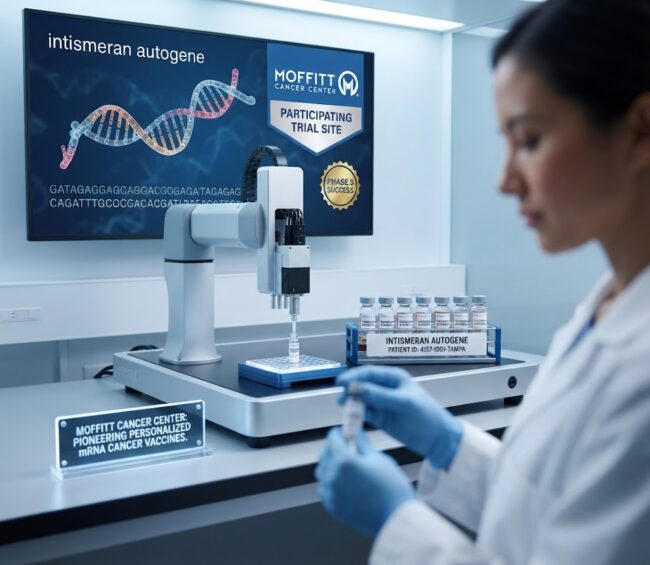
Moffitt was a participating research site in the Phase 3 trial. Tarhini, director of Moffitt’s Cutaneous Clinical and Translational Research, said Moffitt played a major role in running the study and enrolled and treated patients at its Tampa center.
Moffitt experts have also spoken publicly about what the results could mean. Before the Phase 3 announcement, Dr. Nikhil Khushalani, vice chair of Moffitt’s Cutaneous Oncology Department, said that if the Phase 3 trial confirmed the Phase 2 benefit, it would lead to a new standard of care for reducing relapse in high-risk melanoma. After the results, Tarhini told ABC News he expects the treatment to be approved and available to patients likely by early 2027.
Moffitt’s involvement extends beyond this one trial:
- Lung cancer. Moffitt is listed as a recruiting site for the Phase 3 V940-002 trial testing intismeran plus Keytruda in non-small cell lung cancer. Mayo Clinic Florida, Miami Cancer Institute, and AdventHealth Orlando are also listed as Florida sites.
- Head and neck cancer. In 2022, Moffitt was studying mRNA-4157 in head and neck cancer patients whose tumors are not related to HPV, a group that tends to have a worse prognosis.
Why Moffitt Is Well Positioned for This
Moffitt has long been a leader in melanoma treatment. According to Moffitt, its researchers helped bring ipilimumab and vemurafenib, both approved by the FDA in 2011, and many later therapies from clinical trials to patients.
Its experience with personalized cell therapy is especially relevant. Moffitt’s Dr. Amod Sarnaik and colleagues found that lifileucel (Amtagvi), a tumor-infiltrating lymphocyte (TIL) therapy, produced durable responses in metastatic melanoma, and the FDA approved it in February 2024. Moffitt is one of only three treatment centers in Florida authorized to give the therapy.
TIL therapy and intismeran work differently, but both require a similar process: collecting tumor tissue, producing a treatment for one specific patient, and coordinating care around a manufacturing timeline. Moffitt already has experience managing that kind of workflow.
Why This Matters for Florida
Melanoma is the deadliest form of skin cancer. It accounts for only about 1% of skin cancers but causes most skin cancer deaths. Nationally, about 112,000 new invasive melanomas and roughly 8,510 melanoma deaths are expected in 2026.
Florida’s risk is higher than most states. Its strong UV exposure and large older adult population contribute to higher melanoma rates. The age pattern matters too. Among people 50 and older, melanoma rates are still rising in both women and men, and Florida has one of the largest populations of older adults in the country.
For Florida patients, this means that if intismeran is approved, the state’s major cancer centers, including Moffitt, would likely be among the first places to offer it.
The Evidence So Far
| Study | Phase | Patients | Key result |
|---|---|---|---|
| KEYNOTE-942 | 2b | 157 | 49% lower recurrence/death risk |
| KEYNOTE-942 | 2b | 157 | 59% lower distant spread/death risk |
| INTerpath-001 | 3 | 1,137 | Met RFS, DMFS; HR not yet released |
Note on the numbers: The 49% and 59% figures are five-year Phase 2b results. Some news coverage has attributed them to the Phase 3 trial, but the Phase 3 hazard ratios have not been released. Overall survival and other secondary endpoints are still immature. Safety was consistent with earlier experience with the combination.
The Challenges Ahead
1. The detailed data. The companies plan to present full results at an upcoming medical meeting. Analysts expect it could be ESMO 2026, held October 23–27 in Madrid, where the main question will be whether the Phase 3 hazard ratio is close to the Phase 2b result of 0.51.
2. Manufacturing at scale. Because each dose is made for one patient, supplying even the first melanoma indication would require production far larger than the 1,137-patient trial.
3. Access and cost. Pricing has not been announced. Community oncologists will also need a way to connect patients to tumor sequencing and to the manufacturing pipeline.
4. Uncertainty around mRNA. HHS has stopped funding mRNA vaccine research through BARDA. Moderna’s mRNA flu vaccine was eventually approved for adults 50 and older, but only after the FDA initially refused to review the application.
The Broader Potential
Melanoma is the first target, not the only one. The INTerpath program includes nine Phase 2 and Phase 3 trials across melanoma, lung, bladder, and kidney cancers, along with a Phase 1 study in pancreatic, gastric, and lung cancer. Moderna CEO Stéphane Bancel has said the company is also exploring intismeran on its own, possibly in earlier-stage cancers.
On the commercial side, Leerink analyst Daina Graybosch estimates intismeran could reach average revenue of about $1.4 billion by 2032.
Brian’s Take
Having spent years as an investment analyst, I’ve learned to keep two things separate: whether a drug trial succeeded, and how much of an improvement the drug actually delivers. INTerpath-001 clearly succeeded. How large the benefit is will be known at the medical meeting, not from the press release.
For Florida, the more lasting story is Moffitt’s role. Tampa Bay does not need to host Moderna’s headquarters to benefit from this shift. It already has what these treatments depend on: a major melanoma center with experience running Phase 3 trials, collecting tumor tissue, and delivering personalized therapy. If personalized mRNA vaccines expand into lung, bladder, and kidney cancer, that expertise becomes a regional strength, drawing patients, clinical trials, and research talent.
The next milestones are the full data in October and an FDA filing. If the Phase 3 benefit is close to what the Phase 2b study showed, Florida patients could be among the first in the country to receive this treatment.
FAQ
What is intismeran autogene?
It is an investigational personalized mRNA cancer vaccine from Moderna and Merck. It is designed from the mutations in each patient’s own tumor and given together with Keytruda.
Was Moffitt Cancer Center part of the trial?
Yes. Moffitt was a participating Phase 3 site that enrolled and treated patients, with Dr. Ahmad Tarhini as site principal investigator.
Is the vaccine FDA-approved?
No. It is investigational. The companies plan to talk with regulators about filing, and a Moffitt investigator expects availability likely by early 2027.
Who might benefit?
The Phase 3 trial studied adults with high-risk stage IIB–IV melanoma that had been completely removed by surgery. Other cancers are still being studied.
Does it cure melanoma?
No. It is designed to lower the risk that melanoma returns or spreads after surgery. Overall survival data are not yet mature.
How can Florida patients learn about trials?
Patients should talk with their oncologist. Moffitt accepts trial eligibility referrals at 1-888-663-3488.
This article is for informational purposes only and is not medical advice.
Sources and Further Reading
- Merck — INTerpath-001 Phase 3 announcement: https://www.merck.com/news/merck-and-moderna-announce-phase-3-interpath-001-trial-of-intismeran-autogene-plus-keytruda-met-endpoints-of-recurrence-free-survival-rfs-and-distant-metastasis-free-survival-dmfs-in-patient/
- Moffitt — Melanoma mRNA Vaccine Shows Promise: https://www.moffitt.org/endeavor/archive/melanoma-mrna-vaccine-shows-promise-in-preventing-disease-recurrence/
- Moffitt — Personalized Vaccine Could Help Prevent Melanoma Recurrence: https://www.moffitt.org/endeavor/archive/vaccine-melanoma-story/
- ABC News — Personalized mRNA cancer vaccine: https://abcnews.com/Health/personalized-mrna-cancer-vaccine-shows-promise-extending-lifespan/story?id=135771378
- Dermatology Times — Phase 3 trial details: https://www.dermatologytimes.com/view/personalized-mrna-based-melanoma-vaccine-meets-primary-endpoints-in-landmark-phase-3-trial
- AJMC — mRNA cancer vaccine succeeds: https://www.ajmc.com/view/moderna-merck-mrna-cancer-vaccine-succeeds-in-late-stage-trial
- KOL Pulse — INTerpath-001 profile: https://kolpulse.com/kol-pulse-trial-profile-interpath001
- ClinicalTrials.gov — V940-002 lung cancer trial: https://clinicaltrials.gov/study/NCT06077760
- Moffitt — mRNA vaccine for head and neck cancer: https://www.moffitt.org/for-healthcare-professionals/clinical-perspectives/clinical-perspectives-story-archive/mrna-vaccine-technology-being-studied-for-head-neck-cancer/
- Moffitt — Inside the Breakthroughs That Changed Melanoma Care: https://www.moffitt.org/endeavor/archive/inside-the-breakthroughs-that-changed-melanoma-care/
- Moffitt — TIL Therapy for Metastatic Melanoma: https://www.moffitt.org/cancers/melanoma/treatment/til-therapy/
- American Cancer Society — Key Statistics for Melanoma: https://www.cancer.org/cancer/types/melanoma-skin-cancer/key-statistics.html
- CNN — Wave of cancer vaccines: https://www.cnn.com/2026/08/21/health/mrna-cancer-vaccines-wave
- CNBC — Stock reaction: https://www.cnbc.com/2026/08/19/moderna-merck-cancer-vaccine-shows-initial-late-stage-melanoma-data.html
- C&EN — mRNA cancer vaccine succeeds: https://cen.acs.org/pharmaceuticals/vaccines/mrna-cancer-vaccine-succeeds-clinical-trial/104/web/2026/08
- PYMNTS — Scale challenge: https://www.pymnts.com/healthcare/2026/modernas-ai-built-cancer-vaccine-clears-phase-3-with-merck/