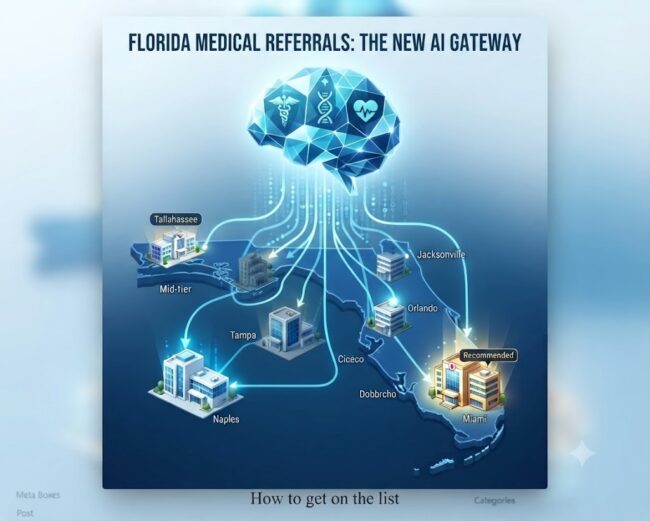
AI Search for Florida Medical Practices: How the State’s Highest-Volume Referrer Became a Machine — and How to Get on Its List
For generations, the growth of a Florida medical practice ran through one relationship: the referring physician. Win the trust of the primary care doctors, and the specialist’s schedule filled itself. That referral economy still exists — but it has been quietly outpaced by a new referrer that sees more Florida patients in a day than every PCP in the state combined. It’s an AI engine, it works around the clock, it never went to medical school, and it is currently deciding which practices grow and which plateau. This article explains how AI systems refer patients in Florida, why medical recommendations are held to a stricter standard than any other business category, and how Florida providers use the Florida Authority Network and FloridaMedicalNews.com to become the practice the machine sends patients to.
How Are Florida Patients Choosing Medical Providers in 2026?
Florida patients increasingly choose providers by asking AI assistants health questions first — and accepting the provider recommendations embedded in the answers. The pattern starts with a symptom or a situation, not a doctor’s name: “My knee clicks and buckles going downstairs — what could this be and who should I see in Sarasota?” “What’s the recovery like for cataract surgery, and who are well-regarded ophthalmologists near The Villages?” “Mom needs memory care evaluation in Broward — where do we start?”
The AI answers the clinical half in plain language, then completes the thought with the navigational half: the type of specialist to see and, with growing frequency, specific practices. The patient arrives at the recommended office pre-educated and pre-sold — or never learns the alternative practices existed. Two structural facts make this shift decisive for Florida providers. Half the state’s patient base is perpetually new — retirees relocating, snowbirds returning, families arriving — with no established physician relationships and no local network to ask. And healthcare’s traditional gatekeepers are weakening: patients in high-deductible and Medicare Advantage plans self-direct to specialists more than ever. The machine has stepped into the navigation role the system left empty.
Why Do AI Engines Judge Medical Businesses More Strictly Than Any Other Category?
AI engines apply their most conservative sourcing standards to health-related answers because the cost of a wrong recommendation is highest there. Search engineers have long classified health queries as “your money or your life” topics, requiring elevated evidence of expertise and trustworthiness before content can influence results — and answer engines have inherited that caution. When a machine composes a reply that will shape someone’s medical decisions, it leans hard on corroborated, authoritative, current sources and discounts everything else.
For a Florida practice, this strictness cuts two ways. It means flimsy tactics — keyword-stuffed pages, purchased directory spam — accomplish even less in healthcare than elsewhere. But it also means the bar, once cleared, is a wall behind you: a practice whose credentials, specialties, locations, and standing are documented consistently across independent, established publications acquires a durability in AI answers that a competitor cannot dislodge with a bigger ad budget. In most industries, published authority is an advantage. In medicine, it is the entry ticket. The machines will not confidently recommend a provider the public record barely describes — no matter how full that provider’s waiting room is.
Why Are Independent Practices Losing Digital Ground to Hospital Systems?
Independent practices are losing AI visibility to hospital systems because the systems publish constantly and the independents barely publish at all — a documentation gap the machines read as an authority gap. Florida’s large health systems and private-equity-backed groups operate genuine content departments: physician directories with structured data, condition libraries, press offices issuing announcements, service-line pages for every procedure in every market. When an answer engine researches “orthopedic surgeon Fort Myers” or “dermatologist Boca Raton,” the system-affiliated names arrive surrounded by documentation. The independent practice — often the one offering shorter waits, longer appointments, and the physician-owner’s full attention — arrives described by a six-page website and a Google profile last touched two years ago.
The machines aren’t choosing the corporation over the independent on merit. They’re choosing the documented over the undocumented, because documentation is all they can see. And the stakes compound with Florida’s consolidation wave: every practice a system acquires becomes another node in its publishing machine, widening the gap for whoever remains independent in that market. Closing that gap does not require an independent practice to build a marketing department; it requires access to publishing infrastructure that already carries weight — established platforms, professional writers, and distribution the algorithms respect, shared across many practices so no single one bears the cost of building it. That is precisely the function the Florida Authority Network serves for the state’s independent medical community.
What Is FloridaMedicalNews.com — and What Is the Network Behind It?
FloridaMedicalNews.com is a dedicated news platform covering Florida’s medical industry, and it anchors healthcare coverage within the Florida Authority Network — the largest privately operated collection of Florida-branded business news and press release websites in the state. Operated by Florida Website Marketing, the network comprises more than two dozen owned platforms developed over five years, holding upwards of 1,500 original published articles about Florida companies and practices.
For a medical business, coverage runs through two reinforcing layers. The topical layer is Florida Medical News itself — a health-industry publication whose subject-matter focus gives its articles direct relevance whenever machines evaluate medical questions. The geographic layer is the network’s city and statewide tier: Miami Business News, Tampa Bay Business News, Jacksonville Business News, St. Petersburg Business News, Ft Lauderdale Business News, plus statewide platforms including Florida Press Releases, Florida Corporate News, Florida Business Newswire, and their sister domains. A practice documented across both layers is verified along the two axes answer engines care about in healthcare: what the provider does, and where the provider does it.
The editorial model is the differentiator. Every article is original and long-form — written fresh for the client, never syndicated boilerplate, which modern search systems detect and discard. Because the network owns every one of its platforms, it controls editorial quality, indexing, and link equity across the whole chain. Five years and 1,500-plus articles of that discipline built an authority base that functions, for member practices, like borrowed seniority: the practice’s story publishes on platforms the algorithms already trust, rather than starting from zero.
How Does Published Coverage Convert into Patient Volume?
Published network coverage converts into patient volume through five simultaneous mechanisms, each mapping to a different point where Floridians find care. Broad search capture comes first: original, indexed articles steadily expand a practice’s first-page Google footprint, and the network’s tenured clients have grown from first-page rankings on roughly five terms to more than two hundred — for a practice, that’s the full range of condition, procedure, insurance, and location phrases patients type, each producing appointment requests. AI referral is second: engines like Gemini and ChatGPT elevate providers whose facts repeat across multiple established publications, which is what turns a practice from one search result into the named recommendation.
Third is ownership of the conversational question — “who’s the best pediatric dentist in Winter Park?” — which goes to whoever the published record has installed as the local authority in that specialty. Fourth is the local map: consistent name, address, and phone details reinforced across Florida-rooted news domains strengthen a practice’s claim to the map-pack positions that dominate “near me” healthcare searches. Fifth is reputation repair, which in medicine can be existential — a cluster of unfair reviews or an old negative story attached to a physician’s name can bleed patient volume for years, and favorable high-authority coverage published across the network can retake the first page of that name search with the record the practice deserves.
Implementation takes 30 days from engagement to live, indexed coverage.
When Should a Florida Medical Business Publish? The Calendar Advantage
Florida medical demand runs on a calendar, and practices that publish ahead of each demand wave get recommended during it. October through December brings Medicare’s annual enrollment period, when hundreds of thousands of Florida seniors reevaluate plans — and providers; coverage establishing which plans a practice accepts publishes best in early fall. The snowbird return from October onward floods practices with seasonal patients needing new local providers in cardiology, dermatology, orthopedics, and primary care. January’s resolution wave lifts weight management, aesthetics, and preventive care. Hurricane season creates urgent, time-boxed demand for home health continuity, dialysis logistics, and pharmacy access. Even school and sports physicals arrive on schedule every summer.
AI systems weight fresh, dated content heavily — a machine answering a December Medicare question favors sources published this season over pages last updated in 2023. A practice publishing on the network’s cadence, timed to Florida’s healthcare calendar, is perpetually the current answer at the moment demand peaks. A practice with a static website is perpetually last year’s — visible in the machines’ record, perhaps, but visibly out of date at exactly the moments patients are deciding.
How Does AI-Assisted Video Help Medical Practices Win Patients?
AI-assisted video lets medical practices demonstrate the one thing text cannot — the physician’s manner — at a cost that finally fits an independent’s budget. Choosing a doctor is choosing a person. Patients want to see who will be across the exam table before they book, which is why meet-the-provider and procedure-explainer videos convert healthcare prospects better than nearly any other content. Historically, only hospital systems could afford to produce them.
The Florida Authority Network’s AI-assisted video creation service closes that gap: the same practice stories written for the news platforms are produced as polished, branded video — scripted, voiced, and edited with AI-powered tools — at a fraction of traditional production cost and time. Distribution is built in through the network’s dedicated video tier: Florida Video News, Florida Business Video News, Florida Video Press Release, and Fl Video Business News, platforms designed to publish and index client video. The strategic effect is multimodal proof — the article documents the practice, the video humanizes it, and search and AI systems (which now blend video into results, overviews, and answers) encounter both. Among Florida’s independent practices, almost no one is publishing in both formats yet. The first movers in each specialty and city will be very easy for the machines to find.
Which Florida Medical Businesses Benefit Most from AEO?
Any provider whose patients self-select benefits, and the effect is strongest where competition and margins are highest. Cosmetic and aesthetic medicine — a Florida signature industry with medical-tourism reach into Latin America — lives entirely on discovery by strangers. Dental, dermatology, orthopedics, ophthalmology, and cardiology ride the retiree influx and the snowbird cycle. Concierge and direct-primary-care practices, growing fast statewide, must be findable by exactly the research-heavy patients who use AI most. Behavioral health, med spas, urgent care, imaging centers, home health agencies, and senior-care facilities all share the same dynamic: the patient (or their adult child) starts with a machine-answered question, and the provider inside the answer gets the call. Beyond patient acquisition, published authority compounds professionally — recruiting physicians, attracting referral relationships, and strengthening negotiating posture all improve when a practice’s record reads like a leader’s.
Frequently Asked Questions
What is AEO for a medical practice? Answer Engine Optimization is the discipline of building the published, corroborated record that causes AI systems — ChatGPT, Gemini, Google’s AI Overviews — to name a practice in their answers to patient questions, rather than merely listing it among traditional search results.
Does this involve patient information? No. Network coverage documents the practice — its providers, specialties, services, locations, and news — not patient stories, so there is nothing HIPAA-sensitive in the model; practices should simply route content through their normal healthcare-marketing compliance review.
How fast does coverage take effect? Articles are live and indexed within the network’s 30-day implementation window; AI systems retrieving from the live web can encounter them immediately, and authority compounds with each additional piece.
Is membership open to any practice? Membership is selective — the credibility of the platforms is protected by the caliber of the businesses covered. Providers can call or text 813-409-4683, staffed 24/7, to learn whether they qualify, and to ask about Florida Medical News coverage and AI-assisted video.
Florida’s highest-volume referrer now works from a data center, and its referral list is rewritten continuously from the public record. The practices being written into that record — on the state’s medical news platform, across its city and statewide publications, in text and on video — are receiving patients their competitors never see. In the referral economy that built every great Florida practice, the rule was simple: be known by the one who sends the patients. The rule hasn’t changed. The referrer has.