By Brian French | FloridaMedicalNews.com | October 3, 2026
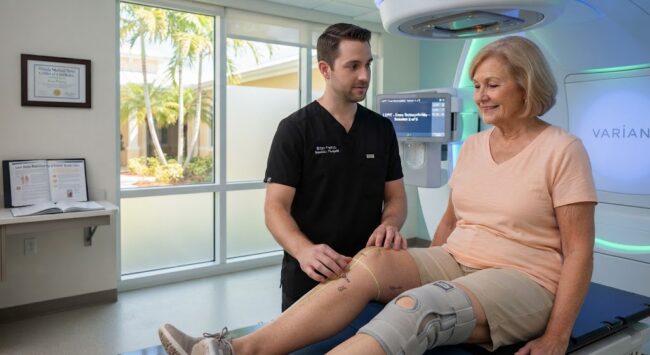
Quick Answer: Low-dose radiation therapy (LDRT) uses a small fraction of a cancer-treatment dose to calm joint inflammation and ease osteoarthritis pain. It’s usually six short outpatient sessions over two to three weeks, and several Florida hospitals and cancer centers now offer it for patients who haven’t gotten relief from medications, physical therapy or injections.
Why This Is in the News Now
Radiation for arthritis is not new, but the evidence behind it is getting stronger fast. A long-term study released by the American Society for Radiation Oncology (ASTRO) indicates that low-dose radiation may slow the progression of knee osteoarthritis. Patients who got the radiation saw longer-lasting gains in pain, function and quality of life than those who got medication alone, and MRI scans showed less structural breakdown inside the knee.
The disability numbers were striking: 31% of the radiation group developed disability, compared with 61% of patients on medication alone. The Russian study followed nearly 300 knee osteoarthritis patients, some for close to 12 years.
For Florida, this matters at scale. CDC survey data compiled by America’s Health Rankings put arthritis prevalence among Florida adults at roughly 25% to 27.5%, and adults 65 and older have a prevalence more than six times higher than adults ages 18 to 44. In one of the nation’s oldest states, that’s millions of potential patients.
What Is Low-Dose Radiation Therapy for Arthritis?
LDRT uses X-rays aimed at the affected joint to dampen the immune response that drives pain and stiffness. It works differently from cancer radiation. Both the daily and total doses are far lower, and instead of killing cells, the small doses trigger cellular changes that reduce inflammation.
The standard course is 3 Gy delivered over six visits at 0.5 Gy each, which Penn Medicine notes is about one-twentieth of the dose used for lung cancer.
Key Facts at a Glance
| Item | Typical Detail |
|---|---|
| Total dose | 3 Gy |
| Sessions | 6 (0.5 Gy each) |
| Schedule | 2–3 weeks, outpatient |
| Pain | Painless, no needles or incisions |
| Repeat course | Possible after 3+ months |
| Best fit | Mild-to-moderate OA |
How Strong Is the Evidence?
The most important recent study came from Korea. Researchers enrolled 114 patients with mild-to-moderate knee osteoarthritis at three academic centers and randomly assigned them to a very low dose (0.3 Gy), a low dose (3 Gy), or a sham treatment where the machine delivered no radiation.
The result: the 3 Gy course significantly cut pain and improved function compared with placebo, with 70% of patients meeting responder criteria versus 42% in the sham group. No radiation-related side effects were seen, and the 0.3 Gy dose did not work.
That sham control is the key. About 40% of the placebo group also improved — typical for arthritis studies — but the trial design let researchers confirm that the radiation itself drove the better results.
A Balanced Note on Earlier Trials
Not every study has been positive. Earlier randomized trials from the Netherlands found no meaningful difference between treated and sham groups for knee osteoarthritis. Newer trials using the standard 3 Gy dose have been more encouraging, and ASTRO’s task force co-chair says the next step is a multi-center trial comparing low-dose radiation with a sham procedure. Patients should view LDRT as a promising, increasingly validated option — not a guaranteed fix.
Who Is a Good Candidate?
Candidates generally share these traits:
- Adults over 40 with diagnosed osteoarthritis whose symptoms haven’t improved with medications, physical therapy or injections
- Mild-to-moderate arthritis, where research has shown the clearest gains in pain and function
- Arthritis in joints away from vital organs. Penn Medicine designs the treatment for joints outside the spine, such as the ankle, knee or wrist.
The process typically starts with a consult. Patients usually meet with a radiation oncologist for an initial evaluation.
Is It Safe?
Cleveland Clinic says that because the arthritis dose is so small, the cancer risk from low-dose radiation is considered extremely low. Side effects are uncommon and usually mild.
It also doesn’t close doors. A radiation oncologist at Holzer Health notes LDRT won’t affect a patient’s options for future joint replacement surgery or steroid injections. Compared with steroid shots, some studies show it may provide longer relief, up to one to two years.
Where Florida Patients Can Get LDRT
A growing number of Florida providers now offer the treatment. This list is not exhaustive or an endorsement; patients should confirm availability directly.
| Provider | Location | Region |
|---|---|---|
| Cleveland Clinic Indian River Hospital | Vero Beach | Treasure Coast |
| Ackerman Cancer Center | Jacksonville (Mandarin), Amelia Island | Northeast FL |
| Florida Radiation Oncology | Winter Park | Central FL |
| Orlando Orthopaedic Center | Orlando | Central FL |
Indian River Hospital is the first Cleveland Clinic site in Florida to adopt the osteoarthritis treatment pathway introduced at the main Ohio campus in 2023. Cleveland Clinic Florida’s radiation oncology program also uses LDRT for conditions such as Dupuytren’s contracture, frozen shoulder and tennis elbow. Ackerman Cancer Center offers LDRT for osteoarthritis at its Mandarin and Amelia Island locations. Florida Radiation Oncology in Winter Park describes itself as Central Florida’s first team offering LDRT for osteoarthritis. Orlando Orthopaedic Center offers it for chronic pain from arthritis, tendinopathy and bursitis.
Does Insurance Cover It?
Coverage varies. Lahey Clinic reports LDRT is covered by most insurance plans but advises patients to check with their provider. Some radiation centers state that Medicare and most major plans cover LDRT for osteoarthritis. Florida’s large Medicare population should verify coverage and any prior-authorization requirements before scheduling.
Frequently Asked Questions
How does radiation help arthritis?
Low-dose radiation reduces the inflammatory response in the joint, easing swelling and improving movement.
How long does treatment take?
Patients can expect six non-invasive outpatient treatments over two to three weeks. Each session takes only minutes.
How many patients get relief?
In a recent trial cited by Cleveland Clinic, about 70% of radiation patients saw knee pain drop, compared with about 40% in the placebo group.
Can multiple joints be treated?
Yes, typically in sequence. Providers generally treat one joint at a time, and a course can be repeated after at least three months if needed.
Is it used for rheumatoid arthritis?
Current U.S. programs and trials focus mainly on osteoarthritis. Patients with rheumatoid or other inflammatory arthritis should ask their rheumatologist and a radiation oncologist whether LDRT fits their case.
Is it covered in Florida?
Many plans cover it, but coverage isn’t universal. Confirm with your insurer before treatment.
Brian’s Take
The story here is not “radiation cures arthritis.” It’s that a decades-old European practice is finally getting the sham-controlled evidence U.S. medicine demands, and Florida is quietly building capacity ahead of the curve. Radiation oncology centers have machines with spare time between cancer cases, and LDRT is a short, low-cost use of that capacity — so expect more Florida centers to add it.
For patients, the sweet spot is the gap between “pills and shots stopped working” and “I’m not ready for a knee replacement.” For Florida’s healthcare economy, the bigger question is whether the new long-term data on slowing disease progression holds up in multi-center trials. If it does, LDRT could shift from a niche option to a routine step in osteoarthritis care in the state with one of the oldest populations in the country.
This article is for informational purposes only and is not medical advice. Talk with your physician or a board-certified radiation oncologist about whether low-dose radiation therapy is right for you.
Sources and Further Reading
- Low-dose radiation therapy may slow progression of knee osteoarthritis, long-term study indicates — ASTRO (2026)
- Low-Dose Radiation Could Help Slow Knee Arthritis — U.S. News/HealthDay (Sept 30, 2026)
- Low-dose radiation therapy offers substantial relief to people with painful knee osteoarthritis — ASTRO (2025)
- Low-dose radiation therapy offers substantial relief — Medical Xpress
- Low-Dose Radiotherapy for Knee Osteoarthritis: The Randomised Controlled Evidence — Joint Pain Practice
- Low-dose radiation for osteoarthritis — Penn Medicine Clinical Briefing
- Relief from osteoarthritis pain with low-dose radiation therapy — Penn Medicine
- How Low-Dose Radiation Might Ease Your Osteoarthritis Pain — Cleveland Clinic
- Cleveland Clinic Indian River Hospital Introduces Low-Dose Radiation Therapy for Osteoarthritis — Consult QD
- Arthritis in Florida — America’s Health Rankings (CDC BRFSS 2024)