By Brian French | FloridaMedicalNews.com | October 3, 2026
Quick Answer
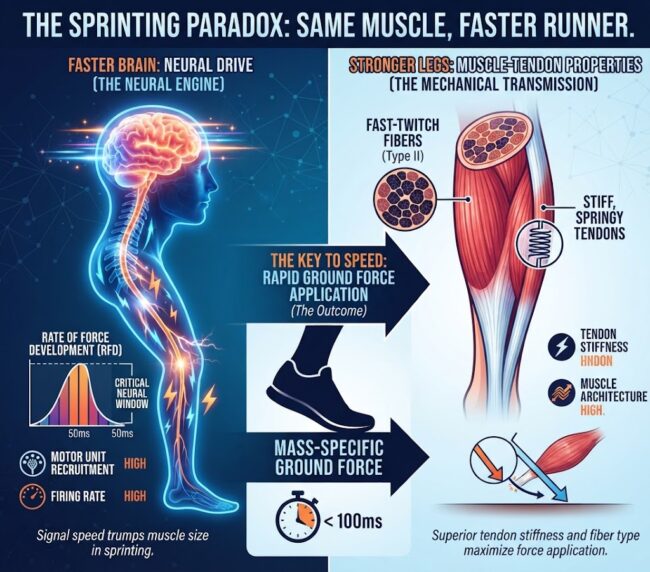
Two athletes with the same muscle mass can differ in speed because sprinting depends less on how much muscle you have than on how quickly you can apply force to the ground. That depends on the nervous system, muscle fiber type, tendon properties, and body proportions.
The research answer to “faster brain or stronger legs” is that it’s mostly a faster nervous system: the speed at which the brain and spinal cord recruit and fire motor units. The best sprinters combine that with fast-twitch muscle and stiff, springy tendons that transfer force efficiently.
Key Takeaways
- Faster runners don’t move their legs faster through the air. They push harder on the ground in less time.
- Elite sprinters’ feet stay on the ground for less than a tenth of a second per step, so force has to be produced almost instantly.
- The first 50 milliseconds of force production are driven mainly by the nervous system.
- How fast motor neurons fire largely explains individual differences in explosive force.
- A common gene variant (ACTN3 577XX) that eliminates a fast-twitch muscle protein is rare among elite sprinters.
- Tendon stiffness, fiber type, and body proportions also matter.
- Explosive power declines with age faster than strength, which matters for fall prevention in Florida’s older population.
Muscle Isn’t the Whole Story
| Factor | What it does | Can it be trained? |
|---|---|---|
| Neural drive | How fast motor units are recruited and fired | Yes, significantly |
| Fiber type | Share of fast-twitch fibers | Somewhat; largely genetic |
| Genetics (ACTN3) | Fast-twitch protein present or absent | No |
| Tendon stiffness | Returns stored energy like a spring | Yes, moderately |
| Muscle architecture | Fiber length and angle | Yes, somewhat |
| Body proportions | Lever lengths at the ankle and foot | No |
| Technique | Direction and timing of force | Yes |
The Key Finding: Speed Comes From the Ground
For decades, coaches assumed faster sprinters moved their legs faster. A landmark 2000 Harvard study by Peter Weyand and colleagues showed otherwise. Comparing 33 runners of different abilities, the researchers concluded that faster runners reach higher top speeds by applying greater force to the ground, not by repositioning their limbs more rapidly in the air.
The time a runner takes to swing a leg forward for the next step barely differed between fast and slow runners. The difference was force. When runners sprinted downhill and uphill, their faster downhill top speeds came with ground forces about 1.3 times greater, while swing times stayed similar.
The magnitudes are large. Human runners typically apply peak forces of about 3.5 times body weight, and average forces during ground contact of up to 2.0 times body weight.
That explains how two athletes with the same muscle mass can run at different speeds. What matters is mass-specific force applied quickly, meaning force relative to body weight, delivered in a very short time. Weyand summarizes the key to human speed as applying large forces to the ground quickly.
The Time Problem
At top speed, an elite sprinter’s foot is on the ground for roughly 80 to 100 milliseconds per step. A muscle needs several hundred milliseconds to reach its maximum force. A sprinter never gets there.
This is why maximum strength, the heaviest weight you can lift, is not the limiting factor. The limit is rate of force development (RFD): how much force you can produce in the first few milliseconds of contact.
Research shows that early-phase RFD, from 0 to 50 milliseconds, is determined mainly by neural factors: how quickly motor units are recruited, how fast they fire, and how well they fire together. Sprinting takes place almost entirely within this window.
The Case for a “Faster Brain”
“Faster brain” is a slightly misleading phrase. It doesn’t refer to thinking faster or reacting faster to the gun. It refers to the speed of the signals the brain and spinal cord send to the muscles.
Motor neurons set the limit
A 2019 study in the Journal of Physiology, titled “You are as fast as your motor neurons,” measured large populations of motor neurons during explosive contractions. It found that the speed of motor neuron recruitment and the maximum firing rate largely explain individual differences in the ability to produce rapid force. The maximum firing rate was strongly associated with explosive force, explaining about 71% of the variation (r² = 0.71).
The researchers also found that motor neuron firing peaks before force begins to rise. The brain and spinal cord “pre-load” the signal, and that signal determines how explosive the contraction will be. The study concluded that differences in explosive force were determined by neural activation that came before force generation.
A related computational study found that how quickly motor units are recruited is the main factor limiting maximum rate of force development.
Firing speed
During explosive efforts, motor units can fire at 100 to 120 times per second, compared with 30 to 60 times per second during sustained contractions. Highly trained athletes can activate 98% to 99% of their available motor units during maximal efforts, compared with 85% to 93% in untrained people. Two people with identical muscle can therefore produce very different force, because one is using more of what they have.
Signals from the brain predict sprint times
A 2025 study of male college sprinters looked at both spinal reflexes and signals descending from the brain. It found that V-wave amplitude, a measure of drive from the brain, and a muscular measure predicted 30-meter sprint time.
Neural speed is trainable
Training can improve motor unit firing rates. A study comparing sprinters with non-athletes found that training increased firing rates and electrical signal strength at the same force level, providing strong evidence that neural input adapts to training.
What about reaction time?
Reaction to the starting gun is a separate neural skill, and it matters less than most people think. Under World Athletics rules, any reaction faster than 0.100 seconds is considered a false start, and elite reaction times usually fall between about 0.12 and 0.18 seconds. That window is small compared with the time differences that come from force production over 40 to 50 steps.
The Case for “Stronger Legs”
The muscle still matters. The question is what kind of muscle and how it’s built.
Fiber type
Fast-twitch (Type II) fibers contract and build force much faster than slow-twitch fibers. Faster people generally have a higher percentage of Type II fibers. Two people with the same muscle mass can have very different fiber mixes, and fiber type is largely inherited.
The “speed gene”
The ACTN3 gene makes alpha-actinin-3, a protein found in fast-twitch fibers. A common variant (577XX) eliminates the protein completely, and it occurs in an estimated 18% of people worldwide.
In a study of 346 elite sprinters from 10 countries, the variant that eliminates the protein was rare. Among elite Japanese athletes, sprinters with at least one working copy of the gene ran the 100 meters faster than those without one. Elite strength athletes also show this pattern, with the variant found in 6.7% of athletes versus 16.3% of controls.
ACTN3 is not a “speed gene” that guarantees fast times. It is one of many genetic factors, and people without the protein can still be athletic. It does help explain why two people who train the same way can end up with different top speeds.
Tendons
Tendons store and return elastic energy like a spring. Stiffer tendons, particularly the Achilles, transmit force faster and return more of it. In the same 2025 college sprinter study, vertical leg stiffness was a key predictor of rate of force development.
Muscle design and body proportions
Research on sprinters has found that faster runners tend to have longer muscle fascicles, the bundles of fibers within a muscle, which allows faster shortening. Studies have also linked differences in ankle and foot lever lengths, such as the distance from the ankle joint to the Achilles tendon, to sprint ability. These are structural differences that a scale or a body-composition scan wouldn’t show.
So Which Is It?
It’s both, but the nervous system is often what separates two athletes with the same muscle.
- Muscle mass sets the ceiling. Sprinters with more lean mass and strength generally perform better.
- The nervous system determines how much of that capacity you can use in a tenth of a second. Firing speed and recruitment speed explain most of the difference in explosive force.
- Fiber type and genetics determine how fast the muscle responds to those signals.
- Tendons and body proportions determine how efficiently that force reaches the ground.
The fastest athlete is not necessarily the most muscular. It is the one whose nervous system can activate fast-twitch muscle most completely and quickly, delivering that force through stiff tendons at the right angle.
The Florida Connection
Florida has a strong claim in the sprint world. Noah Lyles, the 2024 Olympic 100-meter champion, was born in Gainesville, and both of his parents ran track in college. He was recruited by the University of Florida before turning professional in 2016. He is coached by Lance Brauman, and his training group, PURE Athletics, is based in Clermont.
Lyles is a good example of how neural and genetic factors combine. He comes from a family of sprinters and started in gymnastics, a sport built on explosive, precise movement, before switching to track at 12.
Why This Matters Beyond Elite Sport
The same science applies to Florida’s older adults. Power, meaning force produced quickly, declines faster with age than strength. Fast-twitch fibers shrink, and motor neurons fire more slowly.
This has direct consequences for falls. Recovering from a trip requires producing force within a fraction of a second. An older adult may still be strong enough to stand up but too slow to catch themselves. In a state with one of the largest populations of older adults in the country, training for speed of movement is a fall-prevention strategy as well as an athletic one.
How to Train a Faster Nervous System
- Sprint at maximum speed. Short sprints with full recovery train the nervous system to fire at its maximum.
- Lift heavy. Strength training increases the capacity for force.
- Move explosively. Jumps, bounds, and fast lifts train rate of force development.
- Rest fully between efforts. Neural training needs quality, not fatigue.
- Build tendon stiffness. Hopping and bounding drills gradually strengthen tendons.
- For older adults: Do the lifting phase of an exercise quickly and the lowering phase slowly, under professional supervision.
FAQ
Why are some athletes faster with the same muscle mass?
They apply force to the ground faster. That depends on how quickly the nervous system activates muscle, the share of fast-twitch fibers, tendon stiffness, and body proportions.
Is sprint speed in the brain or the legs?
Mostly in the nervous system’s ability to fire muscles quickly, combined with fast-twitch muscle and springy tendons. It isn’t about thinking speed or reaction time.
Do faster runners move their legs faster?
Not much. Research shows that fast and slow runners take about the same time to swing their legs. Faster runners push harder on the ground.
Is there a speed gene?
ACTN3 is the best-known example. A common variant that eliminates a fast-twitch muscle protein is rare among elite sprinters, but many genes contribute to speed.
Can you train yourself to be faster?
Yes. Firing rate, recruitment speed, and tendon stiffness all respond to training, especially sprinting, heavy lifting, and explosive exercises.
Does this matter for older adults?
Yes. Power declines faster than strength with age, which raises the risk of falls. Explosive training under professional guidance can help.
Brian’s Take
The takeaway for any coach, parent, or fitness enthusiast is that more muscle alone doesn’t make someone faster. Someone who adds 10 pounds of muscle without training the nervous system to use it quickly will simply be heavier.
This also connects to Florida’s healthcare economy. The science that explains why Noah Lyles wins races also explains why a 78-year-old in The Villages falls. Both depend on the speed at which the nervous system can produce force. Florida’s sports medicine and geriatric care providers are working on the same problem from opposite ends, and there is room for them to work together.
This article is for informational purposes only and is not medical advice. Consult a physician or qualified professional before starting an exercise program.
Sources and Further Reading
- Weyand et al. (2000), Journal of Applied Physiology — Faster top running speeds are achieved with greater ground forces: https://journals.physiology.org/doi/full/10.1152/jappl.2000.89.5.1991
- Mendeley — Weyand et al. abstract: https://www.mendeley.com/catalogue/5ebb33de-c06a-3616-a694-27ae8465a457/
- Weyand, ISBS 2017 — Force, Motion, Speed: https://commons.nmu.edu/cgi/viewcontent.cgi?article=1302&context=isbs
- SpeedEndurance — Q&A on Peter Weyand’s research: https://speedendurance.com/2013/08/23/questions-answers-on-peter-weyands-research/
- Del Vecchio et al. (2019), Journal of Physiology — You are as fast as your motor neurons: https://pubmed.ncbi.nlm.nih.gov/30768687/
- Journal of Neurophysiology — Neural and muscular determinants of maximal rate of force development: https://journals.physiology.org/doi/pdf/10.1152/jn.00330.2019
- Frontiers in Physiology (2022) — Motor unit adaptations in sprinters: https://www.frontiersin.org/journals/physiology/articles/10.3389/fphys.2022.994857/xml
- Frontiers in Physiology (2025) — Neuromuscular factors in college sprinters: https://pmc.ncbi.nlm.nih.gov/articles/PMC11746912
- Rate of force development overview: https://research.poin-t-go.com/en/research/rate-of-force-development-explosive
- Papadimitriou et al. — ACTN3 and ACE variants in elite sprinters: https://www.ncbi.nlm.nih.gov/pmc/articles/PMC4831144/
- PubMed — ACTN3 genotype in elite Japanese athletes: https://pubmed.ncbi.nlm.nih.gov/23868678/
- European Journal of Human Genetics — ACTN3 in elite strength athletes: https://www.nature.com/articles/5201964
- Limitations of animal running speed: https://en.wikipedia.org/wiki/Limitations_of_animal_running_speed
- Britannica — Noah Lyles: https://www.britannica.com/biography/Noah-Lyles
- Noah Lyles profile: https://en.wikipedia.org/wiki/Noah_Lyles
- Lee & Piazza (2009), Journal of Experimental Biology — Built for speed: musculoskeletal structure and sprinting ability.
- Kumagai et al. (2000), Journal of Applied Physiology — Sprint performance is related to muscle fascicle length in male 100-m sprinters.