Quick Answer: Florida hospitals and practices are using AI agents to answer patient calls, write clinical notes, chase prior authorizations, fight claim denials and cut no-shows, adding appointment capacity while avoiding new hires and freeing clinicians from paperwork.
From AI Pilots to Digital Co-Workers
Florida has become one of the country’s most active proving grounds for AI in health care. The shift underway is from tools that suggest to agents that act: an agent answers the phone, books the appointment, checks a claim’s status on a payer website and writes the result back into the medical record.
Tampa General Hospital is the clearest local example. The academic system has 61 AI applications in production, ranging from a digital voice agent that has avoided 48 hires to ambient listening tools that are persuading some physicians to delay retirement. Its revenue cycle chief has called 2026 the age of AI agents in revenue cycle, describing the technology as fully operational rather than theoretical.
The opportunity is still wide open for most organizations. In an HFMA survey analyzed by Guidehouse, 59% of providers said they had not yet implemented AI or automation in the revenue cycle.
Use Case 1: AI Agents in the Call Center
Patient access is where Florida providers are seeing the fastest payoff. Tampa General’s agentic AI assistants have answered more than 2 million calls since September 2025, cutting wait times by 58% and increasing appointment capacity by 21%, according to figures released in September 2026.
Speed of deployment matters too. TGH’s voice agent, Aimee, built with vendor Hyro, went live in just three months, handling common questions, appointment management and call routing. After launch, daily call abandonment fell 56%. The agent connects to the hospital’s Epic record and telephony systems to guide callers to the right service and reduce manual work for staff.
Florida AI Snapshot
| Organization | AI Agent Use | Reported Result |
|---|---|---|
| Tampa General | Voice agents in call centers | 2M+ calls, 58% shorter waits |
| Tampa General | Ambient note drafting | Documentation time cut in half |
| AdventHealth | Ambient AI scribe | 86% of users report less burnout |
| Moffitt Cancer Center | Patient-facing chat agent | Fewer scheduling disruptions |
Use Case 2: Ambient Scribes That Write the Note
Ambient AI listens to the visit and drafts the clinical note, so the physician can face the patient instead of the screen. AdventHealth deployed Nuance’s DAX Copilot to nearly 2,000 physicians and advanced practice providers; 86% of users report less burnout and 80% report a better patient experience. At Tampa General, more than 500 physicians use ambient listening that drafts clinical notes, cutting documentation time by half.
Independent research supports the direction but tempers the size of the gains. A UCLA randomized trial of 238 outpatient physicians found that Nabla users cut time-in-note by 9.5% versus control, while DAX users showed no significant change; both groups improved on burnout measures, though reviewers noted clinically significant inaccuracies occasionally. In an emergency department study, ambient scribe use was tied to a 28% reduction in per-encounter documentation time.
The takeaway for executives: the burnout and retention benefit is consistent, while time savings vary by tool, specialty and how well clinicians adopt it.
Use Case 3: Revenue Cycle Bots That Fight Denials
Denials are the most expensive paperwork problem in medicine. Hospitals spent nearly $18 billion overturning denials in 2025, and the average cost to rework a denied claim rose to $57.23 from $43.84 the year before. Only 14% of providers use AI to reduce denials, though 69% of those who do report fewer denials and better resubmissions.
Payers are moving faster. In the HFMA/Guidehouse survey, 74% of providers reported longer prior authorization delays, and 20% reported denials on more than 5% of claims, up from 12% previously.
Agents level the field. Mayo Clinic’s revenue cycle team built bots that check claim and prior authorization status on payer websites and bring the answers back into Epic. Through attrition, Mayo cut about 30 FTE positions over two years and saved $700,000 in vendor costs. An AHA analysis found that systems using AI for prior authorization saw a 22% drop in authorization-related denials from commercial payers.
Use Case 4: Filling Empty Appointment Slots
A no-show is lost revenue that can’t be recovered. Prediction agents flag patients likely to miss visits, then trigger outreach. A review of 52 studies found most clinic no-show rates fall between 10% and 20%. At Children’s Specialized Hospital, a no-show predictor cut missed appointments 8.5% across 14 locations in three months, with one clinic down 63%. A primary care study in the UAE reported no-shows falling from 20.8% to 10.3% after an AI-guided outreach dashboard launched.
Novel Ideas Florida Providers Can Build Now
Beyond the standard call center and scribe, these are creative agent uses designed around how health care works in Florida. Most can be assembled from existing scheduling, messaging and EHR tools.
| Agent Idea | What It Does | Payoff |
|---|---|---|
| Hurricane continuity | Confirms evacuation plans for dialysis, oxygen and home-health patients | Fewer missed treatments |
| Snowbird handoff | Coordinates refills and records for patients who split the year | Keeps seasonal patients |
| Bilingual access | Handles calls in Spanish or Haitian Creole | Wins under-served patients |
| Heat-risk outreach | Checks on high-risk seniors during heat advisories | Prevents ER visits |
| Referral closer | Tracks referrals until the specialist visit happens | Stops revenue leakage |
| Price estimator | Builds good-faith cost estimates on request | Faster self-pay collection |
| Discharge follow-up | Calls patients 48 hours after discharge | Lower readmissions |
| Credentialing agent | Tracks license, DEA and payer renewals | Avoids billing gaps |
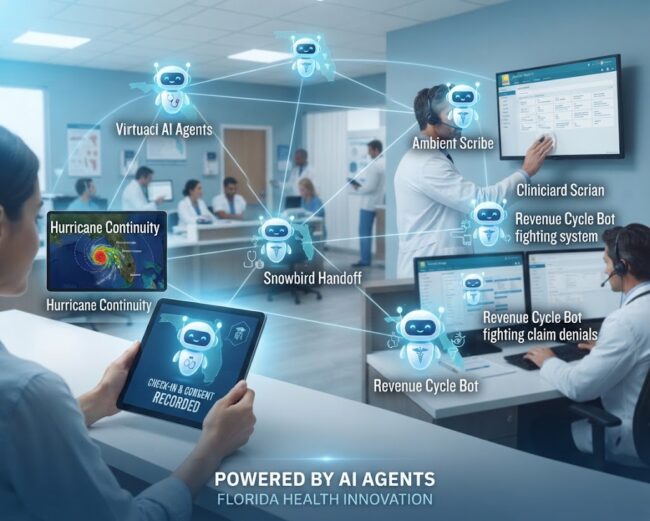
Hurricane continuity. When a storm approaches, the riskiest patients are those who can’t miss treatment. An agent can work down the list of dialysis, infusion, oxygen and home-health patients, confirm where they will shelter, reschedule treatments early, and flag anyone without a plan to a nurse.
Snowbird handoffs. Florida practices often share patients with a doctor up north. An agent can confirm departure and return dates each spring and fall, arrange 90-day refills, send records to the out-of-state physician with consent, and book the first visit back before the patient returns.
Referral closers. Many referrals never become appointments. An agent that follows each referral until the specialist visit is booked keeps patients in-network and protects revenue.
Discharge follow-up. Automated calls two days after discharge can check symptoms, confirm prescriptions were filled and escalate concerns to a nurse, which supports readmission goals.
Each of these keeps a human in charge of clinical judgment. The agent does the outreach, logistics and documentation; licensed staff make the care decisions.
The Compliance Checklist for Florida
Health care AI carries more legal exposure than most industries. Key points for Florida organizations:
- Recording consent. Florida is an all-party consent state, so patients must consent before an ambient scribe records a visit. Build consent into check-in.
- No AI-specific health law yet. As of an August 2026 review, Florida had not enacted an AI-specific health care law; the 2026 AI Bill of Rights passed the Senate but died in the House. Governor DeSantis later asked lawmakers to take it up in a special session, so watch for changes.
- Breach rules. Florida’s FIPA imposes a 30-day breach notification window that covers medical records. Any agent touching patient data needs a HIPAA business associate agreement with the vendor.
- Denials debate. Lawmakers have proposed requiring a human professional to sign off on insurance claim denials rather than letting AI decide alone. Providers should apply the same standard to their own automated decisions.
- Outbound calls. AI-generated voices count as artificial voices under federal telephone law, so outbound AI calls need the right consent. Have counsel review any outbound agent program.
Governance is not optional. Moffitt Cancer Center caught a patient-facing AI agent going off script early in deployment and had to set firm limits on what it could do. Its chief risk officer now leads AI governance, and Moffitt requires review by its Patient and Family Advisory Council before implementing some tools.
Where to Start
- Measure the leaks. Pull data on call abandonment, no-show rates, denial rates and documentation hours.
- Start with the call center. It is the fastest, lowest-risk win and connects directly to scheduling.
- Add ambient scribes for clinicians most at risk of burnout, with consent workflows in place.
- Automate revenue cycle status checks for claims and prior authorizations.
- Layer in Florida-specific agents such as hurricane continuity and snowbird handoffs.
- Stand up governance first, with clear limits on what patient-facing agents may say or decide.
Brian’s Take
Florida’s health systems are not waiting on Washington or Tallahassee to settle the AI rules, and the results at Tampa General show why. Two million calls answered, waits cut by more than half and 48 hires avoided is a business case any CFO can read. The bigger story is the arms race in the revenue cycle: insurers are using AI to deny claims faster, and providers that don’t automate their side will lose that fight on volume alone. For independent practices, the lesson is to start small and concrete: the phone line, the no-show list and the claim-status backlog. The Florida-specific ideas, especially hurricane continuity and snowbird handoffs, are where a regional provider can build something national competitors won’t. Keep a close eye on the evidence, though. Ambient scribe gains are real for burnout but uneven for time saved, and Moffitt’s off-script agent is a reminder that governance has to come before scale.
Frequently Asked Questions
How are Florida hospitals using AI agents?
Florida systems use AI agents to answer patient calls, schedule appointments, draft clinical notes, check claim and prior authorization status, and predict no-shows. Tampa General’s call-center agents have handled more than 2 million calls.
Do AI scribes reduce physician burnout?
Studies consistently show burnout improvements. At AdventHealth, 86% of ambient scribe users reported less burnout. Time savings vary by tool, with a UCLA trial finding gains of 0% to 9.5% in note time.
Is patient consent required for AI scribes in Florida?
Yes. Florida is an all-party recording consent state, so patients must agree before a visit is recorded by an ambient AI tool.
Does Florida have a law regulating AI in health care?
As of mid-2026, Florida had not enacted an AI-specific health care law. Several bills, including restrictions on AI in mental health practice, died in the 2026 session. Federal HIPAA rules and Florida privacy and breach laws still apply.
Can AI reduce claim denials?
Yes. Health systems using AI for prior authorization have reported a 22% drop in authorization-related denials from commercial payers, and Mayo Clinic saved $700,000 in vendor costs using revenue cycle bots.
What should a small practice automate first?
Most practices see the fastest return from an AI phone agent tied to scheduling, followed by no-show outreach and automated claim-status checks.
Sources and Further Reading
- Becker’s Hospital Review, Health Systems Using AI: 50 Examples – https://www.beckershospitalreview.com/healthcare-information-technology/ai/health-systems-using-ai-50-examples/
- Becker’s Hospital Review, Tampa General Has 61 AI Applications – https://www.beckershospitalreview.com/healthcare-information-technology/ai/tampa-general-has-61-ai-applications-with-little-appetite-for-pilots/
- Tampa Bay Business & Wealth, Tampa General’s AI Assistants Handle 2 Million Calls – https://tbbwmag.com/2026/09/14/tampa-general-ai/
- American Hospital Association, How Tampa General Hospital Accelerates AI Adoption – https://www.aha.org/aha-center-health-innovation-market-scan/2026-03-03-how-tampa-general-hospital-accelerates-ai-adoption
- PR Newswire, Tampa General Hospital and Hyro Partner on Voice AI Agents – https://www.prnewswire.com/news-releases/tampa-general-hospital-and-hyro-partner-to-transform-call-center-operations-with-voice-ai-agents-302624823.html
- MobiHealthNews, Tampa General Taps Hyro Voice AI – https://www.mobihealthnews.com/news/tampa-general-hospital-taps-hyro-voice-ai-boost-call-center-efficiency
- Florida Politics, Tampa General and Palantir Showcase AI – https://floridapolitics.com/archives/749019-ai-in-action-tampa-general-palantir-showcase-the-future-of-health-care/
- Pulmonology Advisor, AI-Based Ambient Scribes May Reduce Documentation Time and Burnout (NEJM AI trial) – https://www.pulmonologyadvisor.com/news/ai-based-ambient-scribes-may-reduce-physician-documentation-time-burnout/
- PMC, Ambient AI Scribes and Emergency Department Documentation Burden – https://pmc.ncbi.nlm.nih.gov/articles/PMC13376842/
- Cedar, Five Ways AI Is Improving Revenue Cycle Management in 2026 – https://www.cedar.com/blog/five-ways-ai-is-improving-revenue-cycle-management-in-2026
- Healthcare Finance News, Payer Denials and Prior Authorization Delays Are Top RCM Concerns – https://www.healthcarefinancenews.com/news/payer-denials-and-prior-authorization-delays-are-top-rcm-concerns
- HFMA, Battle of the Bots: Providers Fight Back on Denials – https://www.hfma.org/revenue-cycle/denials-management/health-systems-start-to-fight-back-against-ai-powered-robots-driving-denial-rates-higher/
- Stealth Agents, AI Revenue Cycle Management Statistics 2026 – https://stealthagents.com/research/ai-revenue-cycle-management-automation-statistics-2026
- SAS, Turning Patient No-Show Predictions Into Action – https://blogs.sas.com/content/sascom/2026/08/06/turning-patient-no-show-predictions-into-action/
- ScienceDirect, Predicting Patient No-Shows Using Machine Learning: A Review – https://www.sciencedirect.com/science/article/pii/S2666521225000328
- ScienceDirect, Real-Time Analytics and AI for Managing No-Shows (UAE) – https://www.sciencedirect.com/org/science/article/pii/S2561326X25000125
- BastionGPT, State Laws on Healthcare AI – https://bastiongpt.com/post/state-laws-on-healthcare-ai
- Troutman Pepper, Proposed State AI Law Update, April 2026 – https://www.troutmanprivacy.com/2026/04/proposed-state-ai-law-update-april-20-2026/
- Ensemble Health Partners, Tracking State Regulation of AI in Healthcare – https://www.ensemblehp.com/blog/tracking-potential-state-regulation-of-artificial-intelligence-in-healthcare/
- Florida Senate, SB 344 (2026) – https://www.flsenate.gov/Session/Bill/2026/344
- Becker’s Oncology, When Your AI Agent Goes Off Script: Moffitt Cancer Center – https://www.beckersoncology.com/oncology/when-your-ai-agent-goes-off-script-what-moffitt-cancer-center-caught-early/
- HealthLeaders, Investing in Revenue Cycle Technology: Lessons From Moffitt – https://www.healthleadersmedia.com/cfo/investing-revenue-cycle-technology-lessons-moffitt-cancer-center
- Avair, Is AI Cold Calling Legal? TCPA Rules Explained – https://www.avair.ai/resources/blog/is-ai-cold-calling-legal