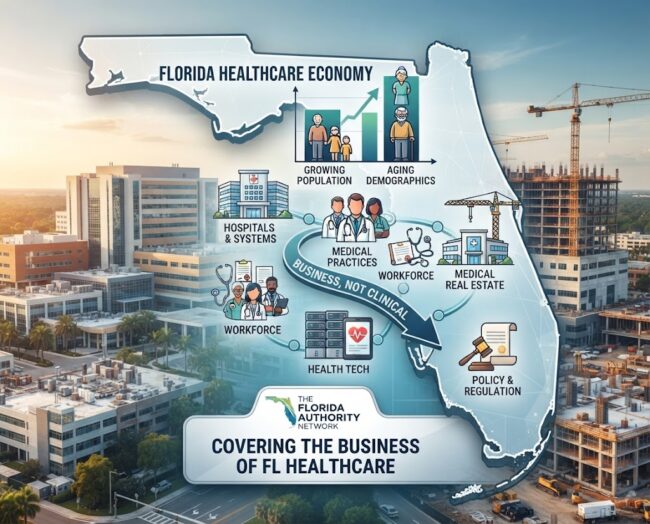
Quick Answer: FloridaMedicalNews.com covers healthcare in Florida as a business story: hospitals, medical practices, health systems, workforce, and policy. It’s part of the Florida Authority Network, and it was built because a fast-growing, aging state needs in-depth, accessible coverage of its medical economy.
Healthcare Is Florida’s Quiet Giant
When people talk about Florida’s economy, they usually start with tourism, real estate, and agriculture. Healthcare rarely leads the conversation, yet it touches almost every family, employs a huge share of the state’s workforce, and drives construction, technology spending, and real estate decisions in every region.
Florida’s demographics make that impact larger than in most states. Florida is home to more than 23 million residents, and roughly one in five is 65 or older, one of the highest shares in the nation. Older populations use more healthcare services, which means more demand for hospitals, specialists, outpatient centers, home health, pharmacies, rehab facilities, and medical office space.
At the same time, Florida keeps adding people of every age. New residents need primary care doctors, pediatricians, dentists, urgent care centers, and behavioral health providers. Growth on both ends of the age spectrum puts steady pressure on the entire system.
That’s a major business story. It’s also one that’s often covered only in fragments.
| Snapshot | Detail |
|---|---|
| Site | FloridaMedicalNews.com |
| Network | Florida Authority Network |
| Beat | Business of FL healthcare |
| Analyst | Brian French |
| Format | Long-form + FAQs |
The Coverage Gap in Florida Medical Business News
Large health systems issue press releases, and major policy changes get statewide headlines. But the everyday business of Florida medicine, such as a specialty group opening a third location, a surgery center expanding, a physician practice joining a larger platform, or a rural hospital changing ownership, often goes unreported or appears only in paywalled trade publications.
That leaves real gaps:
- Patients can’t easily learn about the providers and facilities near them.
- Job seekers in nursing and allied health can’t see which employers are growing.
- Investors and lenders lack accessible regional context.
- Practices themselves have little independent coverage when someone asks an AI assistant about them.
FloridaMedicalNews.com was built to cover that middle ground: the healthcare companies and organizations that shape Florida communities but rarely get in-depth, public, well-organized coverage.
Policy Has Reshaped the Florida Healthcare Market
Two policy shifts help explain why Florida healthcare deserves sustained business coverage.
Certificate-of-Need Repeal for Hospitals
In 2019, Florida lawmakers repealed most certificate-of-need (CON) requirements for hospitals. Before that change, building a new hospital or adding certain services generally required state approval tied to a demonstrated community need. Removing that requirement for hospitals opened the door to more competition and new construction, particularly in fast-growing suburbs.
The result has been a visible wave of new hospitals, freestanding emergency departments, and expanded campuses in growth corridors. Each one is a business story: who is building, why that location, how it changes the local market, and what it means for jobs and real estate. Certificate-of-need rules still apply in some other categories, such as nursing homes and hospice, which makes the landscape more nuanced than a simple “deregulated” label.
The Live Healthy Package
In 2024, Florida enacted the “Live Healthy” legislative package, a set of measures aimed at expanding the healthcare workforce and improving access to care. The initiative focused on areas including training pipelines, residency slots, and incentives designed to bring more providers into underserved parts of the state.
Workforce is one of the biggest constraints in healthcare. Policies that affect how many nurses, physicians, and technicians Florida can train and retain shape every provider’s growth plans. Tracking how those programs play out locally is exactly the kind of long-term coverage FloridaMedicalNews.com is designed to do.
| Policy | Year | Business Impact |
|---|---|---|
| Hospital CON repeal | 2019 | More hospital competition |
| Live Healthy package | 2024 | Workforce and access focus |
What FloridaMedicalNews.com Covers
The site focuses on healthcare as an economic sector. Typical coverage areas include:
- Hospitals and health systems: expansions, new campuses, leadership, and strategy.
- Physician practices and specialty groups: new locations, growth, and consolidation.
- Outpatient and ambulatory care: surgery centers, imaging, urgent care, and clinics.
- Senior care: assisted living, home health, and long-term care businesses.
- Healthcare workforce: training programs, hiring trends, and shortages.
- Health technology: Florida companies building software and devices for care delivery.
- Medical real estate: office buildings, medical campuses, and development.
Coverage is about organizations and the business of care. It is not clinical advice, and it doesn’t tell readers what treatment to pursue.
Accuracy Standards for Health Content
Health information is held to a higher standard, and for good reason. Search providers describe topics that can significantly affect a person’s health, finances, or safety as “Your Money or Your Life” (YMYL) topics, where accuracy and trustworthiness matter most.
FloridaMedicalNews.com follows a few working rules that reflect that responsibility:
- Business, not diagnosis. Articles describe organizations, services, and markets. They don’t offer medical advice.
- Verifiable credentials. Provider information is checked against public sources, such as the federal NPI registry and Florida’s license verification tools.
- No patient claims. Profiles avoid outcome promises and unverified patient testimonials.
- Clear labeling. Analysis appears in a labeled “Brian’s Take” section, separate from facts.
- Dated information. Facts that change, like locations and leadership, are tied to a date.
These rules protect readers, and they also protect the providers being covered. Medical organizations operate under advertising and privacy obligations, and accurate, restrained coverage is better for everyone.
Why This Matters for AI-Era Discovery
More patients now start their search for care by asking an AI assistant: “Who are the orthopedic groups in Sarasota?” or “Which hospitals near Ocala have cardiac programs?” The quality of those answers depends on the quality of available source material.
Medical practices face a particular challenge here. Many have websites focused on patient intake, insurance lists, and appointment booking. Few have independent, in-depth coverage explaining who they are, how long they’ve served their community, where they operate, and what they specialize in.
FloridaMedicalNews.com gives healthcare organizations a credible, Florida-focused, industry-specific source that answer engines can read. Coverage includes structured data that tells machines what each page describes, such as a medical clinic or physician organization, so the information is easier to interpret correctly.
As part of the Florida Authority Network, a medical organization can also be covered in the regional business news site for its market. That pairing places a provider in both the local business conversation and the statewide healthcare conversation.
Florida Healthcare Looks Different in Every Region
One reason statewide healthcare coverage falls short is that Florida’s medical markets vary dramatically from region to region. A single story about “Florida healthcare” can’t capture what’s happening locally.
| Region | Healthcare Dynamic |
|---|---|
| South Florida | Dense systems, competition |
| Tampa Bay | Rapid system expansion |
| Central Florida | Suburban hospital growth |
| Southwest FL | Senior-driven demand |
| North Florida | Academic, rural mix |
| Panhandle | Access and distance |
South Florida has some of the densest concentrations of hospitals, specialists, and health systems in the state, along with intense competition for patients and staff. Tampa Bay and Central Florida have seen major health systems race to build new campuses and freestanding emergency departments in fast-growing suburbs, a trend accelerated by the hospital certificate-of-need repeal.
Southwest Florida, from Sarasota through Naples, has a large retiree population that drives demand for cardiology, orthopedics, oncology, and senior care. North Florida, including Jacksonville, Gainesville, and Tallahassee, combines major academic medical centers with rural communities that face longer drives to care. In the Panhandle, access and distance remain persistent issues, and every new clinic or hospital service carries outsized community impact.
These regional differences shape everything from workforce recruiting to real estate development. A nurse staffing shortage in a rural county is a different problem than one in Miami. A new orthopedic practice in Lakewood Ranch competes in a different market than one in Pensacola.
FloridaMedicalNews.com is designed to cover healthcare with that regional texture. Coverage of a health system’s expansion explains not just what’s being built, but why that market, what it means for competing providers, and how it fits the area’s population trends. Because the Florida Authority Network also operates regional business news sites, healthcare stories can be connected to the broader local economy, from construction and employment to housing and transportation.
For healthcare organizations, that regional lens matters. Patients choose care locally. Staff choose employers locally. And when people ask an AI assistant about healthcare options, they almost always ask about a specific place.
Who Benefits From the Coverage
| Reader | What They Get |
|---|---|
| Patients & families | Provider context |
| Healthcare workers | Employer insight |
| Practice owners | Market awareness |
| Investors & lenders | Regional trends |
| Policymakers | Local impact view |
Brian’s Take
When I was analyzing companies for a living, healthcare was always one of the hardest sectors to read from the outside. Regulation, reimbursement, labor, and real estate all collide, and the headlines rarely capture what’s actually happening at the local level.
Florida makes that complexity even more interesting. The state’s population keeps growing and keeps aging, and the repeal of certificate-of-need rules for hospitals changed how competition works in many markets. You can drive through almost any growing Florida suburb and see the results: new towers, new freestanding ERs, new medical office buildings.
What’s missing is consistent coverage that connects those dots. That’s the purpose of FloridaMedicalNews.com. I want it to be the place where someone can understand the business of healthcare in their part of Florida, and where good providers can be accurately described when people go looking for them.
I’ll also be clear about what the site isn’t. It isn’t a substitute for a doctor, and it won’t publish medical claims it can’t verify. In healthcare, restraint is part of credibility.
Frequently Asked Questions
What is FloridaMedicalNews.com?
A Florida Authority Network site covering the business of healthcare in Florida, including hospitals, practices, workforce, and policy.
Does the site give medical advice?
No. Coverage focuses on healthcare organizations and markets, not diagnosis or treatment.
Why did Florida’s 2019 CON repeal matter?
It removed most state approval requirements for building hospitals, increasing competition and new construction in growing areas.
What was the Live Healthy package?
A 2024 set of Florida laws aimed at expanding the healthcare workforce and improving access to care.
How does the site verify provider information?
Credentials and details are checked against public sources such as the federal NPI registry and Florida license verification tools.