By Brian French | FloridaMedicalNews.com | October 19, 2026
Quick Answer
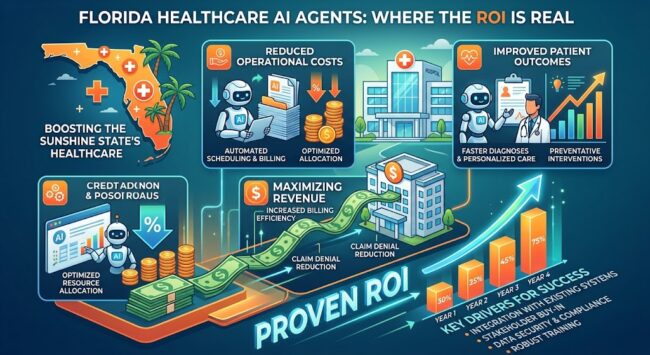
AI agents are paying off in Florida healthcare in two places: phones and paperwork. Voice agents cut call abandonment and hold times. Ambient AI scribes cut documentation time and burnout. The direct revenue gain is modest. The bigger return is keeping clinicians. Florida’s all-party recording consent law is the compliance step every practice must get right.
Key Takeaways
- Tampa General’s voice agent “Aimee” is the clearest Florida proof point for AI on the phones.
- AdventHealth, Tampa General and Mount Sinai Miami Beach are scaling ambient documentation for physicians and nurses.
- National studies show real time savings, but direct revenue gains per clinician are small.
- Florida has no AI-specific healthcare statute. Its recording consent law still applies to every AI scribe.
- For independent practices, the payback math depends heavily on which pricing tier you buy.
What “AI Agents” Means in a Florida Medical Practice
The term covers two families of tools that are now in production across the state.
Patient access agents answer the phone, figure out what the caller needs, and resolve routine requests like scheduling, rescheduling, directions, refills and billing questions. Complex calls go to a human.
Ambient documentation agents listen to the exam-room or bedside conversation and draft the clinical note in the electronic health record. The clinician reviews, edits and signs.
Both target the same problem: Florida’s staffing shortage and the paperwork load that drives clinicians out of practice.
Case Study 1: Tampa General’s Voice Agent
Tampa General Hospital had a phone problem before it had an AI strategy. The seven-hospital system was abandoning roughly 40,000 calls a month before it deployed a digital assistant named “Aimee.”
The rollout was fast. Chief Digital and Innovation Officer Scott Arnold signed with vendor Hyro in late June, the agent was answering calls by mid-September, and it was scheduling appointments by the end of the following month. Arnold said Aimee answered close to half a million calls in its first months.
The measured result: wait times in ambulatory scheduling queues dropped 58%. With the agent handling routine requests, human staff were freed to focus on complex appointment management and patient coordination.
The lesson most practices miss is the prep work. Before launch, Tampa General had to clean up physician scheduling templates and fix “hygiene issues” built up over years of letting individual doctors customize their EMR scheduling. An AI agent cannot book accurately into a messy calendar.
| Tampa General voice agent | Detail |
|---|---|
| Vendor | Hyro |
| Contract to live calls | About 3 months |
| Starting problem | ~40,000 abandoned calls/month |
| Reported result | 58% shorter scheduling wait |
| Key hurdle | Scheduling template cleanup |
Case Study 2: Ambient Documentation Moves From Doctors to Nurses
AdventHealth. The Central Florida-based system deployed Microsoft’s DAX Copilot ambient voice technology, and nearly 2,000 physicians and advanced practice providers now use it across its nine-state network. Governance came first: a multidisciplinary task force guided the rollout, and AdventHealth’s AI Advisory Board reviewed safety, equity and clinical impact before deployment.
Tampa General nursing pilot. In early 2025, a neuro medical-surgical unit began using Microsoft’s ambient listening tool integrated with Epic. The hospital spent a year in talks with Microsoft before launching, making it one of the first systems to deploy the technology for nurses in a live clinical setting.
Mount Sinai Miami Beach. The hospital gated its nursing rollout on its own physician deployment, giving it in-house before-and-after measurements. It says it is the first health system in Florida and fourth nationally to give Epic’s ambient tool to nurses.
Orlando VA. The Orlando VA Health Care System is introducing ambient scribe technology during select appointments, and every AI-generated note is reviewed, edited and finalized by the provider.
What the Evidence Says About Time Saved
Florida systems have shared few hard outcome numbers publicly. The national research fills the gap.
| Study | Finding |
|---|---|
| JAMA, April 2026 | 16 fewer documentation minutes per visit |
| JAMA Network Open, Oct 2025 (6 systems) | Burnout fell from 51.9% to 38.8% in 30 days |
| Mass General Brigham | 21.2-point absolute drop in burnout |
| NEJM AI randomized trial (UCLA) | Nabla cut time 9.5%; DAX gain not significant |
Sources for the table: clinicians in the JAMA study cut total EHR time by 13.4 minutes per encounter and documentation time by 16 minutes per visit; the six-system study saw burnout fall from 51.9% to 38.8% after 30 days; Mass General Brigham saw a 21.2% absolute reduction in burnout prevalence after 84 days; and in the UCLA trial, Nabla’s 9.5% reduction was statistically significant while DAX’s smaller reduction was not.
Adoption is still early. Doximity’s 2026 survey found physicians regularly using AI scribes or ambient tools rose from 20% in April 2025 to 29% by January 2026.
The ROI Math: Smaller Than the Hype, Bigger Than Zero
This is where vendor marketing and peer-reviewed research part ways.
Cost. Most health systems pay $200 to $600 per clinician per month for AI scribes. Lower-cost self-serve tools exist for small practices.
Direct revenue. A five-site academic study found a 1.7% increase in weekly visit volume, conservatively worth about $167 a month in added visit revenue per clinician. Another analysis found a 5.8% increase in weekly RVUs and 2.8% more encounters per week, with no rise in claim denials.
Retention. Researchers argue the 20% to 40% reductions in burnout and documentation burden translate into substantial indirect ROI through workforce retention.
| Practice scenario | Monthly cost per clinician | Pays for itself on direct revenue? |
|---|---|---|
| Self-serve AI scribe | Under $150 | Likely, at ~$167/month gain |
| EHR-integrated enterprise tool | $400–$600 | Not on visits alone; needs retention value |
| Human scribe replaced | ~$2,700–$3,500 saved | Yes, clearly |
There is also a warning. JAMA Health Forum authors note vendors are expanding into billing, which could push preventive visits into higher-coded problem visits. They add that patients may face higher cost-sharing as a result. Florida’s large Medicare population makes that a real exposure.
Florida’s Legal Landscape for Healthcare AI
No AI-specific health statute. Florida does not have a healthcare-specific AI consent law. The 2026 session did not produce a comprehensive cross-sector AI framework.
AI Bill of Rights stalled. Gov. DeSantis’ proposal passed the Senate but did not move in the House, where Speaker Daniel Perez preferred federal action. In the April special session, the House again discarded it even as the Senate voted 37-1 in favor.
Recording consent is the real rule. Because Florida requires all parties to consent to a recording, practices using ambient listening must get consent from everyone recorded before recording begins. That includes family members in the room. Recording without consent in Florida can bring both criminal prosecution and civil lawsuits. Lawyers also recommend that practices document consent and offer a non-AI documentation option when a patient declines.
Web chat and tracking. Florida courts have heard claims under the Florida Security of Communications Act alleging that website chatbots and tracking tools captured patient communications without consent. Any patient-facing chat agent needs a clear disclosure.
Mental health is a watch area. Senate Bill 344, filed for the 2026 session, would have restricted AI use in psychology, clinical social work, marriage and family therapy, and mental health counseling. Behavioral health practices should track whether a version returns.
HIPAA still governs. HIPAA does not require explicit patient consent for AI scribes, but it does require a business associate agreement with the vendor. Florida’s separate data breach law, the Florida Information Protection Act, also applies if patient data is exposed.
Burnout Versus Patient Satisfaction
The early data points the same direction for both groups. A 2026 outpatient study of DAX and Press Ganey scores concluded the results were encouraging and that AI note-taking may improve provider-patient communication. Physicians using the tools describe more eye contact and more attentive listening during visits.
The caution is the “review tax.” Every AI draft needs a clinician to check it. One rheumatology expert told Healio that AI scribes will not stop patient emails, which he called the real cause of burnout. AI agents relieve one pressure point, not all of them.
A Practical Playbook for Florida Practices
- Start with the phones if calls are being dropped. Measure abandonment and hold times first so you have a baseline.
- Clean up scheduling templates before any AI booking. Tampa General’s experience shows this is not optional.
- Build Florida-specific consent into the workflow. Verbal consent before recording, documented in the chart, with a manual option.
- Get the BAA and read the data-use clause. Know whether audio is stored and whether it trains the vendor’s model.
- Match the tier to your size. Small practices rarely need enterprise pricing.
- Watch coding drift. Audit AI-assisted notes for unexplained jumps in visit levels.
- Track retention, not just RVUs. The biggest return may show up in the doctor who does not leave.
Brian’s Take
I spent years as a money manager judging investments by payback period and downside risk. Run AI agents through that lens and the picture is clear.
The phone agent is the cleaner investment. The problem is visible, measurable and costly. Forty thousand dropped calls a month is lost revenue walking out the door. Tampa General fixed it in about a quarter.
The ambient scribe is a different kind of asset. On visit revenue alone, the enterprise tools struggle to pay for themselves. But replacing one burned-out physician in Florida’s tight market costs far more than years of software. That is an insurance policy, not a revenue line, and it should be valued like one.
The risk I would watch is the one regulators are already flagging: coding creep. A tool sold to reduce burnout should not quietly raise patient bills. Florida practices that use AI for honest documentation will keep patient trust. The ones that use it to upcode will eventually meet an auditor.
My advice to Florida practice owners: fix the phones first, buy the scribe for your people, and get the consent process right on day one.
Frequently Asked Questions
Do Florida patients have to consent to an AI scribe?
Yes. Florida’s all-party recording law requires consent from everyone being recorded before recording starts.
Does Florida have a law specifically regulating AI in healthcare?
Not as of October 2026. The proposed AI Bill of Rights passed the Senate but was not taken up by the House.
How much does an AI medical scribe cost?
Health systems typically pay $200 to $600 per clinician per month. Self-serve tools for small practices cost less.
Do AI scribes increase practice revenue?
Modestly. Research shows small gains in visit volume, about $167 a month per clinician in one five-site study.
Which Florida health systems use AI agents?
Publicly reported examples include Tampa General, AdventHealth, Mount Sinai Miami Beach and the Orlando VA.
What is the biggest implementation hurdle?
Data hygiene. Scheduling templates and workflows must be cleaned up before an AI agent can work accurately.
Sources and Further Reading
- “Tampa General’s Call Center AI Drives ROI,” Healthcare IT News
- “How Tampa General Hospital and Startup Hyro Rolled Out AI Voice Agents in 3 Months,” Fierce Healthcare
- Scott Arnold interview, Tampa General Hospital, HealthSystemCIO
- “Reclaiming Time at the Bedside: Tampa General’s AI-Powered Ambient Documentation,” HM Academy
- “AdventHealth’s AI Voice Tool Automates Patient Notes,” CO/AI
- “Mount Sinai Miami Beach Extends Epic’s Ambient AI to Nurses,” Unite.AI
- “Orlando VA Health Care System to Implement Ambient Scribe Technology,” U.S. Department of Veterans Affairs
- “Use of Ambient AI Scribes to Reduce Administrative Burden and Professional Burnout,” JAMA Network Open (Olson et al., 2025)
- “Ambient AI Scribes Reduce Clinician Documentation Time by 16 Minutes per Encounter,” 2 Minute Medicine (on JAMA, April 2026)
- “AI Scribes Can ‘Significantly Reduce’ Doctor Burnout, Study Finds,” Doctors.net.uk (on JAMA Network Open, Mass General Brigham and Emory)
- JAMA Network Open commentary on ambient AI scribe ROI (Shah et al., January 2026)
- JAMA Health Forum on ambient scribes and health care spending (Nong et al., January 2026)
- “AI Scribes Add at Least $167 per Month to Clinician Income: 5-Site Study,” HealthExec
- “Ambient AI Documentation and Patient Satisfaction in Outpatient Care,” PubMed Central (2026)
- “AI Scribes Lead Physicians to See ‘Friend in the Exam Room’ or ‘Sleep With One Eye Open,'” Healio
- “AI in Health Care: Florida, Alabama and Mississippi Take Different Paths,” Phelps Dunbar LLP
- “Chatbots and Website Tracking Technologies: Considerations Under Florida’s Security of Communications Act,” Berger Singerman
- “Florida’s Current Approach to Artificial Intelligence,” Florida State University College of Law
- “Florida House Again Rejects Gov. DeSantis’ AI, Vaccine Measures,” NBC Miami / News Service of Florida
- Florida Senate Bill 344 (2026), Use of Artificial Intelligence in Psychological, Clinical, Counseling, and Therapy Services
- Florida Statutes Section 934.03, Interception and Disclosure of Wire, Oral, or Electronic Communications
- Doximity 2026 State of AI in Medicine, as reported by MemX