Florida Medicaid Managed Care Changes and Physician Reimbursement: The 2026 Living Guide
The Direct Answer
Florida’s Medicaid program pays physicians almost entirely through the Statewide Medicaid Managed Care (SMMC) program, administered by the Agency for Health Care Administration (AHCA). Under the latest SMMC contract cycle, Florida consolidated its regional structure and re-awarded contracts to a smaller set of health plans — meaning many physicians saw their payer mix, credentialing requirements, and fee schedules change even if their patients didn’t move. Reimbursement is set by each plan’s contract, benchmarked loosely against the Florida Medicaid fee schedule, and disputes run through AHCA’s complaint process. If your reimbursement changed recently, the most likely causes are: a new plan contract, a network re-credentialing lapse, or a claims-system migration at your plan.
What Changed in Florida’s SMMC Program
Florida re-procured its entire Medicaid managed care program in the most recent contract cycle (often referred to as SMMC 3.0). The headline changes for practicing physicians:
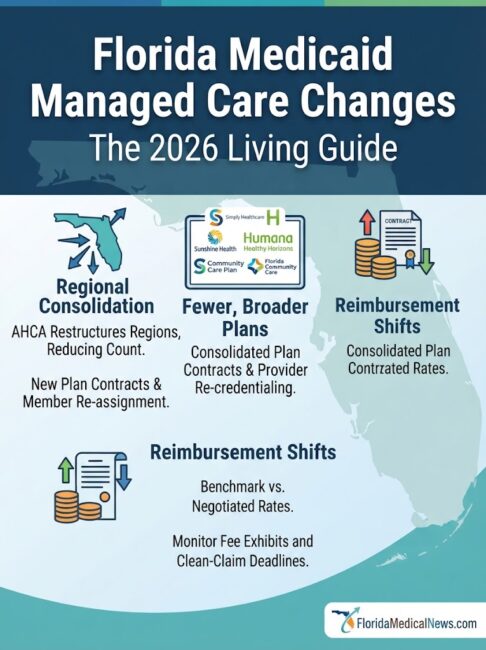
1. Regional consolidation. AHCA restructured the state’s Medicaid regions, reducing the number of distinct regions plans bid on. For physicians, this means a plan that previously operated only in South Florida may now hold your county — and a plan you’ve contracted with for years may have exited it.
2. Fewer, bigger plans. The re-procurement narrowed the field of managed care organizations holding comprehensive contracts. Plans that have historically held major Florida Medicaid market share include Sunshine Health (Centene), Humana Healthy Horizons, Simply Healthcare (Elevance), Community Care Plan, Florida Community Care, and others. (Verify the current contract-holder list directly with AHCA before relying on it — plan lineups change at each procurement and mid-cycle.)
3. Integrated benefits. The current contracts push further integration of physical health, behavioral health, and long-term care under single plan umbrellas — which changes prior-authorization pathways and, in some specialties, which entity actually pays your claim.
4. Member auto-reassignment. When plans exit a region, their members are auto-assigned to surviving plans. Practices frequently discover this only when claims start denying for “member not eligible with plan.”
How Physician Reimbursement Actually Works Under SMMC
This is the part most explainers skip, and the part physicians ask about most:
- The Florida Medicaid fee schedule is a floor-ish benchmark, not a mandate. Managed care plans negotiate rates with providers individually. Many contracts pay a percentage of the Medicaid fee schedule; some pay above it for shortage specialties, and value-based arrangements are increasingly common.
- Rate changes ride on contract cycles. When SMMC contracts turn over, plans re-paper provider agreements. Signing the new agreement without comparing the fee exhibit to your old one is the most common self-inflicted reimbursement cut in Florida.
- Clean-claim payment deadlines exist. Florida law imposes prompt-pay requirements on Medicaid managed care plans (with interest owed on late payments). Track your days-in-A/R by plan; the pattern is your evidence.
- Disputes escalate through the plan first, then AHCA. Every SMMC plan must operate a provider complaint system. Unresolved disputes can go to AHCA’s provider complaint portal — and complaint volume is data AHCA uses in plan oversight.
The Reimbursement Problems Florida Practices Are Reporting
(This section is the original-data engine of the page. Replace bracketed placeholders with real survey results — do not publish with placeholder numbers.)
In our most recent FloridaMedicalNews.com Quarterly Reimbursement Survey of [N] Florida practices across [X] specialties:
- [X]% reported payment delays exceeding 30 days from at least one SMMC plan
- The plan most frequently named for delays was [Plan], cited by [X]% of respondents
- [X]% reported credentialing backlogs following the contract transition
- Median reported days-in-A/R for Medicaid managed care claims: [X] days
Methodology: Survey fielded [dates], distributed to [audience], [N] responses. Full dataset available [link]. Cite as: FloridaMedicalNews.com Quarterly Reimbursement Survey, Q[X] 20XX.
What To Do If Your Medicaid Reimbursement Dropped or Stalled
- Pull your fee exhibit. Compare current contract rates against your prior agreement line by line for your top 25 CPT codes.
- Verify credentialing status with each plan — transitions have caused silent network terminations.
- Check member reassignment. Run eligibility on denied claims; the patient may have been auto-moved to a plan you’re not contracted with.
- Document prompt-pay violations and demand statutory interest in writing.
- File with the plan’s provider complaint system, then escalate to AHCA’s provider complaint process if unresolved.
- Report patterns to your specialty society and the FMA — aggregated complaints move AHCA in ways individual ones don’t.
Frequently Asked Questions
What is SMMC in Florida? The Statewide Medicaid Managed Care program — the delivery system through which nearly all Florida Medicaid enrollees receive care via contracted private health plans, overseen by AHCA.
Who sets Medicaid physician reimbursement rates in Florida? Base fee schedules are published by AHCA, but the rate you’re actually paid is set in your contract with each managed care plan. Rates vary by plan, specialty, and negotiation.
How long does a Florida Medicaid plan have to pay a clean claim? Florida imposes prompt-payment timeframes on Medicaid managed care plans, with interest on late payments. Check the current statutory timeframes and your contract — and verify against the latest version of Florida law, as deadlines and interest terms are statutory and can be amended.
Which health plans hold Florida SMMC contracts right now? The lineup changes with each procurement. Confirm the current list on AHCA’s SMMC page rather than relying on any static article — including this one, which is why we log updates above.
Can I appeal a Medicaid managed care underpayment in Florida? Yes. Start with the plan’s internal provider dispute process, escalate to AHCA’s provider complaint portal, and preserve documentation. Contractual arbitration clauses may also apply.
Does Florida Medicaid pay for telehealth at parity? Coverage exists but the details (originating site, modality, payment parity) are plan- and policy-dependent. Verify against current AHCA policy and each plan’s provider handbook.
Sources & Further Reading
- AHCA — Statewide Medicaid Managed Care: ahca.myflorida.com
- Florida Medicaid fee schedules and provider handbooks (AHCA portal)
- Online Sunshine — Florida Statutes (prompt-pay and Medicaid provisions): leg.state.fl.us
- Florida Medical Association advocacy resources
- [Link to full FMN survey dataset]
I