By Brian French | Florida Authority Network | September 14, 2026
Quick Answer
Florida has no state heat protection standard for outdoor workers, and since July 1, 2024, Florida Statute § 448.111 has barred cities and counties from adopting their own. The enforceable rules that do apply come from federal OSHA: the General Duty Clause of the Occupational Safety and Health Act, and the revised National Emphasis Program on heat hazards issued April 10, 2026, which targets 55 high-risk industries for inspection on any day the National Weather Service issues a heat advisory. A Florida employer’s liability exposure runs through OSHA citations, workers’ compensation claims for heat illness, and, in cases of gross or intentional disregard, civil suits that fall outside comp’s exclusive remedy. The best-practice framework most Florida employers now follow tracks OSHA’s proposed federal standard: water, shade, and rest at a heat index of 80°F, mandatory paid breaks at 90°F, a written prevention plan, and acclimatization for new and returning workers.
The Summer 2026 Picture
Florida’s outdoor workforce, roughly 2 million people in construction, agriculture, landscaping, roofing, utilities, delivery, and tourism operations, works through a season in which heat index readings above 105°F are routine from June through September across the peninsula. Heat is the leading weather-related killer in the United States, and OSHA data cited in the 2026 emphasis program attributes about 50 worker deaths and nearly 3,500 lost-workday illnesses to heat each year nationally, with Florida, Texas, and the Southwest accounting for a disproportionate share.
What makes 2026 different from prior summers is not the temperature. It is the enforcement posture. Federal OSHA’s heat inspection program had been scheduled to lapse in April, and it did, for two days, before the agency reissued it with a broader target list and a five-year term. Florida employers who assumed heat enforcement was going away with the stalled federal rule are now operating under a more aggressive inspection regime than at any point since the program began in 2022.
What Florida Law Says
No state standard. Florida has never adopted a heat illness prevention statute or rule for private employers. Bills to create one, including SB 510 and HB 35 in the 2024 session and successor bills in 2025 and 2026, died in committee.
Local ordinances are preempted. House Bill 433, signed in April 2024 and codified at § 448.111, prohibits any county or municipality from requiring employers to provide heat exposure protections beyond what state or federal law requires, and from giving preference in contracting to employers who do. The law was a direct response to a proposed Miami-Dade County ordinance that would have mandated water, shade, and rest breaks for outdoor workers. Since July 1, 2024, no Florida local government can act.
Workers’ compensation covers heat illness. Under Chapter 440, heat exhaustion, heat stroke, and rhabdomyolysis arising in the course of employment are compensable injuries. The employer’s comp carrier pays medical costs and indemnity, and § 440.11 makes comp the employee’s exclusive remedy against the employer in most cases.
Public employees. State and local government workers are covered by Florida’s Occupational Safety and Health program only to the extent the Department of Financial Services’ Division of Risk Management applies safety standards; Florida is not a federal OSHA state-plan state, so public-sector workers have thinner formal protection than private-sector ones.
What Federal Law Requires
General Duty Clause. Section 5(a)(1) of the OSH Act requires every employer to furnish a workplace free from recognized hazards likely to cause death or serious harm. OSHA has used it for decades to cite employers after heat deaths and hospitalizations, and it remains OSHA’s primary tool for heat enforcement, with more than $2 million in heat-related penalties issued in 2024 alone without any specific heat standard. Serious violations carry penalties above $16,000 per citation in 2026, with willful or repeat violations exceeding $160,000.
The 2026 National Emphasis Program. On April 10, 2026, OSHA issued an updated National Emphasis Program for outdoor and indoor heat-related hazards, CPL 03-00-024, after the previous program expired on April 8. Under it, compliance officers expand any inspection where there is evidence of heat hazards on heat priority days and, on days when the National Weather Service issues a heat advisory or warning, conduct random inspections focused on heat hazards in high-risk industries. The NEP now lists 55 high-hazard industries, 22 of them new, spanning construction, farming, manufacturing, retail, transportation, warehousing, and restaurants. The program runs for five years, through April 2031.
The stalled federal rule. OSHA’s proposed Heat Injury and Illness Prevention standard, published August 30, 2024, has not been finalized and has no target finalization date following the January 2025 regulatory freeze, with analysts broadly characterizing it as unlikely to advance in the near term. Its proposed triggers, an initial heat index of 80°F for water, rest areas, and acclimatization, and 90°F for mandatory 15-minute paid breaks every two hours plus observation for symptoms, have nonetheless become the de facto benchmark OSHA inspectors use when evaluating whether an employer’s program is adequate under the General Duty Clause.
Existing standards that apply. Even without a heat rule, 29 CFR 1926.51 (construction sanitation) requires potable water on site, 29 CFR 1910.151 requires first aid readiness, and the recordkeeping rules at 29 CFR 1904 require logging heat illnesses that result in medical treatment, lost time, or death.
Business Owner Liability
| Exposure | Source | Typical Consequence |
|---|---|---|
| OSHA citation | General Duty Clause, NEP | $16k–$160k+ per violation |
| Workers’ comp claim | Chapter 440 | Medical + indemnity, premium increase |
| Civil suit by employee | § 440.11 intentional tort exception | Uncapped damages |
| Suit by non-employee | Common law negligence | Uncapped damages |
| Wrongful death | § 768.16 et seq. | Survivor damages |
| Contractor liability | Multi-employer worksite doctrine | Citation to GC for sub’s exposure |
| Criminal referral | OSH Act § 17(e) | Rare; willful violation causing death |
The workers’ comp exclusive remedy shields most Florida employers from civil suits by injured employees. The exception in § 440.11(1)(b) applies when an employer engaged in conduct it knew was virtually certain to cause injury or death and concealed the danger. Florida courts apply that standard narrowly, but heat cases with documented prior incidents, ignored complaints, and no water on site are the fact pattern most likely to meet it.
General contractors carry a second layer of exposure. Under OSHA’s multi-employer worksite doctrine, a controlling employer can be cited for a subcontractor’s heat violations. Under Florida’s statutory employer rules in § 440.10, a GC that fails to ensure its subs carry comp becomes liable for the sub’s injured workers.
Delivery, landscaping, and agricultural operations that use independent contractors or H-2A labor face parallel exposure under the Fair Labor Standards Act, the Migrant and Seasonal Agricultural Worker Protection Act, and federal H-2A housing and field sanitation standards, all of which are independent of Florida’s preemption statute.
Policies Florida Employers Are Adopting
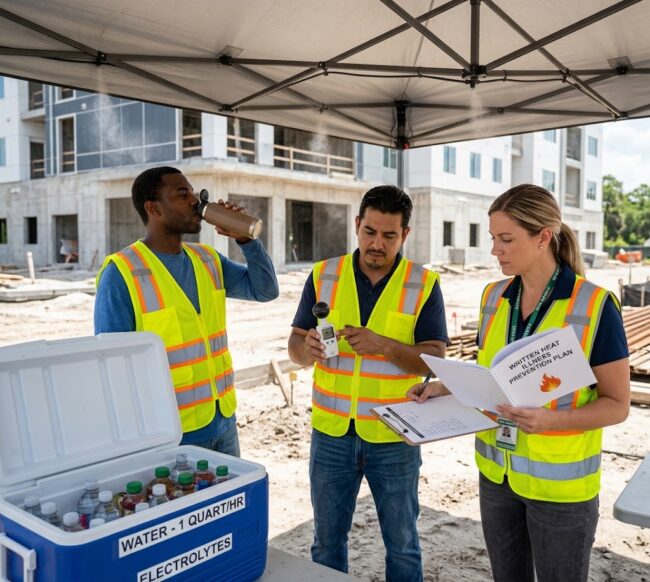
Because Florida’s preemption law bars only local mandates, not voluntary employer programs, most larger Florida contractors and agricultural operators now maintain written heat plans modeled on the federal proposed rule. The core elements:
Written Heat Illness Prevention Plan. A site-specific document identifying heat hazards, trigger thresholds, control measures, emergency procedures, and a designated heat safety coordinator. OSHA inspectors ask for it first.
Monitoring. Daily heat index or wet-bulb globe temperature readings at the work site, not the airport. The NWS HeatRisk product and the OSHA-NIOSH Heat Safety Tool app are the most-used free sources. Several Florida utilities and large builders now use on-site WBGT meters.
Water. One quart per worker per hour, cool, within reach of the work area, with active reminders. Electrolyte replacement for shifts over two hours in high heat.
Shade and rest. Shaded or air-conditioned rest areas available at 80°F heat index. Mandatory paid rest breaks of at least 15 minutes every two hours at 90°F, more frequent for heavy exertion or impermeable PPE.
Acclimatization. New workers and workers returning after seven or more days away are phased in over five to seven days, beginning at 20% of normal exposure. Roughly three-quarters of heat deaths occur in the first week on the job.
Buddy system and observation. Supervisors or paired workers trained to spot confusion, staggering, cessation of sweating, and altered speech, and empowered to stop work.
Emergency response. A written protocol for cooling first, then calling 911, with ice, water, and shade staged on site. Aggressive cooling within 30 minutes is the single largest determinant of heat stroke survival.
Training. Annual training for workers and supervisors, in the languages spoken on the crew, documented with sign-in sheets. Florida’s outdoor workforce is heavily Spanish- and Haitian Creole-speaking, and English-only training is a citation risk.
Schedule controls. Earlier start times, split shifts, and rotating the most strenuous tasks to morning hours. Some Florida roofing and paving contractors now run 5 a.m. to 1 p.m. schedules from June through September.
Industry-Specific Notes
Construction. The highest-risk sector by fatality count. Roofing, concrete, and framing crews in direct sun should treat 90°F heat index as a hard trigger. OSHA’s Fort Lauderdale, Tampa, Jacksonville, and Fort Myers area offices lead the state in heat inspections.
Agriculture. Florida’s citrus, vegetable, and nursery operations face NEP targeting plus federal field sanitation rules under 29 CFR 1928.110, which independently require water, toilets, and handwashing within a quarter mile of the work area.
Landscaping and tree service. Small employers under 10 workers are exempt from most OSHA recordkeeping but not from the General Duty Clause or NEP inspections.
Delivery and logistics. Warehouse and last-mile operations are now on the NEP target list. Vehicle cab temperatures in Florida summer routinely exceed 120°F without air conditioning.
Tourism and hospitality. Theme park, golf course, marina, and outdoor event staff were added to the 2026 NEP’s expanded industry list.
Brian’s Take
Florida’s political position on heat is that regulation should be federal or nothing, and with the federal rule frozen, the practical outcome is “nothing” on paper. But the enforcement reality moved the other way in April. OSHA’s decision to reissue the heat emphasis program for five years, with a longer target list and random inspections keyed to NWS advisories, means a Florida contractor is more likely to see an inspector on a hot day in 2026 than in 2024, when the local ordinance fight was at its peak.
The business case for a heat program does not depend on the law. A single heat stroke hospitalization is a $50,000 to $150,000 comp claim, a three-year experience modifier hit, and a General Duty citation with a published news release attached. A written plan, a $300 WBGT meter, coolers, pop-up shade, and a supervisor who is allowed to stop work costs a fraction of that. The Florida employers who treat § 448.111 as permission to do nothing are the ones OSHA’s inspection data are designed to find.
The longer-term issue is labor supply. Florida’s construction and agricultural workforces are aging, immigration enforcement has tightened the pool, and workers with options are choosing employers with reputations for not sending people to the hospital. Heat policy is becoming a recruiting variable, and the firms that understand that will have crews in August when their competitors do not.
Frequently Asked Questions
Does Florida require employers to give outdoor workers water and rest breaks?
No. Florida has no state heat standard, and § 448.111 prevents local governments from imposing one. Federal OSHA’s General Duty Clause still requires employers to protect workers from recognized heat hazards, which in practice means water, shade, and rest.
Can a Florida city pass its own heat ordinance?
Not since July 1, 2024. House Bill 433 preempted local heat protection requirements statewide.
Is heat stroke covered by workers’ compensation in Florida?
Yes. Heat illness arising out of and in the course of employment is compensable under Chapter 440, and the employer’s carrier is responsible for medical and indemnity benefits.
Can an employee sue a Florida employer for a heat injury?
Generally no, because workers’ comp is the exclusive remedy. The exception is intentional tort conduct under § 440.11(1)(b), which requires proof the employer knew injury was virtually certain and concealed the risk.
What heat index triggers OSHA action?
There is no binding federal threshold yet. OSHA’s proposed rule uses 80°F heat index for initial protections and 90°F for mandatory breaks, and inspectors use those figures as benchmarks. The NIOSH criteria document and the NWS heat advisory (typically 108°F heat index in Florida) are the other reference points.
Does the OSHA heat emphasis program apply to small businesses?
Yes. The NEP has no size exemption. Employers with fewer than 10 workers are exempt from certain recordkeeping rules but remain subject to inspection and citation.
What should a Florida employer do if OSHA shows up on a heat advisory day?
Produce the written heat plan, training records, water and shade provisions, and acclimatization logs. Inspectors under the 2026 NEP evaluate programs against a standardized appendix, and documented programs close most inspections without citation.
Sources and Further Reading
- Florida Statutes § 448.111, Preemption of Heat Exposure Requirements – https://www.leg.state.fl.us/statutes/index.cfm?App_mode=Display_Statute&URL=0400-0499/0448/Sections/0448.111.html
- Florida House of Representatives, HB 433 (2024), Employment Regulations – https://www.flsenate.gov/Session/Bill/2024/433
- Florida Statutes § 440.11, Exclusiveness of Liability – https://www.leg.state.fl.us/statutes/index.cfm?App_mode=Display_Statute&URL=0400-0499/0440/Sections/0440.11.html
- OSHA, National Emphasis Program – Outdoor and Indoor Heat-Related Hazards, CPL 03-00-024 (April 10, 2026) – https://www.osha.gov/news/newsreleases/osha-national-news-release/20260410
- OSHA, Heat Injury and Illness Prevention in Outdoor and Indoor Work Settings Rulemaking – https://www.osha.gov/heat-exposure/rulemaking/
- Federal Register, Heat Injury and Illness Prevention NPRM, 89 Fed. Reg. 70698 (August 30, 2024) – https://www.federalregister.gov
- Littler, OSHA Updates and Extends its Heat Program for Five More Years (April 2026) – https://www.littler.com/news-analysis/asap/osha-updates-and-extends-its-heat-program-five-more-years
- Ogletree Deakins, OSHA Revives National Emphasis Program for Heat-Related Illness (2026) – https://ogletree.com/insights-resources/blog-posts/osha-revives-national-emphasis-program-for-heat-related-illness/
- Conn Maciel Carey, OSHA Updates its Heat National Emphasis Program (April 2026) – https://www.connmaciel.com/osha-defense-report/osha-updates-its-heat-national-emphasis-program/
- NIOSH, Criteria for a Recommended Standard: Occupational Exposure to Heat and Hot Environments (2016) – https://www.cdc.gov/niosh/docs/2016-106/
- OSHA-NIOSH Heat Safety Tool App – https://www.cdc.gov/niosh/heat-stress/communication-resources/heat-app.html
- National Weather Service, HeatRisk Forecast – https://www.wpc.ncep.noaa.gov/heatrisk/