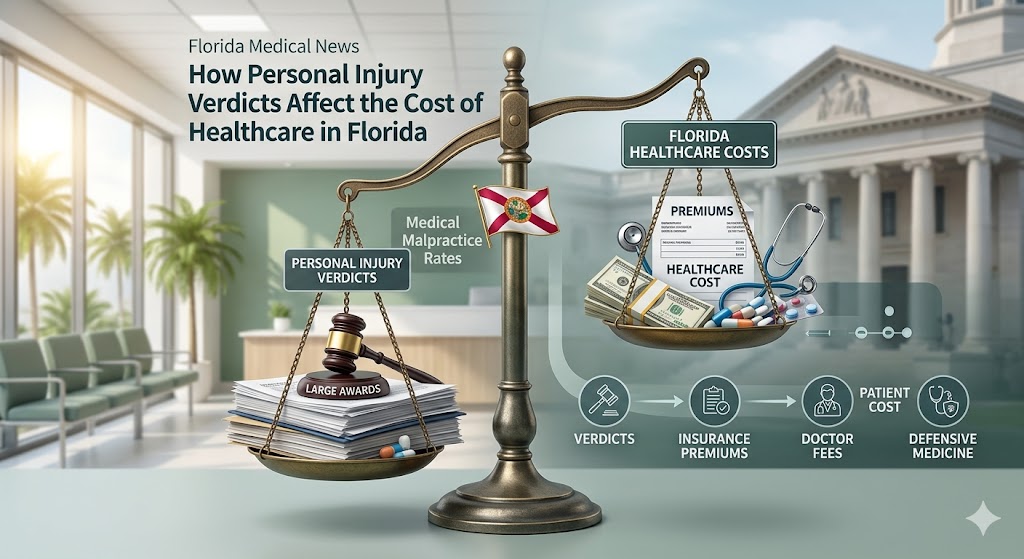
Few topics in Florida public policy generate more heat — and less light — than the relationship between personal injury verdicts and the cost of healthcare. Doctors blame “jackpot” awards. Plaintiffs’ attorneysblame insurance companies and hospital pricing. Legislators pass reforms; courts strike them down; reformers come back with new bills. Through all of it, Florida residents pay some of the highest health insurance premiums and medical malpractice rates in the country.
What’s actually true? The honest answer is that the relationship is real but smaller than either side typically claims. Here’s what the evidence shows, where Florida sits in the national picture, and what’s actually changed in the last three years.
The Mechanism: How Verdicts Touch Healthcare Costs
Civil personal injury verdicts can affect healthcare costs through four main channels. Each is real; each is also frequently overstated.
1. Medical malpractice insurance premiums. Doctors and hospitals carry liability insurance. Insurers price that coverage based on expected payouts, which are driven in part by jury verdicts. When verdicts climb, premiums climb. Those premiums get passed through to patients in the form of higher fees, higher hospital charges, or — eventually — higher health insurance premiums.
2. Defensive medicine. Physicians worried about being sued may order tests, scans, consultations, or admissions that aren’t strictly necessary, primarily to document that they didn’t miss anything. A 2010 Health Affairs study by Mello and colleagues — still the most-cited estimate — pegged total medical liability system costs (premiums plus defensive medicine plus administrative costs) at roughly $55.6 billion in 2008, or about 2.4% of total U.S. healthcare spending. Defensive medicine alone was estimated at $45.6 billion. Other studies put the figure higher, in the 5–9% range, and a few outliers go higher still.
3. Hospital and provider risk pricing. Hospitals build litigation risk into their charge structures. The “chargemaster” prices that flow into bills — and into the rates negotiated with insurers — partly reflect legal exposure.
4. Auto and premises insurance pass-through. A meaningful share of Florida personal injury cases involve auto accidents, slip-and-falls, and premises liability rather than medical malpractice. Verdicts in these cases drive up auto and homeowners insurance, which Florida residents already pay among the highest rates in the country for. Health insurers serving Florida factor a high-cost-of-living, high-litigation environment into their pricing too.
What “Nuclear Verdicts” Actually Mean
The phrase “nuclear verdict” — generally defined as a jury award of $10 million or more — gets used by advocacy groups on both sides. The data are real but require context.
From 2009 through 2022, Florida ranked second in the nation for nuclear verdict payouts. That ranking — and Florida’s reputation as a “judicial hellhole” in industry rhetoric — was a major driver of the 2023 tort reform legislation. By 2024, after that reform took effect, Florida had dropped to tenth on the same nuclear verdict ranking, according to the Marathon Strategies tracker cited in industry reports.
The same dynamic plays out in malpractice specifically. The American Medical Association’s 2025 Policy Research Perspectives report found that nearly half of medical liability insurance rate filings nationally showed premium increases in 2024 — the highest level since 2005 — with Florida among the states experiencing the sharpest premium spikes.
The honest framing: large verdicts do correlate with higher insurance costs. Whether they cause the bulk of the cost or simply move with it is harder to pin down.
Florida’s 2023 Tort Reform: HB 837
In March 2023, Florida enacted House Bill 837, the most significant tort reform package in the state in decades. The law changed how personal injury cases work in several material ways:
- Statute of limitations cut in half. Plaintiffs now have two years to file most personal injury claims, down from four.
- Modified comparative fault. A plaintiff found more than 50% at fault for their own injury can recover nothing. Previously, Florida used pure comparative fault, allowing partial recovery even for plaintiffs who were largely at fault.
- Medical damages evidence rule (Fla. Stat. 768.0427). Juries now see what was actually paid for the plaintiff’s medical care — typically the negotiated insurance rate — rather than the original “sticker” billed amount. Since billed charges are often three to ten times what insurers actually pay, this materially reduces the medical-damages number juries consider.
- Letter of Protection disclosure. When plaintiffs receive treatment under arrangements where the provider defers payment until the case settles, financial relationships between plaintiffs’ attorneys and providers must now be disclosed.
- Bad-faith insurance reforms. Insurers received a 90-day “safe harbor” to tender policy limits and clearer standards for when they can be sued for bad-faith claim handling.
- Premises liability protections. Multifamily property owners using crime prevention through environmental design (CPTED) measures get a presumption against liability in negligent security cases.
- Attorney fee changes. Repealed one-way attorney fee provisions in property and auto insurance suits.
The intent was straightforward: lower verdict frequency, lower verdict severity, lower insurance costs.
What’s Happened Since: The Evidence So Far
The data through 2025 suggest meaningful effects, particularly in non-medical insurance lines.
Auto insurance. After HB 837, the Florida Office of Insurance Regulation required carriers to factor expected litigation reductions into their rates. Major insurers filed rate decreases: GEICO -10.5%, Progressive -8.1%, State Farm -6%. The statewide average rate increase dropped from roughly 21% in 2023 to a projected 0.2% in 2025. Auto glass repair litigation — a particular Florida abuse — fell from 24,720 lawsuits in Q2 2023 to 2,613 in Q2 2024, a roughly 89% drop.
Nuclear verdicts. Florida’s ranking dropped from second to tenth nationally between 2022 and 2024.
Medical malpractice. The picture is murkier. Premiums for Florida physicians continued rising into 2024–2025 despite tort reform — a fact reform skeptics point to as evidence that tort reform doesn’t deliver on promises to consumers. Reform supporters argue it takes years for premium markets to absorb litigation changes, and that without HB 837 increases would have been worse.
Healthcare costs broadly. Florida health insurance premiums and hospital charges did not drop measurably in the two years following HB 837. As one Florida personal injury law firm noted bluntly: “we have yet to see any reductions in costs despite HB 837 passage.” Reform supporters counter that the law’s full effects take years to show up in healthcare pricing, since insurance markets re-price slowly and hospital charge structures reflect many cost drivers beyond litigation.
The Counter-Argument: Why Tort Reform May Do Less Than Advertised
Skeptics of the “verdicts drive healthcare costs” narrative make several points worth taking seriously:
The 2.4% problem. Even the Mello et al. estimate — friendly to reformers in that it counts defensive medicine — put the entire medical liability system at about 2.4% of total healthcare spending. Even completely eliminating the system, which no one proposes, would not meaningfully bend the U.S. healthcare cost curve.
Defensive medicine is hard to measure. Studies asking physicians how much of their ordering is “defensive” produce wide ranges (5% to 25%+), but more rigorous analyses comparing states with and without strong tort reform find smaller effects than physician self-reporting suggests. One peer-reviewed analysis found Medicare costs were 5.3% lower for new myocardial infarction diagnoses and 9% lower for ischemic heart disease in states with effective tort reform — meaningful but far from the dominant cost driver.
Premium savings don’t always reach patients. A widely cited finding from research summarized by industry observers: damage caps can modestly reduce malpractice insurance premiums for doctors but generally don’t translate into lower medical bills or health insurance premiums for consumers. The savings tend to stay inside the insurance system.
Florida’s prior cap was struck down. Florida had a non-economic damages cap in medical malpractice cases, but the Florida Supreme Court declared it unconstitutional in 2017, ruling that arbitrary caps violated the state’s equal protection guarantees. Some legislators have proposed reintroducing targeted caps (Senate Bill 248 in 2024 addressed pediatric neurological injury cases), but a sweeping cap like California’s MICRA does not currently exist in Florida.
Compensation for genuine harm. Civil verdicts also serve a function reform critics argue is undervalued: they provide the only meaningful compensation patients harmed by negligence can obtain, since the U.S. has no broad social safety net for medical injuries. Restricting verdicts shifts costs from negligent providers and their insurers onto injured patients, taxpayers (Medicare/Medicaid), and the broader healthcare system.
The Florida-Specific Cost Environment
Several Florida-specific factors compound the picture:
- Aging population. Florida has one of the highest concentrations of seniors in the country. Older patients have more medical encounters, more complex care, and statistically more medical injury claims — which puts upward pressure on liability costs regardless of legal regime.
- Tourist and snowbird population. Florida sees a high volume of out-of-state visitors who may suffer injuries here, including in auto accidents and slip-and-falls. This drives premises liability and auto litigation volumes higher than the resident-only numbers would predict.
- Hospital concentration. Several Florida regions have highly concentrated hospital markets, which independent of litigation tend to push prices up. Disentangling market concentration effects from litigation effects is genuinely difficult.
- Insurance market dynamics. Florida’s property insurance market has been in crisis for unrelated reasons (hurricane risk, fraud, reinsurance costs). When reform supporters cite auto insurance rate decreases, critics point out that homeowners insurance has continued rising sharply — suggesting tort reform alone doesn’t fix Florida’s broader insurance affordability problem.
What This Means for Florida Patients and Consumers
A few practical takeaways:
- Verdicts contribute to healthcare costs, but they’re not the dominant driver. Hospital pricing, insurance market structure, drug costs, chronic disease prevalence, and administrative overhead each likely account for more of what you pay than litigation does.
- HB 837 has measurably affected the legal environment. Verdicts have moderated, auto insurance rates have stabilized or dropped, and the landscape for filing personal injury cases is more restrictive. Whether you view that as good or bad depends on whether you’re more concerned about over-litigation or about access to justice for injured patients.
- Healthcare costs aren’t dropping yet. Two-plus years after HB 837, Florida residents have not seen meaningful reductions in health insurance premiums, hospital charges, or medical malpractice premiums. Whether that changes in the coming years is one of the genuinely open empirical questions in Florida health policy.
- The debate is legitimate on both sides. Reform supporters are right that out-of-control verdicts can distort healthcare markets and physician behavior. Reform critics are right that civil litigation also serves accountability and compensation functions, and that tort reform’s healthcare-cost benefits are often overstated.
The Bottom Line
Personal injury verdicts do affect the cost of healthcare in Florida — through malpractice premiums, defensive medicine, hospital risk pricing, and broader insurance pass-through. But the effect is smaller than political rhetoric on either side suggests. The credible peer-reviewed range puts the entire medical liability system, including defensive medicine, at somewhere between 2.4% and 9% of total healthcare spending.
Florida’s 2023 tort reform appears to have achieved its narrower legal goals — fewer nuclear verdicts, lower auto insurance rates, more predictable litigation. Whether it will deliver materially lower healthcare costs is a question the next several years will answer. The honest assessment in 2026 is: probably yes, modestly, eventually — but anyone promising that tort reform alone will fix Florida’s healthcare affordability problem is selling something.
For Florida residents, the real cost drivers remain the ones that drive costs everywhere: an aging population, expensive specialty care, prescription drug prices, hospital consolidation, and an insurance system that’s complicated by design. Civil verdicts are one piece of that puzzle. They are not the whole puzzle.
Disclaimers (repeated):
This article is for general informational purposes only. It does not provide legal, medical, financial, or insurance advice and should not be relied upon for any specific decision.
Statistics, case rulings, statutory references, and insurance market data cited here reflect the author’s best understanding at the time of writing and are subject to change. Florida law in this area has evolved rapidly and may continue to evolve.
Mention of specific statutes, court decisions, advocacy organizations, insurance carriers, or law firms is for informational purposes only and does not constitute endorsement of any party, position, or political viewpoint. Readers seeking guidance on specific legal, medical, or financial matters should consult a Florida-licensed professional in the relevant field.
Reasonable people analyzing the same data on tort reform and healthcare costs reach different conclusions. The article presents the major perspectives in good faith but does not endorse any particular policy position.