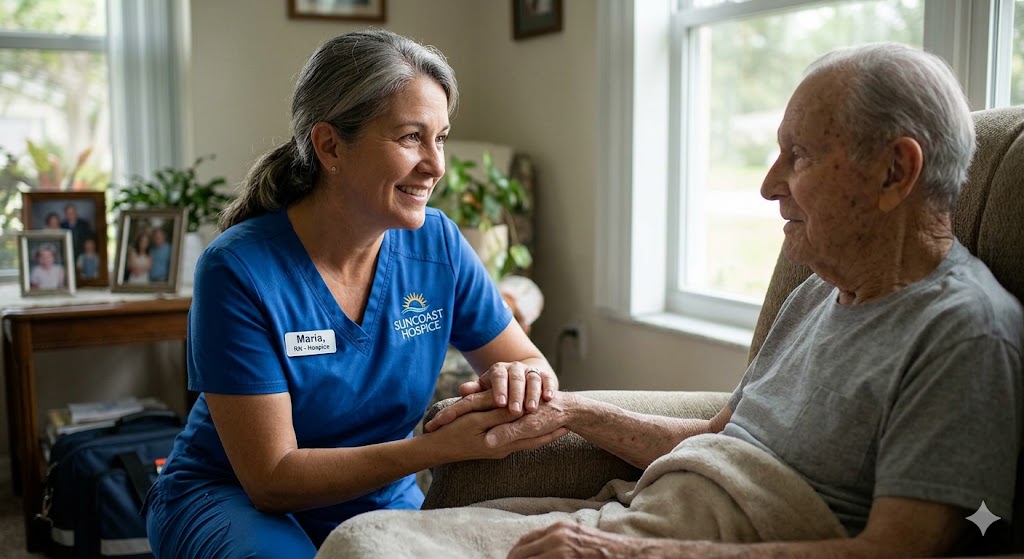
There is a category of healthcare worker most Americans never think about until they need them — and then never forget them.
They are the hospice professionals of Florida.
The nurses who arrive at 3 AM when a family is in crisis. The hospice aides who bathe and dress patients with the dignity their condition no longer allows them to maintain themselves. The chaplains who sit with the dying and hold space for grief, doubt, faith, and silence. The social workers who navigate the terrifying paperwork of dying so families can focus on being present. The volunteers who read books out loud to patients who can no longer hold one. The bereavement counselors who walk with families through the months and years after a loved one’s passing. The medical directors who calibrate medications with the singular goal of comfort and peace. The administrative staff who keep the wheels turning so that the people doing the sacred work can focus on what matters.
These are the people who show up, day after day, year after year, to care for Floridians at the most vulnerable moment of their lives. They walk into homes filled with grief. They touch hands that won’t be held much longer. They witness final breaths. They hold sobbing children. They listen to last regrets and last gratitudes. They work in a field most people can’t imagine entering and yet they treat it as a calling.
This article is an attempt — inadequate as words always are for this subject — to honor them.
If you’ve ever had a family member receive hospice care, you already know. If you haven’t, this is your introduction to one of the most quietly heroic workforces in Florida’s entire healthcare system.
Let’s give them their flowers while we can.
What Hospice Actually Is — and What It Isn’t
For those who haven’t yet encountered hospice, here’s what it actually is.
Hospice is comfort-focused care for individuals with a life-limiting illness, generally with a prognosis of six months or less if the illness runs its expected course. It is not “giving up.” It is not abandoning hope. It is not a place — though some hospice care happens in dedicated facilities, the majority of hospice care in Florida is delivered in the patient’s own home.
Hospice shifts the goal of care from cure to comfort. From battling the disease to honoring the person. From extending life at all costs to preserving the quality of whatever life remains.
A hospice team typically includes:
- Hospice physicians and medical directors who oversee medical care and pain management
- Registered nurses who manage symptoms, administer medications, and serve as the family’s primary clinical contact
- Hospice aides (CNAs) who provide personal care including bathing, dressing, and grooming
- Social workers who navigate practical, emotional, and financial concerns
- Chaplains and spiritual care counselors of various faith traditions (and for those without one)
- Bereavement counselors who support families before, during, and after the patient’s passing
- Volunteers who provide companionship, respite for caregivers, and countless small acts of kindness
- Therapists (physical, occupational, speech, music, art) when appropriate
- Pharmacy staff who manage complex medication regimens
In Florida, hospice services are delivered by both nonprofit and for-profit organizations, with major providers including VITAS Healthcare (one of the largest hospice providers in America, headquartered in Miami), Suncoast Hospice / Empath Health, Cornerstone Hospice, Tidewell Hospice, Hope Hospice, Halifax Health Hospice, Big Bend Hospice, Catholic Hospice, Trustbridge Hospice, Avow Hospice, Community Hospice & Palliative Care, Hospice of Marion County, Treasure Coast Hospice, Gulfside Hospice, Stratum Hospice, Compassus Hospice, Heartland Hospice, Hospice of the Comforter, Cornerstone Hospice and Palliative Care, and dozens of others serving every region of Florida.
Hospice care is largely covered by Medicare, Medicaid, most private insurance, and the Veterans Administration. For those without coverage, many Florida hospices provide care regardless of ability to pay through donor-funded compassionate care programs.
Brian’s Take: I’ve Watched Four Family Members Walk the Home Hospice Path, and Every Single One Made Me More Grateful for the People Who Do This Work.
Our family is one that passes on at home — that’s how we’ve done it through four loved ones now, and the hospice teams who walked beside us each time were nothing short of heroes who I think about long after the funerals were over. The bravery people show when they face death and make peace with it is one of the greatest lessons in life, and the hospice workers who hold space for that bravery — who never look away, never rush it, never minimize it — are doing some of the most sacred work happening anywhere in our healthcare system. There aren’t enough words to thank them. The least we can do is donate, volunteer, advocate, and remember.
— Brian
The Hospice Nurse: The Person You Will Never Forget
Ask any family member who has lived through a loved one’s hospice journey to describe the experience, and they will almost always start with one person: the hospice nurse.
Hospice nurses are the central pillar of the entire hospice experience. They are the ones who arrive at the home, often within hours of the hospice referral. They are the ones who explain — gently, clearly, repeatedly — what to expect in the coming days, weeks, or months. They are the ones who manage pain when nothing else has worked. They are the ones who answer the panicked 2 AM phone call when a family member doesn’t know what to do. They are the ones who arrive in the middle of the night to provide comfort and reassurance during the most frightening hours.
What hospice nurses do every single day:
- Assess pain, symptoms, and comfort
- Administer and adjust medications including controlled substances for pain management
- Educate family caregivers on what to expect
- Coordinate with physicians, pharmacies, durable medical equipment providers, and other team members
- Provide hands-on clinical care
- Recognize and respond to the signs of approaching death
- Walk families through the actual moment of death
- Document everything for regulatory compliance
- Drive — often huge distances across Florida’s massive geography — to reach patients in their homes
- Carry an emotional weight most healthcare workers cannot imagine sustaining
The best hospice nurses bring not just clinical skill but a deep, almost spiritual capacity to be present with another human being who is dying. They cry with families. They laugh at jokes the patient makes. They remember names of grandchildren. They wear the family member’s favorite sports team’s jersey to the next visit. They read aloud. They hold hands. They listen.
And then they get in their car and drive to the next family. And the next. And the next. Often six or eight or ten patients in a day, each one carrying their own grief, each one needing the nurse’s full presence.
Most hospice nurses will tell you they wouldn’t trade the work for anything. They are some of the most fulfilled, mission-driven, soul-grounded healthcare workers in the entire industry. But the work exacts a real cost, and most do it out of pure calling.
The Hospice Aide: The Hands That Care for the Body
The hospice aide — typically a Certified Nursing Assistant — performs work most people would shrink from. Bathing dying patients. Changing soiled linens. Repositioning bodies that can no longer move on their own. Brushing hair. Trimming fingernails. Cleaning up messes that come with dying. Doing the thousand small acts of physical caregiving that preserve the patient’s dignity through their final weeks.
The hospice aide is often the team member patients see most frequently — sometimes daily. The relationship that develops is profound. The hospice aide knows the patient’s preferences, sensitivities, favorite music, and life stories in ways that even family sometimes don’t. They know how the patient likes their coffee, even if the patient can no longer drink it. They know which side the patient prefers to sleep on. They know how to gently make the patient laugh.
When you watch a great hospice aide work, you see something close to art. Every movement is calm. Every touch is purposeful. The patient is treated not as a body to be cared for but as a complete person worthy of dignity until the very last breath.
These are some of the lowest-paid healthcare workers in America. They do work most other healthcare workers don’t want to do. They do it with kindness, professionalism, and reverence.
If you’ve never thanked a hospice aide, please look for an opportunity to do so. They deserve far more than they receive.
Brian’s Take: The Hospice Aides I Watched Care for My Family Members Were Doing Sacred Work, and I’ll Never Forget Them.
The hospice aides who came into my family’s homes during our four hospice journeys were quiet, steady, deeply professional, and performed their work with the kind of grace that makes you understand the word “vocation” at a level you didn’t before. They will never get rich. They will never be famous. But the work they do at the bedsides of dying Floridians every single day is some of the most important work happening in this state, and they deserve our deepest possible gratitude.
— Brian
The Hospice Chaplain: Holding Space for the Soul
Few people in any profession carry as profound a responsibility as the hospice chaplain. They walk into homes where someone is dying and they don’t get to know in advance what tradition, faith, or framework that person uses to make sense of life and death. Sometimes the patient is deeply religious. Sometimes they’re agnostic. Sometimes they’re angry at God. Sometimes they’re at peace. Sometimes they have no idea what they believe.
The hospice chaplain shows up for all of them.
Hospice chaplains are typically trained as interfaith spiritual care providers — meaning they’re competent to support patients of any tradition or none. They listen. They pray when prayer is welcomed. They sit in silence when silence is needed. They officiate small bedside rituals. They help families find clergy from the patient’s own tradition when appropriate. They support family members who are wrestling with their own questions about meaning, mortality, and what comes next.
What the chaplain provides isn’t religion in the doctrinal sense. It’s spiritual presence — the willingness to sit with another human being at the threshold of mystery and not look away. To hold the questions even when there are no answers. To bear witness to the fullness of what a human life has been, and what its ending is.
For many families, the hospice chaplain becomes one of the most cherished members of the hospice team — sometimes the person who returns months after the funeral to check on the family, the person who officiates the memorial service, the person who quietly continues to care.
The Hospice Social Worker: Navigating the Practical Side of Dying
Death has a paperwork problem. Estates. Wills. Insurance claims. Funeral arrangements. Power of attorney. DNR orders. Caregiver coordination. Medicaid applications. Veterans’ benefits. End-of-life decisions. Family conflicts. Communication breakdowns.
The hospice social worker is the professional who steps into all of this and helps families navigate it without losing their minds.
Hospice social workers help with:
- Advance directives and end-of-life decision-making
- Family communication and conflict mediation
- Practical arrangements for caregiving support
- Connection to community resources
- Emotional support for patients and families
- Funeral planning and after-death logistics guidance
- Bereavement preparation
- Connection to legal, financial, and benefits resources
- Education on what to expect through the dying process
For families overwhelmed by grief, the social worker is often the steady, organized presence who keeps the practical wheels turning while everyone else focuses on being present with the patient. They handle paperwork, answer questions, return phone calls, and quietly remove obstacles families don’t even know they have.
The Hospice Volunteer: Florida’s Quiet Army of Compassion
Hospice care in America is built, in part, on the foundation of an enormous volunteer workforce. Federal Medicare regulations actually require hospice agencies to have volunteers contributing at least 5% of patient care hours — meaning hospice literally cannot exist without volunteers.
Florida’s hospice volunteers number in the tens of thousands, contributing millions of hours of service every year. They:
- Sit with patients so caregivers can take a break
- Read aloud to patients who can no longer read themselves
- Play music for patients
- Bring therapy dogs to bedside visits
- Run errands for caregivers
- Provide transportation to medical appointments
- Make memorial bracelets, blankets, and keepsakes
- Conduct life review interviews and create legacy projects
- Support bereavement programs for grieving families
- Provide administrative support so staff can focus on patient care
- Send cards on anniversaries to grieving families
- Hold the hand of a dying patient who has no family present (sometimes called “no one dies alone” programs)
That last category is perhaps the most extraordinary. In hospice programs across Florida, trained volunteers commit to ensuring that no patient dies alone. When a patient has no family available, volunteers maintain a vigil at the bedside, sometimes for days, sometimes through the actual moment of death, ensuring that a fellow human being is held, witnessed, and honored at the end.
Imagine being the kind of person who signs up for that.
Brian’s Take: Hospice Volunteers Are the Most Underappreciated Force in Florida Healthcare.
The thousands of Florida hospice volunteers who give their time to sit with dying strangers, read to patients who can’t read anymore, hold hands during final breaths, and provide respite for exhausted caregivers are doing something most people in our culture can’t even fathom doing once, let alone every week for years. If you’ve ever benefited from hospice services, find your local hospice and ask how you can support their volunteer program — these people deserve every ounce of support our communities can give them.
— Brian
The Bereavement Counselor: Walking With Families After the Patient Is Gone
Hospice care doesn’t end when the patient passes. Most Florida hospices continue providing bereavement support to families for at least 13 months after a death — a federally mandated standard. Bereavement counselors call families on anniversaries, send cards, host support groups, run grief workshops, lead memorial services, and provide ongoing counseling for those navigating loss.
Grief is not a problem to be solved. It is a journey to be walked. The bereavement counselor walks alongside families through the months when everyone else has moved on, when the casseroles have stopped arriving, when the calls have slowed, when the shock has worn off and the long road of life-without-them stretches ahead.
For many family members, the hospice bereavement program is one of the most quietly transformative experiences of their adult lives — a place where their grief is held without judgment, where their tears are met with patience, where their slow rebuilding is supported with skill and care.
Florida’s Largest and Most Established Hospice Organizations
Florida is served by some of the largest and most respected hospice organizations in America. While there are dozens more we couldn’t list here, these are some of the major providers serving Florida communities — all worthy of consideration for donations, volunteer time, or memorial gifts:
VITAS Healthcare
Headquarters: 100 SE 2nd Street, 35th Floor, Miami, FL 33131 Phone: (800) 723-3233 (Reception) | (800) 938-4827 (Donations) Website: vitas.com Donations: vitascharitablefund.org One of the largest hospice providers in America, founded in Miami in 1978. The VITAS Healthcare Charitable Fund supports patients in financial need.
Empath Health / Suncoast Hospice
Address: 5771 Roosevelt Boulevard, Clearwater, FL 33760 Phone: (727) 467-7423 | (888) 596-7758 Website: empathhealth.org Tampa Bay’s largest hospice provider, serving the region for over 50 years. Donations support patients regardless of ability to pay.
Cornerstone Hospice & Palliative Care
Address: 2445 Lane Park Road, Tavares, FL 32778 Phone: (866) 742-6655 Website: cornerstonehospice.org Serving Central Florida’s Lake, Orange, Osceola, Hardee, Highlands, Polk, and Sumter counties.
Hope Hospice
Address: 9470 HealthPark Circle, Fort Myers, FL 33908 Phone: (239) 482-4673 Website: hopehcs.org Southwest Florida’s largest community-based, not-for-profit hospice serving Lee, Hendry, Glades, Charlotte, and Collier counties.
Community Hospice & Palliative Care
Address: 4266 Sunbeam Road, Jacksonville, FL 32257 Phone: (904) 268-5200 | (866) 253-6681 Website: communityhospice.com Northeast Florida’s largest hospice and palliative care organization, serving the Jacksonville region for over 40 years.
Tidewell Hospice (Empath Health)
Address: 5955 Rand Boulevard, Sarasota, FL 34238 Phone: (941) 552-7500 Website: tidewellhospice.org Sarasota, Manatee, Charlotte, and DeSoto counties’ primary hospice provider.
Avow Hospice
Address: 1095 Whippoorwill Lane, Naples, FL 34105 Phone: (239) 261-4404 Website: avowcares.org Naples and Collier County’s leading not-for-profit hospice and palliative care organization.
Trustbridge / Hospice of Palm Beach County
Address: 5300 East Avenue, West Palm Beach, FL 33407 Phone: (888) 458-3712 Website: trustbridge.com Palm Beach and Broward counties’ major nonprofit hospice provider.
Catholic Hospice
Address: 14875 NW 77th Avenue, Miami Lakes, FL 33014 Phone: (305) 351-7000 Website: catholichospice.org South Florida’s faith-based hospice provider serving Miami-Dade, Broward, and Monroe counties.
Treasure Coast Hospice
Address: 1201 SE Indian Street, Stuart, FL 34997 Phone: (772) 403-4500 Website: treasurehealth.org Serving Martin, St. Lucie, Indian River, and Okeechobee counties.
Big Bend Hospice
Address: 1723 Mahan Center Boulevard, Tallahassee, FL 32308 Phone: (850) 878-5310 | (800) 772-5862 Website: bigbendhospice.org North Florida’s nonprofit hospice serving the Big Bend region.
Halifax Health Hospice
Address: 3800 Woodbriar Trail, Port Orange, FL 32129 Phone: (386) 322-4700 Website: halifaxhealth.org/hospice Volusia and Flagler counties’ hospice provider, part of Halifax Health.
Hospice of Marion County
Address: 3231 SW 34th Avenue, Ocala, FL 34474 Phone: (352) 873-7400 Website: hospiceofmarion.org Marion County’s nonprofit hospice serving Central Florida.
Gulfside Hospice
Address: 2061 Collier Parkway, Land O’ Lakes, FL 34639 Phone: (727) 845-5707 | (800) 561-4883 Website: gulfside.org Serving Pasco County and surrounding areas of West Central Florida.
For other regions of Florida, visit the Florida Hospice and Palliative Care Association at floridahospices.org to find hospice providers serving your specific area.
Brian’s Take: Hospice Nurses, Aides, Chaplains, and Volunteers Deserve Far More Than Most Floridians Realize.
Most people only encounter hospice when they’re in the worst week of their lives, which means hospice workers do their most beautiful work in front of an audience that’s too overwhelmed to fully appreciate what they’re witnessing. Years later, when the grief has softened, families remember and they understand. The least we can do as a community is donate to these organizations, volunteer where we can, and tell every hospice worker we encounter that their work matters and is seen.
— Brian
How to Support Florida Hospice — Whether or Not You’ve Used It
If you’ve benefited from hospice care, you already know how valuable it is. If you haven’t yet, you may someday. Either way, supporting Florida’s hospice infrastructure is one of the best community investments any Floridian can make.
Ways to support:
- Donate to your local hospice’s foundation. Most Florida hospices are nonprofit, and donations directly fund care for patients without insurance, complementary therapies (music, art, pet therapy), bereavement programming, and community education. Use the contact information above to give to the hospice serving your community.
- Make memorial donations. When a friend or family member passes, ask if their family would like memorial donations directed to the hospice that cared for them. It honors the patient and supports the next family.
- Volunteer. Most Florida hospices have extensive volunteer programs. The training is provided. The need is constant. Whether you can give 2 hours a week or 20, you’ll be welcomed.
- Become a “no one dies alone” volunteer. Specialized volunteer programs ensure dying patients have someone present at the end. The training and support are robust.
- Provide professional services. Lawyers, accountants, marketing professionals, IT consultants, designers — many hospices need pro-bono professional support.
- Sponsor or attend hospice fundraising events. Galas, golf tournaments, and walks raise critical funds.
- Advocate. Support state and federal policies that protect Medicare hospice benefits, fair reimbursement rates, and workforce sustainability.
- Talk about hospice openly. One of the biggest barriers to people receiving full hospice benefits is delayed referral — patients often enter hospice in their final days when they could have benefited from weeks or months of care. Normalizing conversations about hospice helps families access it sooner.
- Write thank-you notes to hospice teams. When you’ve had a positive hospice experience, write to the agency, name the people who served you, and tell them what their work meant. Hospice workers carry an enormous emotional load. Recognition matters.
The Bottom Line: A State Built on Quiet Heroes
Florida has a larger senior population than any state in America. We have more deaths per year than nearly any state. We have more hospice patients, more hospice agencies, more hospice nurses, more hospice volunteers, and more hospice families than almost anywhere on Earth.
Behind that statistical fact is a workforce of human beings who have chosen — often deliberately, often as a calling — to spend their days at the bedsides of the dying. They walk into rooms most people would walk away from. They hold hands most people wouldn’t have the courage to hold. They witness moments that most of us are spared from witnessing, and they do it again and again, year after year, because they believe — rightly — that no human being should die alone, in pain, or without dignity.
These are the quiet heroes of Florida hospice. The nurses who arrive at 3 AM. The aides who bathe with reverence. The chaplains who hold space for mystery. The social workers who navigate paperwork through tears. The volunteers who read aloud to dying strangers. The bereavement counselors who walk with families through the months that follow.
If you’ve ever benefited from their work, thank them. Volunteer with them. Donate to them. Honor them. Tell their stories. Defend their funding. Recognize their humanity.
And if you haven’t yet — keep them in mind for the day you may. Because Florida hospice workers are doing the work that holds the rest of us together at the moment we need holding most.
The bravery of those who face death and make peace with it is, indeed, one of the greatest lessons in life.
The bravery of those who walk beside them — who never look away, who never minimize, who never rush, who simply show up — is one of the greatest gifts our state has to offer.
To every Florida hospice worker reading this: thank you.
For everything you’ve done. For everything you do. For everything you will continue to do.
We see you. We honor you. We are deeply, deeply grateful.
You are walking us home.
Resources & Further Reading
- Florida Hospice and Palliative Care Association (FHPCA) — The statewide trade and advocacy organization for Florida hospice providers, with a full directory of hospice organizations serving every Florida region.
- National Hospice and Palliative Care Organization (NHPCO) — The leading national organization providing resources, education, and advocacy for hospice care nationwide.
- Medicare.gov: Hospice Care — Official federal information on Medicare hospice benefits, eligibility, and what’s covered.
- CaringInfo.org — A program of NHPCO providing free resources on advance care planning, hospice and palliative care, and end-of-life decision-making.
- Hospice Foundation of America — Educational nonprofit providing resources for families, caregivers, and bereaved family members.
- VITAS Healthcare Charitable Fund — National hospice charitable foundation supporting patients in financial need, headquartered in Miami.