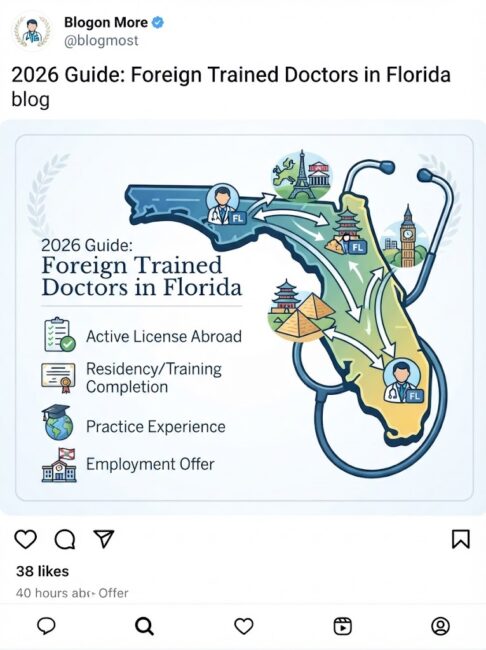
The Direct Answer
Yes — Florida now offers pathways for internationally trained physicians to become licensed without completing a U.S. residency, a major departure from the traditional model.
Under legislation enacted in Florida’s Live Healthy health-workforce package (2024), the state created a licensure route for physicians who are actively licensed and have practiced abroad for a qualifying period (commonly cited as four years post-residency-equivalent), completed a residency or substantially similar postgraduate training abroad, passed a recognized examination, and hold an offer of full-time employment from a qualifying Florida healthcare provider — typically with an initial restricted/supervised period tied to that employer before full unrestricted licensure.
This sits alongside the traditional IMG route (ECFMG certification → USMLE → U.S. residency → standard licensure) and Florida’s other alternative doors (faculty certificates, area-of-critical-need provisions, and the out-of-state telehealth registration).
The Pathway Landscape: Every Door Into Florida Medicine
| Pathway | Who it fits | U.S. residency required? | Key constraint |
|---|---|---|---|
| Traditional IMG route | Early-career IMGs | Yes | Residency match bottleneck |
| International graduate license (Live Healthy pathway) | Experienced physicians licensed abroad | No | Qualifying foreign practice years + Florida employer sponsorship; initial supervised/restricted period |
| Medical faculty certificate | Academics recruited by Florida med schools | No | Tied to the institution; limited scope/duration |
| Area of Critical Need provisions | Physicians serving designated shortage settings | Varies | Geographic/setting restrictions |
| Out-of-state telehealth registration (§ 456.47) | Physicians licensed elsewhere in the U.S. serving Florida patients remotely | N/A (U.S. license required) | Telehealth only; no Florida offices |
The Live Healthy International Pathway, Step by Step
Step 1 — Confirm baseline eligibility. The statute’s core elements (verify exact current text in ch. 458/459 as amended):
- Active, unencumbered license in good standing in the foreign jurisdiction
- Completion of a residency or substantially similar postgraduate training abroad
- A qualifying period of active practice post-training (commonly cited: four years)
- No disciplinary history that would disqualify
- Passage of a qualifying examination recognized by the Board
- A full-time employment offer from a Florida healthcare provider meeting the statute’s definition (health systems and qualifying entities — solo self-sponsorship is not the design)
Step 2 — Credential documentation. Foreign medical education and training credentials must be verified (expect ECFMG/EPIC-style primary-source verification, certified translations, and licensure history letters from every jurisdiction).
Step 3 — Application to the Board of Medicine (or Osteopathic Medicine). Fees, fingerprinting/background screening, and the standard licensure-application disclosures apply.
Step 4 — The restricted period. The pathway’s design ties initial licensure to the sponsoring employer with supervision/oversight for a defined period (verify the current duration and conditions) before conversion to full unrestricted licensure. Changing employers mid-period has consequences — read the conditions before signing employment terms.
Step 5 — Convert to full licensure after satisfying the restricted-period requirements.
The Part Nobody Else Explains: Immigration ≠ Licensure
A Florida license does not confer the right to work in the United States. The pathway solves the licensure barrier only:
- Physicians still need work authorization — typically H-1B (which for physicians in clinical roles has its own licensure prerequisites, creating a chicken-and-egg sequencing problem the employer’s counsel must plan around), O-1, employment-based green card, or existing status.
- J-1 waiver questions don’t disappear: physicians who trained in the U.S. on J-1 visas remain subject to the home-residency requirement regardless of the Florida pathway.
- The practical sequencing — offer → licensure application → visa petition → start date — varies by employer and status. This is why the realistic users of the pathway in early years are health systems with immigration infrastructure recruiting deliberately, not individual physicians applying cold.
Honest Limitations & Open Questions
- Board rulemaking defines the details. The statute created the frame; implementing rules govern exam recognition, “substantially similar” training determinations, and restricted-period mechanics. Early applicants are navigating a developing process — timelines are uncertain.
- Employer dependence is structural. The license is born tied to a qualifying employer; physicians should have contracts reviewed with the licensure conditions in mind (non-competes, termination effects on license status).
- Hospital privileging and payer credentialing are separate hurdles — a pathway license doesn’t compel a hospital to privilege or a plan to credential; expect case-by-case review while the pathway is young.
- Other states are copying Florida’s model — a growing multi-state landscape means requirements diverge; this page covers Florida only.
Frequently Asked Questions
Can a doctor licensed in another country practice in Florida without redoing residency? Yes, potentially — via Florida’s international-graduate pathway enacted in the 2024 Live Healthy package, if they meet the foreign-practice, training, exam, and Florida-employer requirements, with an initial restricted period.
Do I still need to pass the USMLE for the Florida international pathway? The statute requires passage of a Board-recognized qualifying examination — which examinations qualify is defined by statute and Board rule. Verify the current list before planning around it.
Do I need a job offer before applying? Yes — a qualifying full-time employment offer from a Florida healthcare provider is a structural element of the pathway, not an afterthought.
Does the Florida license solve my visa situation? No. Licensure and immigration are independent; you need separate work authorization, and sequencing the two is the hard part.
Can I open my own practice on this pathway? Not initially — the restricted period ties practice to the sponsoring employer. Independent practice becomes possible after conversion to full licensure.
Are other states doing this too? Yes — several states have enacted or are considering similar international-physician pathways. Requirements differ significantly by state.
Sources
- Live Healthy legislation (2024) and current ch. 458/459 text — Online Sunshine, leg.state.fl.us
- Florida Board of Medicine licensure pages and rulemaking — flhealthsource.gov / flrules.org
- ECFMG / EPIC credential verification — ecfmg.org
- USCIS physician visa categories; ECFMG J-1 sponsorship materials
- [FMN interview: a physician or health-system recruiter navigating the pathway — the original-quote payload]